You have likely encountered them before. They show up in math class, sure. They also hide in physics equations where variables and exponents collide. But they can be as simple as adding two numbers then subtracting one.
These are combined operations.
The definition is straightforward. They consist of several arithmetic operations following one another. Think addition, subtraction, multiplication, and division all lined up in a single expression.
Why does this matter? Because life rarely deals with just one number at a time. Real-world problems require chaining steps. You need to know the order. You need to know the logic.
The core concept is simple. It is about sequence. It is about precedence. Without a clear method, you get the wrong answer every time.
Why Order Matters
Imagine you are buying supplies for a project. You have a budget. You need to calculate costs.
If you just go left to right, you might mess up the total. That is where combined operations come in. They force you to respect the hierarchy of math.
This isn’t just about school. It is about accuracy. A small error in sequence can throw off an entire scientific calculation. Or a business model. Or a recipe.
Breaking It Down
Let’s look at the building blocks.
- Addition
- Subtraction
- Multiplication
- Division
These are the tools. When you combine them, you create complexity. But the complexity is manageable. You just need a strategy.
Start with the hardest part. Tackle the exponents if they exist. Then handle multiplication and division. Finally, do addition and subtraction.
This is the standard approach. It works for simple sums. It works for complex physics formulas. The principle remains the same.
Respect the order. Respect the operations. Get the right answer.
The order of operations: PEMDAS and beyond
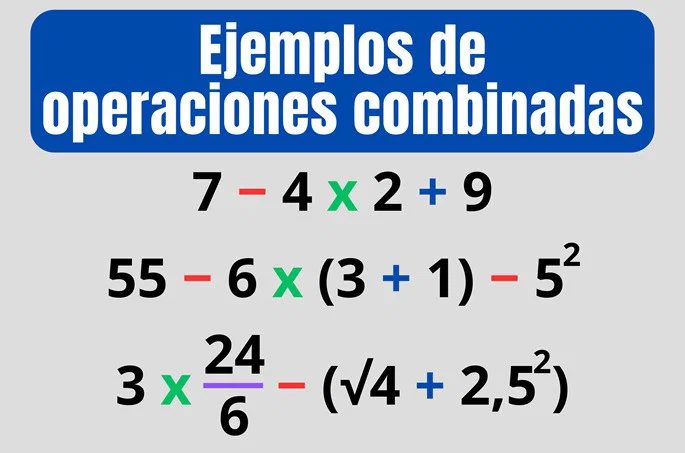
You want the answers to those three combined operations? They are 8, 6, and 3.75. Getting there isn’t magic. It requires a strict hierarchy. You can’t just go left-to-right every time. If you skip the rules, you get the wrong number.
The general instinct is to calculate from left to right. That works for simple addition or subtraction chains. But real math gets messy. You need a system.
How to solve combined operations correctly
There is a hierarchy you must follow. Ignore it at your own risk.
- Parentheses : Everything inside them goes first.
- Exponents : Powers and roots come next.
- Multiplication and Division : These are equal. Do them left to right.
- Addition and Subtraction : The final step. Also left to right.
Remember the acronym PEMDAS. It stands for Parentheses, Exponents, Multiplication, Division, Addition, Subtraction. It is a mnemonic device. Use it until it becomes muscle memory.
Here is how that hierarchy looks in practice.
Take an expression with parentheses and radicals. You must clear the parentheses first. Then handle the roots. If there are other exponents, calculate them next. Only then do you move to multiplication and division. Remember: left to right. Finally, add and subtract what is left. The result might be 6.
Examples of combined operations
I have listed several solved problems below. Try them yourself first. Check your work against the solutions. This is where the learning happens.
Combined operations with only sums and subtractions
If you only have addition and subtraction, there is no hierarchy to worry about. Just go left to right.
The result here is 12.
Combined operations with natural numbers
Natural numbers bring parentheses and exponents back into the mix. These take priority.
Solve the inside of the parentheses first. Then handle the powers. The result is 30.
Combined operations with integers
Negative numbers change the game slightly. You still follow the hierarchy. Exponents and division beat addition and subtraction.
Watch your signs. The final result is -2.
Combined operations with fractions
Fractions add a layer of complexity. You must multiply the fractions before adding or subtracting.
The solution is approximately 7.083. To add integers and fractions, convert the integer using the common denominator. Multiply and divide by that denominator to make the pieces fit together.
Combined operations with grouping symbols
Complex problems often use parentheses and brackets.
Prioritize the innermost calculations. If a parenthesis is inside another, solve the inner one first. Then move outward. The result is 10.