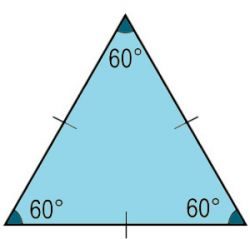
A triangle is a flat, two-dimensional shape with three sides, three corners, and three angles. If you add up those angles, they will always equal exactly 180 degrees. Not all triangles look the same, though. They break down into categories based on how long their sides are and how wide their angles sit.
You will usually see them sorted by side length first. This gives you equilateral, isosceles, and scalene triangles. Then there is the angle method. Here, you get acute, right, and obtuse triangles. Understanding this classification helps you identify shapes quickly and solve geometry problems without guessing.
How Side Lengths Define Triangle Types
The way you label a triangle often starts with its sides. This is the most common way to categorize them in basic geometry. Knowing which side lengths match up tells you the triangle’s name and several of its hidden traits.
What Makes a Triangle Equilateral?
The equilateral triangle is the most symmetrical of the bunch. It has three sides that are all the same length. Because the sides are identical, the angles don’t have a choice but to be identical too.
Every single angle inside an equilateral triangle measures 60 degrees. This makes it a regular polygon. A regular polygon means it is both equilateral (equal sides) and equiangular (equal angles). It is a perfect shape.
If you are looking at a shape and all three sides match up, you have an equilateral triangle. You don’t need to measure the angles to know they are 60 degrees. The side lengths guarantee it.
Other Side-Based Classifications
While the source text focuses on the equilateral triangle, the broader category of triangles by side length includes two other types. You should know them to fully grasp the classification system.
- Isosceles triangles : These have exactly two sides of equal length. The angles opposite those sides are also equal.
- Scalene triangles : These have no equal sides. Every side and every angle is different.
Knowing the difference between these three helps you identify shapes in textbooks or real-world designs. An equilateral triangle is a specific type of isosceles triangle, but not all isosceles triangles are equilateral.
Why Angle Classification Matters
Side length is only half the story. You can also classify triangles by the amplitude of their angles. This method looks at how “open” the corners are.
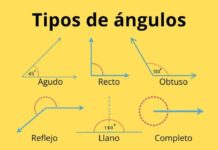
- Acute triangles : All three angles are less than 90 degrees.
- Right triangles : One angle is exactly 90 degrees.
- Obtuse triangles : One angle is greater than 90 degrees.
These classifications overlap with side lengths. For example, an equilateral triangle is always acute. A right triangle can be isosceles or scalene. Understanding both methods gives you a complete picture of any triangle you encounter.
Practical Steps for Identification
When you need to identify a triangle, start with the sides. Look for equal lengths.
- Check if all three sides are equal. If yes, it is equilateral.
- Check if only two sides are equal. If yes, it is isosceles.
What defines an isosceles triangle?
It is not just a random shape. It has a specific rule book.
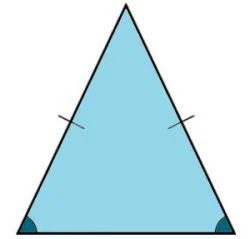
An isosceles triangle is defined by its sides. Two of them are exactly the same length. The third side is different. This creates a distinct asymmetry that is actually balanced.
Because of this side structure, the angles follow suit. You get two equal angles. They sit opposite the equal sides. The third angle? It is unique. It is different from the other two.
Think of it as a pair of identical twins and one lone sibling. The geometry reflects that relationship perfectly.
“Two equal sides create two equal base angles.”
This relationship is not arbitrary. It is a mathematical necessity. If you change the side lengths, the angles shift. But as long as two sides remain equal, those two angles must also match.
This makes the isosceles triangle easy to identify. Look for the matching sides. Then look for the matching angles. They will be there.
Why does this matter? Because it simplifies calculations. You do not need to find all three angles. Find one base angle. The other is identical. The third angle is just what is left.
It is a shortcut. A useful one.
Students often confuse this with equilateral triangles. Do not make that mistake. An equilateral triangle has three equal sides. An isosceles triangle has only two. That distinction is everything.
Where do you see this in real life? Roof trusses. Bridges. The structure of many tents. The design relies on this stability. The two equal legs distribute weight evenly to the base.
It is practical geometry. Not abstract theory.
How to identify and use it
You do not need a compass to spot one. Just look at the side lengths.
- Measure the sides.
- Identify the two that match.
- Locate the angles opposite those sides.
They will be equal. Verify this by measuring them. The result will confirm the rule.
This property allows for quick problem-solving. If you know one base angle is 50 degrees, you know the other is 50 degrees. You do not need complex theorems. Just simple subtraction.
180 degrees is the total sum. Subtract the two known angles. The remainder is the vertex angle.
This is the core of working with isosceles triangles. It is not complicated. It is just logical.
But what happens if you change the angle between the equal sides? The base angles shrink. They adapt. The shape changes, but the rule holds. The symmetry remains.
It is a resilient structure. One that has been used for millennia. From ancient cathedrals to modern engineering. The logic never fails.
Lifelong learners should appreciate this consistency. It is a small example of order in a chaotic world. A predictable pattern in a field full of variables.
Parents helping with homework can use this as a teaching moment. It is visual. Tangible. Easy to demonstrate with paper cutouts.
Students can fold a paper triangle. Align the equal sides. The crease will show the symmetry. It makes the abstract concrete.
There is no ambiguity here. Two sides equal means two angles equal. It is a direct cause and effect.
And that is the beauty of it
The scalene triangle: geometry’s rebel
It’s the odd one out.
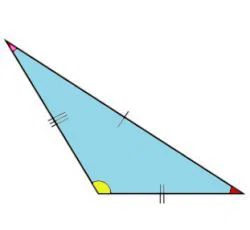
In a world of equilateral symmetry and isosceles balance, the scalene triangle refuses to conform. It doesn’t have two equal sides. It doesn’t have three. Every single side is a different length. Every single angle measures something else entirely.
This makes it the most unpredictable of the basic shapes. You can’t rely on shortcuts. You can’t assume that because one angle is 60 degrees, another must be too. That’s the trap students fall into. They see a triangle and think pattern. The scalene triangle says nothing.
Why does it matter?
You might wonder why we spend time on a shape that looks so chaotic. It’s not about chaos. It’s about precision.
When you’re solving for a missing side or an unknown angle in a scalene triangle, you can’t use the easy rules. You can’t just drop an altitude and split it in half. You have to use the Law of Cosines. Or the Law of Sines. These are the heavy hitters of trigonometry.
“A scalene triangle is a reminder that not everything in math is symmetrical.”
This is where students struggle. They want the clean answer. The integer. The whole number. The scalene triangle rarely gives that up without a fight.
How to identify it (and not get tricked)
Visual inspection is your first tool. Look at the sides.
- Side A is 5 cm.
- Side B is 7 cm.
- Side C is 9 cm.
All different. It’s scalene.
Now look at the angles.
- Angle A is 41°.
- Angle B is 55°.
- Angle C is 84°.
All different. Confirmed.
But be careful. Sometimes a drawing looks scalene but isn’t. Or looks isosceles but has tiny measurement errors. In a test, if the sides are marked with tick marks, that’s your code. No tick marks? Assume nothing. Measure everything.
Real-world examples
You see scalene triangles everywhere, but you don’t recognize them because they lack the “pretty” symmetry.
- Roof trusses: Many modern roofs use uneven spans for drainage or space reasons. The framing triangles aren’t balanced.
- Navigation: If you’re hiking and use three landmarks that aren’t equidistant, your triangulation forms a scalene triangle.
- Art and Design: Designers use scalene shapes to create tension. It feels unstable. Dynamic. Isosceles feels calm. Scalene feels like movement.
The learning curve
For students, this is a hurdle. It forces you to learn the Law of Sines :
$$ \frac{a}{\sin A} = \frac{b}{\sin B} = \frac{c}{\sin C} $$
And the Law of Cosines :
$$ c^2 = a^2 + b^2 – 2ab \cos C $$
These formulas work for any triangle. But they are essential for the scalene kind. Without them, you’re stuck.
Parents: don’t worry if your kid hates this
Classifying triangles by angle size
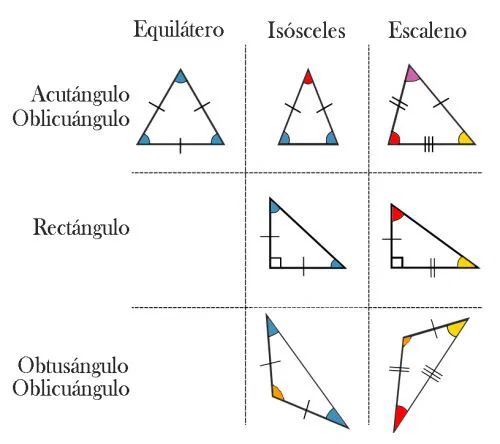
Look at a triangle’s corners. That’s where the real classification happens. Angles determine if a shape is right, acute, or obtuse. It is not just about side lengths.
Right triangles and their limits
A right triangle has one 90-degree angle. The other two must be acute. This forces the longest side to be the hypotenuse.
You might see this in isosceles or scalene shapes. The math works out. An equilateral triangle never makes the cut here. Its angles are fixed at 60 degrees each. They cannot reach 90.
Oblique triangles: No right angles
Oblique triangles have zero right angles. This category splits into two distinct groups. Both share the absence of a 90-degree corner.
- Acute triangle : All three angles are less than 90 degrees. Sharp corners only.
- Obtuse triangle : One angle is greater than 90 degrees. The other two remain acute.
The difference lies in how wide that single angle gets. But both stay firmly in the oblique zone.