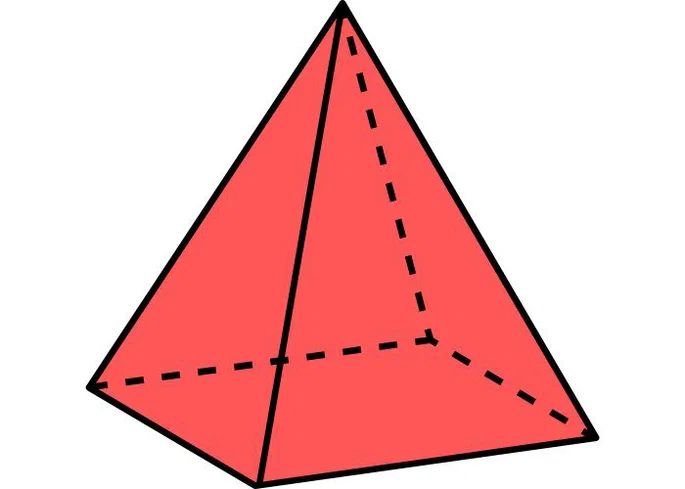
A pyramid is a three-dimensional geometric figure defined by a polygonal base and triangular faces. These triangular sides all meet at a single point called the apex. It looks like a truncated cone with a flat bottom, but the rules for calculating its volume and surface area are distinct.
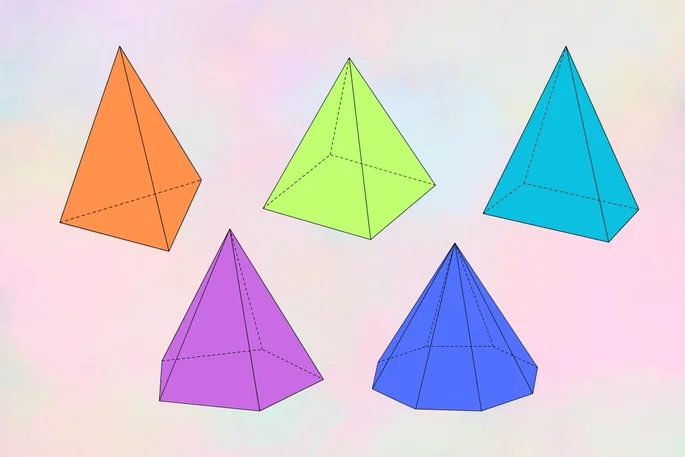
The shape of the base determines the name of the pyramid. If the base is a triangle, it’s a triangular pyramid. A square base makes it a square pyramid. Pentagons, hexagons, and any other polygon can serve as the foundation.
Height is measured differently than you might expect. It’s not the length of the slanted side. It is the perpendicular distance from the apex straight down to the center of the base plane.
This concept appears in two main fields. Geometry uses it for calculations. Architecture uses it for structures. Both rely on the same fundamental shape.
Defining the pyramid’s flat geometry
A pyramid is defined by rigid rules. One base. At least three side faces. They all meet at a single point: the apex.
There is no curve here. Every surface is flat. The sides are triangles. The base is a polygon.
The triangles vary. You might see equilateral, isosceles, or scalene shapes. The base determines the name. It can have any number of sides.
Naming pyramid types by base
The type depends entirely on the base.
A triangular pyramid has three sides. It is also known as a tetrahedron.
Change the base. The name changes.
- Square pyramid : Four sides.
- Pentagonal pyramid : Five sides.
- Hexagonal pyramid : Six sides.
Each shape is distinct. The structure remains the same. Flat faces. Straight lines. Sharp angles.
Breaking Down Pyramid Geometry Beyond the Basics
We’ve looked at the big picture. Now let’s get granular. You might think a pyramid is just a pyramid. A base. Four sides meeting at a point. Done. But geometry doesn’t work that way. The shape changes based on its dimensions. The structure shifts. This classification isn’t just academic trivia. It matters if you’re studying for a geometry test, designing a building, or trying to understand why some structures feel more stable than others.
The differences lie in the base and the angles of the sides.
The Regular vs. Irregular Split
Start with the Pirámide regular (regular pyramid). This is the textbook definition. The base is a regular polygon—meaning every side is equal length. Think equilateral triangle or perfect square. The sides? They are identical triangles. Specifically, isosceles triangles. The height you measure from the apex to the base is called the apotema. It’s clean. Symmetrical. Predictable.
Then you have the Pirámide irregular. The base is an irregular polygon. No symmetry. No equal sides. The sides won’t match up either. It’s messy. Real-world ruins often fit here. Nature doesn’t care about perfect geometry.
Convexity and Concavity
Look at the shape of the base itself. Is it pushing out or pulling in?
A Pirámide convexa has a convex polygon as its base. All internal angles are less than 180 degrees. It bulges outward. Standard structure.
A Pirámide cóncava flips the script. The base is a concave polygon. At least one internal angle is greater than 180 degrees. It caves inward. Visually, this creates a weird, non-standard silhouette. It’s rare in ancient architecture but common in theoretical geometry problems.
Straight vs. Tilted
How does the apex sit above the base? This is where students get tripped up.
A Pirámide recta (right pyramid) is straightforward. The sides are isosceles triangles. The height points directly to the center of the base. If you drop a plumb line from the top, it hits the middle. It’s balanced.
A Pirámide oblicua (oblique pyramid) is tilted. One of the sides isn’t an isosceles triangle. The apex isn’t centered. It leans. It feels unstable. It’s harder to calculate volume for because the height isn’t perpendicular to the center in the usual way.
Why does this distinction matter? Because stability depends on the center of gravity. A right pyramid distributes weight evenly. An oblique one shifts the load. If you’re building anything, knowing which one you’re dealing with changes the engineering completely.
The regular pyramid is easy to work with. The oblique one requires more careful calculation.
But geometry is just a model. The real world is rarely perfectly regular.