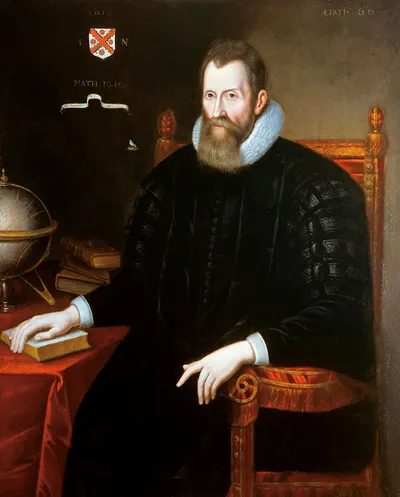
John Napier was not your typical academic. Born in 1550 at Merchiston Castle near Edinburgh, he was a Scottish mathematician and a theological writer who had a temper. He didn’t just study numbers; he invented a tool that would eventually make calculators and computers possible. That tool was logarithms.
His early years were a blur of short stops and long absences. At 13, he walked into the University of St. Andrews but left without a degree. It’s likely he traveled abroad like other sons of the Scottish gentry, but records are thin. He was back home by 1571. He married soon after. His first wife died in 1579. He remarried a few years later and stayed at Merchiston or Gartness for the rest of his life. No more degrees. No more leaving.
A Hot-Tempered Protestant
Religion wasn’t a hobby for Napier. It was a war zone. He was a passionate, uncompromising Protestant. He hated the Roman Catholic Church and gave it no quarter.
Scotland was tense. King James VI hoped to succeed Elizabeth I on the English throne. Rumors swirled that he was seeking help from Catholic Philip II of Spain. Panic spread. The general assembly of the Scottish Church, a group Napier was close with, begged James to crush the Catholic threat. Napier sat on a committee three times. He urged the king to ensure justice was done against the “enemies of God’s Church.”
In January 1594, he wrote a letter to the king. It served as the dedication for his book, Plaine Discovery of the Whole Revelation of Saint John. The book looked scholarly but was designed to stir up political action.
Let it be your Majesty’s continuall study to reforme the universall enormities of your country, and first to begin at your Majesty’s owne house, familie and court, and purge the same of all suspicion of Papists and Atheists and Newtrals…
The work became a landmark in Scottish church history.
Inventing Weapons of War
After the book, Napier turned to war. He invented secret instruments of defense. Manuscripts at Lambeth Palace in London bear his signature. He listed inventions “designed by the Grace of God” to protect his country.
He designed two types of burning mirrors. He created a new piece of artillery. He even sketched a metal chariot that could discharge shot through small holes. He was busy.
The Invention That Simplified Multiplication
Napier spent his leisure time on math. Specifically, he wanted to make calculation faster. Complex roots, products, and quotients took forever by hand. He needed a shortcut.
He started working on logarithms around 1594. He built a computational system. It used tables showing powers of a fixed number as a base. The result was a way to find roots and products quickly.
His findings appeared in two books. The first, Mirifici Logarithmorum Canonis Descriptio, came out in 1614. It explained the steps he took to invent the system. The second, Mirifici Logarithmorum Canonis Constructio, was published two years after his death. It detailed how to build the tables.
Logarithms turned multiplication into addition. In astronomy, where numbers were huge, this was a lifesaver. The rule was simple: log mn = log m + log n. You didn’t multiply anymore. You added.
Napier worked with Henry Briggs to refine the idea. They adjusted it into the form we recognize today. Napier’s original version compared points moving on a line. The logarithm point moved uniformly from minus infinity to plus infinity. The sine point moved from zero to infinity at a speed proportional to its distance from zero. The logarithm was zero when the sine was one. Their speeds were equal at that point.
The core discovery generalized the relationship between arithmetic and geometric series. Multiplication of the sine values corresponded to addition of the logarithm values.
In practice, it was easier to limit the motion. They set L = 1 when X = 10, while keeping X = 1 when L = 0. This shift created the Briggsian, or common, logarithm.
The Descriptio focused on how to use the tables. It promised to explain how to construct them later. That promise became the Constructio. That book is notable for its systematic use of the decimal point. Simon Stevin introduced decimal fractions in 1586, but his notation was clumsy. Napier used a point to separate the fractional part from the integral part. It appeared frequently in the Constructio.
Priority in Discovery
Joost Bürgi, a Swiss mathematician, invented a system of logarithms independently. He worked on it between 1603 and 1611. He published in 1620.
Napier worked earlier. He published in 1614. Napier has the priority. The date matters.
The impact was immediate. Astronomers used these tables to calculate planetary positions. Navigators used them to chart courses across oceans. The math became less of a barrier and more of a bridge.
Napier died in 1617. He never saw the digital age. He never used a spreadsheet. But every time you use a scientific calculator, you are using a descendant of his work. The logarithm simplified the complex. It made the impossible routine.
Why do we still talk about him? Because he solved a hard problem with a clever abstraction. He didn’t just calculate. He changed how we calculate. The decimal point is everywhere now. We take it for granted. But without Napier’s notation, we might still be struggling with Stevin’s unwieldy symbols. The shift was subtle. The impact was massive.
Math didn’t change overnight. It evolved. But Napier gave it a new language. A language of addition replacing multiplication. A language of speed replacing tedium. The rest is history. Or rather, the rest is computation.
Beyond Logarithms: The Tools and Theory of Napier
John Napier is famous for one thing. Logarithms. They changed math forever. But they weren’t his only trick.
In 1617, he published Rabdologiae. The title translates to Study of Divining Rods; or, Two Books of Numbering by Means of Rods. It sounds obscure. It was practical.
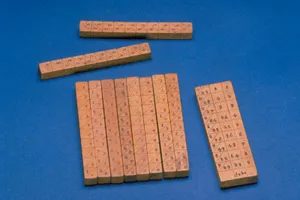
He described Napier’s bones. These were small rods. You used them to multiply and divide. The method was ingenious for its time. It was a physical tool. Think of it as a mechanical calculator before the digital age.
The bones were the direct forerunner of the slide rule.
This device made complex arithmetic accessible. You didn’t need a genius-level brain. You just needed the rods. And the know-how.
Napier also changed spherical trigonometry. Before his work, the field was messy. There were too many equations. Too many ways to say the same thing.
He cut the clutter. He reduced the number of equations from ten down to two. Just two general statements.
These two rules could express all the trigonometrical relationships needed for spherical geometry. That is a massive simplification. It made the subject easier to teach. And easier to learn.
There is a gray area here though.
He is credited with Napier’s analogies. These are specific spherical trigonometrical relations. But the history is fuzzy.
It seems likely that Henry Briggs had a hand in them. Briggs was Napier’s contemporary. A fellow mathematician. A collaborator of sorts.
So while Napier gets the name, the work might have been shared. Or at least, heavily influenced by their interaction.
Math isn’t just about solitary genius. It’s about conversation. About building on what others have started. Even if the credit gets messy.
Napier’s bones are still a cool concept. The two-equation rule is elegant. The analogies? Well, they’re there. We just don’t know who wrote them down first.
It’s not always about being first. It’s about being useful.