Most math students learn to solve differential equations by finding a general solution. You integrate, you simplify, and you end up with a family of curves defined by an arbitrary constant c. That is usually where the story ends. But sometimes, there is another curve hiding in the math. It satisfies the differential equation perfectly. Yet, you cannot find it by plugging any number into c.
This is a singular solution.
It is not part of the general family. It stands apart. In the world of calculus, this curve is known as the envelope of the general solution family.
The Geometry of Envelopes
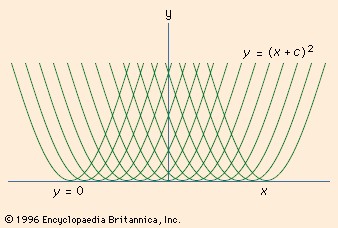
Think of the general solution as a set of parallel tracks or a bundle of strings. Each value of c gives you a different track. The singular solution is the line that touches every single one of those tracks at exactly one point. It is tangent to them all.
This geometric relationship is key. If you can visualize the general solutions as a flock of birds, the singular solution is the invisible boundary that shapes the flock’s movement. It is the curve that is tangent to a given family of curves.
A Concrete Example
Consider the differential equation:
(y ′)² = 4y
If you solve this using standard methods, you get the general solution:
y = (x + c )²
This equation describes a family of parabolas. Shift c to the left or right, and the parabola moves. But there is another solution. The line y = 0 (the x-axis) also satisfies the original differential equation.
Check it yourself. If y = 0, then y ′ = 0. Plugging these into the equation:
0² = 4(0)
0 = 0
It works. But look at the general solution y = (x + c )². Can you pick a value for c that makes this equation equal to zero for all x? No. For any fixed c, (x + c )² is positive everywhere except at x = –c. It never forms the line y = 0 across the entire domain.
So, y = 0 is a singular solution. It is the envelope of the parabolas.
How to Find It
You might wonder how to locate this elusive envelope when you are solving problems. The trick lies in optimization.
The envelope occurs where the general solution reaches an extreme value (maximum or minimum) with respect to the parameter c for a fixed x.
Here is the step-by-step process:
- Start with the general solution y = (x + c )².
- Treat x as a constant. Look for the value of c that makes y as small as possible.
- Since (x + c )² is always non-negative, its minimum value is 0. This happens when x + c = 0.
- Solve for c : c = –x.
- Substitute this back into the general solution: y = (x + (-*x