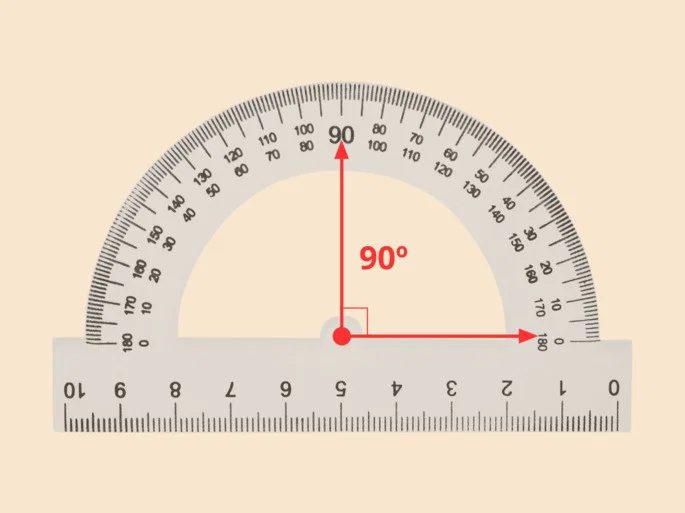
An acute angle might grab your attention with its sharpness, and an obtuse angle stretches out lazily, but the right angle is the standard by which we measure structure. It is not just any angle. It is specifically the space between two lines that share a single vertex and open up to exactly 90 degrees. You see this everywhere, from the corner of your phone screen to the intersection of city streets. It is the definition of perpendicularity.
In geometry, this 90º measurement is fundamental. Without it, we lose our anchor for defining squares, rectangles, and even the concept of height in three-dimensional space. But how do you actually identify one without a protractor in hand? The answer lies in a simple visual cue.
The Square Symbol at the Vertex
When you look at a diagram or a drawing, you will rarely see a curved arc indicating the measure of a right angle. Instead, look for a small square drawn at the vertex where the two lines meet. This square is the universal symbol for 90 degrees. It replaces the need for numbers. It tells you immediately that the lines are perpendicular.
This symbol is not arbitrary. It connects directly to the shape itself. If you were to complete the square at that corner, the angle would form two sides of it. This visual shorthand allows architects, engineers, and students to communicate precision quickly.
Why 90 Degrees is Unique
Why do we care so much about this specific angle? Why not 89 or 91? The difference seems tiny, but it changes everything.
A right angle creates stability. When two lines intersect at 90 degrees, they balance each other out. This is why buildings stand upright. If the foundation lines were not perpendicular, the structure would lean. It would collapse under its own weight. The right angle provides a reliable reference point. It allows us to measure distance accurately.
Consider the Pythagorean theorem. This famous rule, which states that $a^2 + b^2 = c^2$ for a right-angled triangle, only works because of that specific 90º corner. Without it, the relationship between the sides of the triangle falls apart. The math relies on the purity of the angle.
Where You Will Encounter Right Angles
You do not need to be in a classroom to find them. They are woven into the fabric of daily life.
- Digital Devices: Look at your laptop. The screen forms four right angles at its corners.
- Furniture: A standard dining table is usually rectangular. Each corner is a right angle.
- Navigation: When you turn a corner in a city grid, you are making a 90-degree turn. This is why city blocks are so easy to navigate.
Even in nature, right angles are rare. Crystals might form them, but organic shapes rarely do. This makes the right angle a human invention, a tool we use to bring order to a chaotic world.
How to Draw a Perfect Right Angle
You do not need advanced tools to create one. A simple sheet of paper works perfectly.
- Fold the paper in half.
- Fold it in half again.
- The corner where the folds meet forms a perfect 90-degree angle.
This method has been used
Why the 90-Degree Angle Matters in Math and Life
The right angle isn’t just a textbook definition. It’s the anchor. In geometry, it’s the easiest way to spot perpendicular lines. Without that fixed 90-degree reference, mapping out space gets messy fast. Take analytic geometry. We rely on Cartesian planes because they are built on these rigid, intersecting right angles. It brings order to coordinates.
Trigonometry leans on this stability too. If you’re looking at a right triangle, the 90-degree corner jumps out. Once you spot it, the rest clicks. The other two angles must be acute. They have to be. Less than 90 degrees each. That simple constraint makes solving for missing sides or angles intuitive. You don’t need complex formulas to see the structure. It’s there.
This 90-degree mark acts as the dividing line. It separates acute angles from obtuse ones. Visualizing that threshold helps when you’re trying to classify shapes. It grounds abstract concepts in something tangible.
Beyond the Right Angle
Right angles get the glory, but they aren’t the only players. Angles are defined by their openness. How wide do they spread?
Acute Angles
These measure less than 90°. Think of a small slice of pizza. The crusts meet at a sharp point. That tight corner is acute. It’s narrow. It’s precise.
Obtuse Angles
Here, the opening is wider. More than 90°, but not quite a straight line. Less than 180°. Picture a room door left slightly ajar. That gap between the door and the frame forms an obtuse angle. It’s broad. It invites you in.
Straight Angles
Exactly 180°. No bend. If you stretch your arms out to your sides, fully extended, you’re creating a straight angle. It’s a line. Nothing more.
Knowing these distinctions isn’t just for passing tests. It’s about reading the world. When you understand the degrees of openness, you start seeing the geometry in everyday objects. The hinge of a cabinet. The corner of a book. The way light hits a surface. It changes how you look at space. Does that sharp corner in your design feel too aggressive? Or maybe the wide angle feels too lazy? You can tweak it. You have the language for it now.
But what happens when those angles shift? When a right angle becomes acute under pressure? The structure changes. The weight distributes differently. That’s where the real work begins.