Photons from distant stars have a bad run. Dust clouds. Thick atmospheres. Lossy optics. Most die on the way to your detector. Astronomers fix this by building bigger mirrors, collecting more light. Until you run out of money or physics. Then the mirror gets too heavy to move. The image stays blurry.
Radio astronomers solved this decades ago. They built interferometers. Networks of small telescopes acting like one big eye. If the timing is exact, the signals combine. The “baseline”—the distance between telescopes—determines the sharpness. Go wide enough. Map a black hole shadow from across the globe. It works beautifully at radio wavelengths.
Visible light is harder. Much harder. Signals decay. Photons get lost between telescopes. Until now.
A Harvard team says tiny quantum computers could save optical interferometry. Not giant machines. Small chips. They hold onto photon information until it’s time to read it.
“I think this could really become a very excited area where one could do things classical systems cannot.”
Mikhail Lukin knows his stuff. His team, including MIT PhD student Maxim Sirotin, has been chasing this problem for two years. Early this year, they showed proof. A paper appeared in Nature in February. Sirotin got there first with a proof-of-concept.
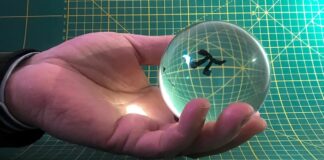
They used diamond. Tiny ones. With silicon defects. These spots store quantum information using electron spins and silicon nuclei. Qubits. Like classical bits, but stranger.
Here was the setup:
– Two “telescopes” (receivers) six meters apart.
– Connected by a 1.5km spool of optical fiber.
– A weak laser beamed through the middle.
They entangled the diamond chips via light before measuring the laser. Then they retrieved the interference pattern. It worked. Two small eyes acting like one wide eye.
What happens if you replace the laser with starlight?
In theory, the two small telescopes could produce an image as sharp as a mirror 1.5km wide. Move the telescopes farther apart? Get sharper images of exoplanets. Better data on star motions. Catch things current scopes miss.
It is not ready for prime time. Lukin admits it. This is a lab demo. The fiber was coiled, not strung across a canyon. The laser wasn’t starlight. Turning this into a sky-mapping tool takes years. Maybe decades.
John Monnier at Michigan University was not on the team. He thinks it is a breakthrough anyway. A new way to make the old technique work. But he warns of hurdles. Building the infrastructure is hard. Expensive. Slow.
So we are in the early days. Testing different techs. Figuring out what these machines can actually do. Lukin sees a path forward. A new class of applications.
Is it practical today? No. Does it open the door?
Maybe.