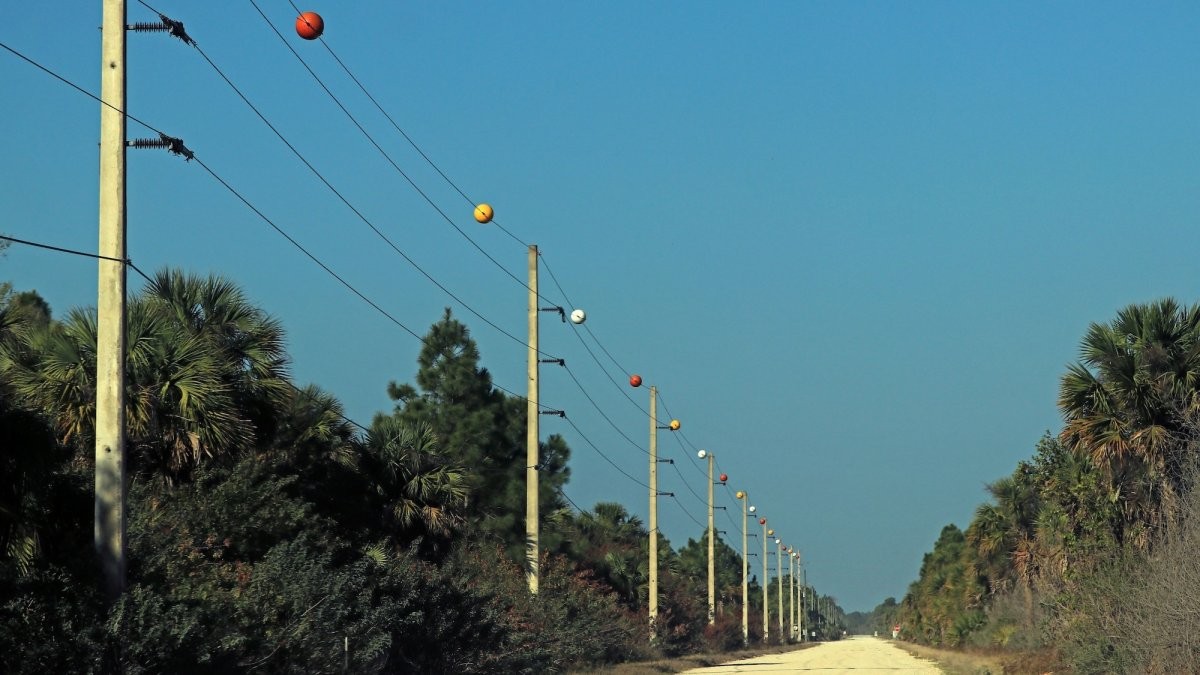
Maggie asked from Pennsylvania. Age eight. She wants to know what those giant orange beads are hanging off the power lines.
I look up when I drive too. They look like overgrown basketballs. Strung along the wires like toys.
They don’t carry electricity. They don’t help the grid run smoother. Their only job is visibility. For pilots.
Spherical markers act as bright warning signs in the sky.
Officially they are called aviation marker balls. They stop airplanes and helicopters from crashing into thin wires that vanish against the sky. It sounds simple. It saves lives.
Why orange? Why there?
Thin metal wires blend into trees. Or blue sky. Or gray clouds. You cannot see them from a cockpit unless you are very close. The orange balls stick out. They shout “danger” without saying a word.
Think of reflective tape on a bike tire. Same idea. Make the invisible visible before it is too late.
Orange was chosen deliberately. It vibrates against nature’s muted palette. Blue. Green. Gray. It works in dawn light. At noon. In the gloom before a storm. Sometimes the spheres are red or white or striped. Orange remains the default champion.
Regulations exist. The U.S. Federal Aviation Administration sets the rules. Other countries have similar guidelines. Obstacles near flight paths must be marked. Period.
Size matters too. From the ground they look small. Like oversized ping-pong balls. Wrong. They are the size of beach balls. Roughly two to three feet across. Ten to twenty-five pounds. That is heavier than a laptop bag stuffed with textbooks.
Plastic. Fiberglass. Materials that laugh at sun and rain and snow. Even birds land on them occasionally. The balls themselves do not conduct electricity. Insulation keeps them neutral. They sit on high-voltage lines but feel nothing.
The architecture of the sky
Why are the wires there? They are highways. Highways for electrons. Carrying power from plants to your home. Your school. Your office.
The towers are tall. Some reach the height of a 15-story building. This keeps the voltage high up. Far away from children playing in parks. From cars on highways. Safety is the point.
Look closely at the bundle. Usually three thick wires. Sometimes a thinner one on top. That top wire is the shield wire. Its job is to take the hit for everyone else. Lightning seeks the highest point. It strikes the shield. The energy travels down the tower into the ground. The other wires keep carrying current uninterrupted.
Three wires work in a rhythm. Shared load. Less waste. More efficiency. It is not magic. It is engineering.
Installation is no picnic
Putting the balls up is not a weekend project. Crews fly helicopters. The line stays live. Electricity keeps flowing. Safety protocols are strict. Tighter than you imagine.
Each sphere comes in two halves. They clamp onto the wire. Bolts secure them. Once installed they stay for a decade or more. Ten to fifteen years depending on how hard the weather fights them. Cracking? Fading? Inspections check for that. Utilities look from afar. Sometimes close up.
Not every line needs a marker. Your neighborhood distribution lines? Probably not. Too low for low-flying aircraft anyway. But rivers. Valleys. Airport approach corridors. Helicopter routes? These get the orange dots. These are the blind spots for pilots.
Next time you see that dot. You know it is not decoration. It is not random color. It is a lifeline for someone flying above.
They are simple tools in a complex world.
Do you have a question? An adult should send it to The Conversation. Tell them your name. Your age. Where you live. Curiosity does not age. Neither do we.