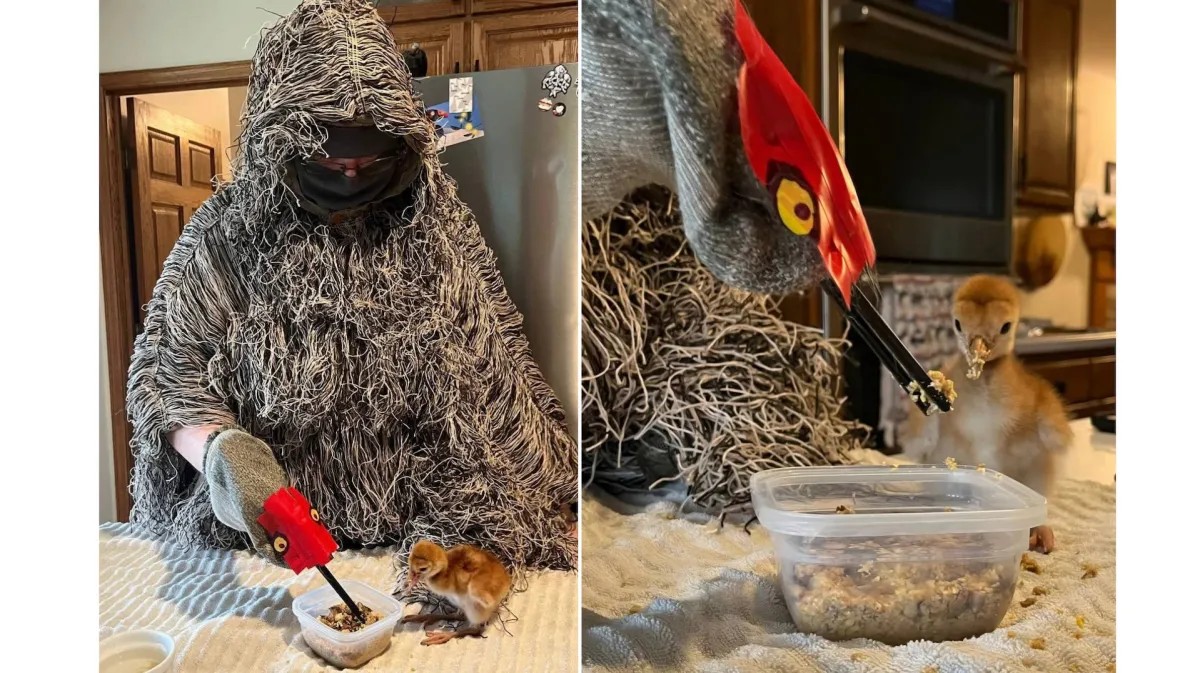
It is ninety degrees in Minnesota. Foxfeather Zenkova is sweating. She isn’t wearing a swimsuit. She is trudging through the mud in a full-body suit covered in fake feathers. Her coworkers call it the “Ugly Mom.” She calls it survival gear.
Zenkova doesn’t trade sequins for feathers on Saturday nights. She wears the costume to save the lives of orphaned sandhill cranes.
The goal isn’t to be cute. It’s to be invisible.
Why Human Imprinting Kills Birds
Sandhill cranes (Antigone canadensis ) are giants. They stand nearly four feet tall and stretch their wings seven feet wide. In the summer, they roam marshes and bogs across northern North America. In the winter, you can see massive flocks in New Mexico and Texas. They look like they walked out of a dinosaur movie. They sound like it too—bugling calls that carry for miles.
They are smart, too. Highly social. Observant.
That intelligence is a problem for wildlife rehabilitators.
When a chick loses its parents, it looks for a figure to follow. It imprints. It bonds. If that figure is a human, the bird grows up thinking it’s a weird, tall, naked bird. It tries to mate with humans. It can’t survive in the wild.
“We stick like glue to our parents’ side,” Zenkova explains. Orphaned chicks need that social cue. They need to know they are cranes, not pets.
This is where the “Ugly Mom” costume comes in.
The Mechanics of Disguise
You don’t just put on a costume and walk away. Rehabilitation is physical labor disguised as dress-up.
Cranes move fast. They start walking within hours of hatching. Within days, they are covering miles. A healthy chick grows an inch a day. To teach them these survival skills, the rehabilitator has to match their pace.
So Zenkova lugs the heavy, hot costume into the sun. She forages with them. She runs with them. She lets them chase her.
“We use crane costumes, puppets, mirrors, even surrogate foster cranes,” Zenkova says. The point is simple. Minimize human contact. Maximize crane identity.
Right now, her clinic at Vulture Conservancy and Foxloft and the Foxloft is caring for four chicks. A fifth is expected.
Most of them were orphaned because cars hit their parents crossing highways.
How to Handle an Orphaned Crane
If you see a baby crane, your instinct might be to scoop it up. Don’t.
Most chicks aren’t actually alone. Parents hide nearby, watching. The chick stays hidden in vegetation until it’s safe.
One of Zenkova’s patients was parked under a bird feeder for two weeks. No parents came back. The homeowners thought maybe it was a deer or rabbit situation. It wasn’t. Baby cranes don’t stay in one spot. It needed help. But intervening too soon can hurt more than help.
Here is the reality: do not try to care for it yourself.
The internet is full of bad advice. You might think you’re being a hero by feeding it, but rehabilitation is complex. It involves socialization, therapy, and medical care. Feeding a bird the wrong food or stressing it out can be fatal.
If you find an orphaned crane with obvious injuries, or one that is constantly crying out for its parents, call a professional.
Use the Animal Help Now database. It connects you with licensed rehabilitators in your state. These centers need volunteers. They need donations. They need people to step back and let the experts handle the “Ugly Mom” work.
The Release
Rehabilitation takes months. It involves swimming therapy to strengthen legs broken by trauma. It involves learning to hunt, to fly, to fear humans.
In Minnesota, that usually means waiting for fall.
When the season turns, the costumed days end. The birds leave.
“Rehabilitating cranes is a ton work,” Zenkova admits. “But watching a crane chick heal and thrive… that’s a great privilege. There is nothing better than seeing them rejoin their counterparts. Get a second chance.”
She takes off the suit. She goes home. Somewhere out in a Minnesota bog, a crane is learning to fly without her watching.
It’s enough.