Paleontologists in Australia have recently solved a long-standing mystery involving a prehistoric giant, proving that a fossil discovered over 100 years ago belonged to a species that had seemingly vanished from the Victorian region.
The discovery centers on the Owen’s giant echidna (Megalibgwilia owenii ), an extinct relative of the modern echidna. While these creatures are well-documented across much of southeastern Australia and Tasmania, their presence in the state of Victoria had remained a scientific gap—until now.
A Century in the Making
The breakthrough did not occur in a fresh excavation, but rather within the quiet halls of Museums Victoria. In 2021, Tim Ziegler, the museum’s vertebrate palaeontology collection manager, identified a partial skull that had been sitting in storage for decades.
Tracing its history revealed that the fossil was part of a 1907 expedition led by naturalist Frank Spry. Using little more than kerosene lamps and ropes, Spry and his team had explored the Foul Air Cave in Buchan, Victoria, retrieving specimens that would take a century to be fully understood.
Meet the Giant Echidna
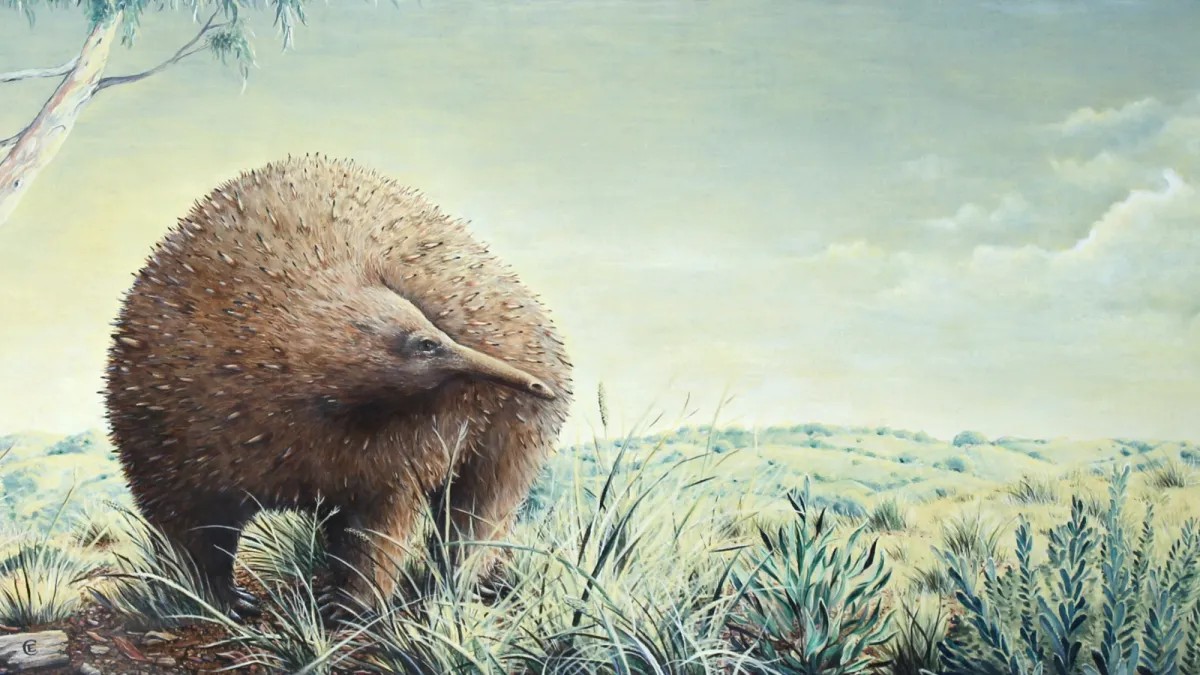
To visualize this creature, imagine a modern echidna, but significantly larger and more robust.
- Size and Weight: The Megalibgwilia owenii grew up to 3.3 feet long and weighed approximately 33 pounds —roughly the size of a large, spiky hamster or a small dog.
- Physical Traits: The fossil features a characteristic straight-beaked snout. This specialized anatomy was essential for its survival, allowing the animal to crush large insects and dig efficiently through the tough soils of Ice Age Australia.
- Scientific Significance: This find is the first confirmed identification of this species in Victoria. It “fills in the map,” connecting the known distribution of these giants across mainland Australia and Tasmania, creating a continuous picture of where they once thrived.
Why This Matters for Paleontology
This discovery highlights a growing trend in modern science: the “re-discovery” of history through existing collections. Often, the answers to evolutionary puzzles are not found in new dig sites, but in the meticulous re-examination of old museum archives.
The research, published in Alcheringa: An Australasian Journal of Palaeontology, underscores how much information remains hidden in plain sight. As researchers like Ziegler and Deakin University student Jeremy Lockett use modern comparative methods to study old bones, they continue to bridge the gaps in our understanding of Earth’s lost megafauna.
“Museum collections preserve the link between science, heritage and people,” says Tim Ziegler. “The next amazing discovery could come from inside the museum, from continued fieldwork, or the keen eyes of a citizen scientist.”
Conclusion
By re-examining a 117-year-old fossil, scientists have successfully mapped the true range of the Owen’s giant echidna, proving that much of our prehistoric history is still waiting to be rediscovered within museum archives.