New York City lives for the exclusive. It loves the things few get to see, the moments that feel like a secret shared between the city and those who look up. Manhattanhenge fits this bill.
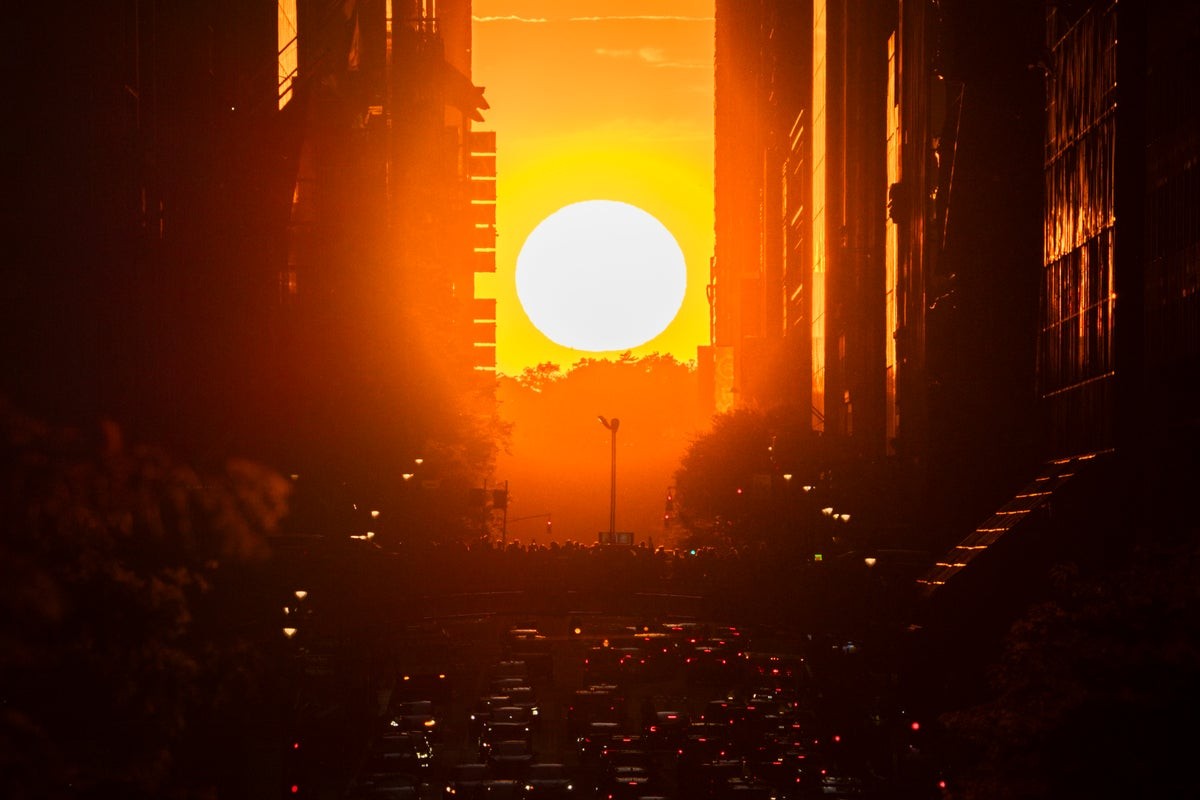
It happens on just four evenings a year. The sun lines up with the East-West grid. It drops straight into the canyon of skyscrapers, appearing as if it is sliding down a chute made of steel and glass.
One of New York’s most anticipated shows. Astronomically speaking.
It occurs in late May. Twice. And twice in mid-July. But watch out—only one of the July dates frames the entire sun. The other gives you a half-measure. Still good, but not the main event.
How it got its name
Neil deGrasse Tyson coined it. The astrophysicist and TV face likely meant to evoke Stonehenge, that ancient British pile of stones which may or may not have served as a solstice calendar for ritual purposes.
But here’s the rub.
Manhattanhenge isn’t ceremonial. It doesn’t align with cosmic intent. It’s an accident. A happy geometric blip born from the Commissioners’ Plan of 811. They rotated Manhattan’s street grid twenty-nine degrees east of true north, just to match the island’s natural orientation.
Two centuries later. That decision makes the light show possible.
We think the sun rises in the East and sets in the West. Simple. Only twice a year is that true. Spring and fall equinoxes. The rest of the time, the sun migrates. As the Earth orbits, sunrise and sunset points crawl along the horizon. Twice a year they line up with New York’s streets.
Coincidence? Maybe. Or just geometry winning again.
It’s a happy accident of the 1811 plan, nothing more, nothing less.
When to look up
Mark the calendars. July 11 is the big one.
On Saturday evening, around 8:20 p.m. EDT, the whole glowing orb will frame itself between buildings. It’s the postcard moment.
The next night, July 12, is different. By 8:21 p.m., you’ll only catch half the sun. Still pretty. Less precise.
Which is better, you ask? Depends on whether you like your art complete or interrupted.