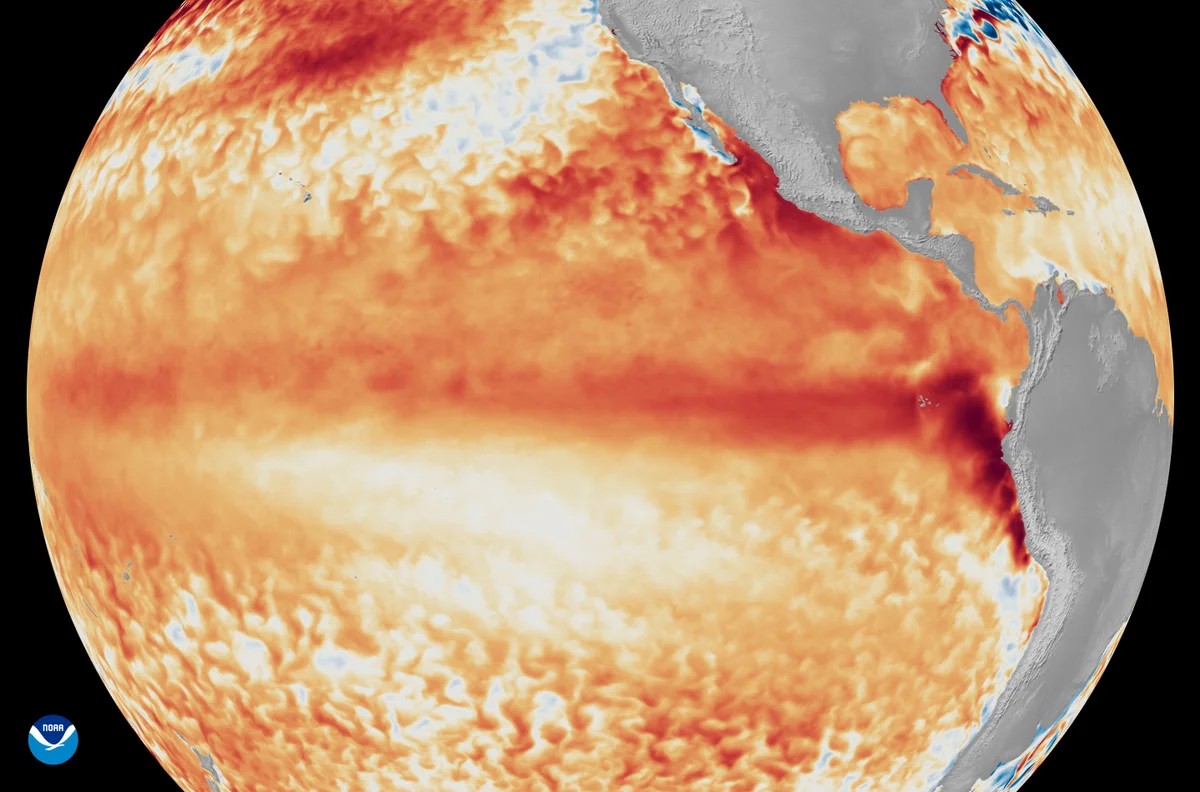
El Niño is coming. And it brings fire with it. Droughts, heat waves, chaos for every continent. The ocean temperatures off Peru and Chile are breaking records, fueling this cyclical monster.
But what if we could blink it out?
A new study in Science Advances proposes just that. Spray sea salt into the sky near the equator. Make the clouds reflect more sunlight. Keep the water cold. Deprive El Niño of its fuel. It sounds like sci-fi. It’s actually marine cloud brightening (MCB). A subset of geoengineering aimed at counteracting warming, or at least, this one particularly vicious symptom of it.
There is a catch. A big one. If we rely on these sky-mirrors and they break? “Termination shock.” Temperature rebounds instantly, catastrophically. Critics say the risk is too high to play god with the weather.
“Could you get some of the shortterm benefits of geoengineering without those longe term risks?”
Jessica Wan, a researcher at the University of Chicago and the lead author of this study, asks exactly this. Her team’s answer? Yes. But only if you act fast. Only if you use it sparingly. Their models simulated the super El Niños of 1997-1998 and 2.015-2.016. Deploying sprayers in May or June, when forecasts are just solidifying, cooled the oceans substantially. Why try it? El Niño is projected to cost the global economy $84 trillion this century. That’s an incentive.
Or maybe just a terrifying idea.
Many scientists want no part of this meddling. “It’s very risky business,” says Michael McPheden, a retired NOAA senior scientist. “Nature is far too complex. You interfere with a process that’s existed for millions of years at your own peril.” He thinks the system is too fragile, too unpredictable for us to tamper with.
Wan agrees the long-term consequences are foggy. In fact, they had to stop their model after two years because it became unreliable. El Niño is tangled in knots. Dampen one year, and you might trigger a severe La Niña the next. Raymond Pierrehumbert of Oxford points this out. La Niña isn’t a vacation from weather; it’s a different flavor of disaster. Who knows which way the dice fall?
Then there is the ethics.
Who gets to pull the trigger? Who benefits? El Niño wrecks crops in Africa and Asia but often keeps hurricanes away from the US Gulf Coast and the Caribbean. If you modify El Niño to help Peru, you might hand hurricane season a loaded gun aimed at Texas. You create winners. You inevitably create losers. McPhaden says as much. The redistribution of misery is hardly a solution.
Frank Keutsch of Harvard thinks there’s a middle path, though. Maybe targeting one extreme event is politically palatable. Playing dice with the entire planet is one thing. Cooling a specific fever spike? Easier to justify. He’s led his own canceled solar geoengineering experiments. He gets the appeal.
The problem is the machinery.
To cool these oceans, Wan’s team calculated you need 2,400 shipping vessels equipped with sprayers. Two percent of the entire world’s merchant fleet, converted into sky-painting trucks. David Keith, also at Chicago, thinks today’s tech isn’t good enough. Efficiency needs to improve a hundredfold before those sprayers are anything more than a conceptual exercise.
Start-ups are trying, though. Research groups are building prototypes. Wan is optimistic. She sees this not as a fix, but as a pause button.
“We are buying time,” she says. Less damage while we actually fix the root problem: burning fossil fuels.
Time is a luxury. Can we afford the interest rate on a planet held hostage by cloud chemistry?
We haven’t answered that. Not really.