The hairdryer screams. It’s a jet-engine whine that drives most people to silence the kitchen or run from the bathroom. But Alexandra Fierra hears something else. She hears motion. She hears rhythms that shift and repeat. She hears textures undulating like waves.
“There is a movement of energy in there,” she says. “If you could hear it, it actually can very elegant.”
Most of us don’t hear it. That’s because the sound isn’t really sound. It’s an electromagnetic field. It’s invisible. It radiates from the motor in your appliance. It’s what we usually call interference.
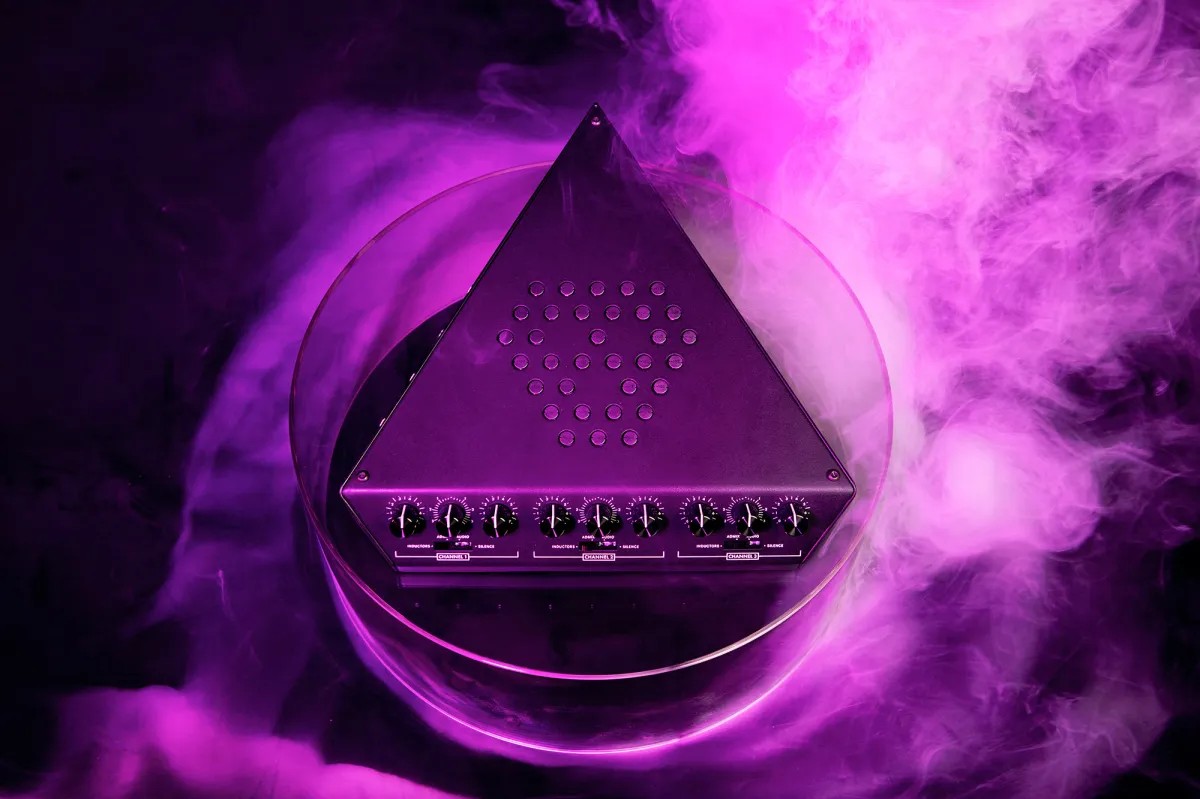
Fierra built an instrument to translate that invisible noise. She calls it the Demon Box.
It is a $999 desktop device. The company is Eternal Research, based in Los Angeles though born in Brooklyn. They launched it this year. The Kickstarter raised over $111,000, proving people want to listen to the things they usually ignore.
The device picks up the electromagnetic fields radiating from your everyday electronics. Then it turns them into sound. It also outputs control signals. You can drive synthesizers with it. You can control modular gear. You can light up stages.
Why Listen to EMF Fields?
The name sounds like something from a horror movie. The marketing leans into the occult. Fierra describes it as “part science and séance.”
The reality is the opposite of mysticism. There is no magic here, strictly speaking. The fields are real. You just can’t hear them without help. Fierra argues that if you learn to listen, you will hear the truth of your environment.
The concept isn’t new. German artist Christina Kubisch started using induction coils in the late 1970s to convert electromagnetic fields into sound. She still does it. Her Electrical Walks series hands headphones to participants. Suddenly, the city’s invisible electrical activity becomes audible. It’s a revelation.
Since then, tools like the open-source Elektrosluch have made listening affordable. They brought the practice to a wider audience.
Fierra sees the Demon Box as the next step. It isn’t just a meter. It isn’t simple field monitoring. It is a spatialized listening device. It is an instrument in its own right.
How the Demon Box Works
Fierra got here by deconstructing guitars years ago. She built a high-powered version of an electromagnetic pickup. She kept going. When people told her the idea existed, she took it as a challenge.
“What does 30 steps beyond that look like?”, she wondered.
Capitalism often stops innovating when a product sells. Fierra refuses to do that.
The technical side is plain enough. Inside the triangular enclosure sit 33 inductors. They are arranged across three channels. Think of them as antennas for electromagnetic fields. Bring a magnetic object near one. The box senses the field.
You can output the signal as audio. You can send control voltage to a modular synth. You can send MIDI to trigger visuals or other instruments.
But that’s not what makes it an instrument. That’s what makes it a sensor.
The magic is phase.
“If you bring multiples of these together… you create this third thing,” Fierra explains.
The pickups interfere with each other. That interference creates new rhythms. It creates shifting amplitudes. It creates something distinct from the source.
A guitar pickup tries to capture one string cleanly. It treats everything else as noise to be eliminated. Fierra doesn’t want cleanliness. She wants complexity.
“We didn’t invent any of the parts,” says Fierra. “We just arranged them… uniquely.”
What Can You Plug In?
You point the box at things with motors. Power drills. Electric toothbrushes. Anything that whirs.
But you don’t need power. A permanent magnet has a magnetic field. The box can read it.
The voice coil in a Bluetooth speaker works too. The inductor coil buried inside a smartphone hums as you move it past the sensors.
Hold two magnets together. Their fields collide. You get a third pattern.
Every magnet has a shape. Every shape has a voice. Fierra often holds magnetic field viewing film over objects. She sees the fields directly.
Her approach is an inversion. She isn’t trying to transform noise. She is trying to become a better listener to details.
Hold a fluorescent light over the box. Run it through effects. It becomes a huge, beautiful drone.
Play a violin? People expect a violin. They want it to sound like one. It’s hard to break that expectation. But nobody expects anything from a hairdryer. That freedom is the point.
The Luddite Who Built a Synthesizer
Fierra didn’t follow a traditional path. She grew up in a Pennsylvania Dutch community.
“If you couldn’t do it yourself,” she says, “you couldn’t do it.”
She describes herself as a former Luddite. She was dismissive of technology she found “adversely inhuman.”
She wrote on a typewriter. She refused to buy an iPhone. Then she reframed her relationship with the machine.
“A synthesizer is just like a new type hammer or a new type saw,” she says.
She started playing piano at 30. At 42, she treats that late start as permission. Not a limit. She came up outside the traditional music world. She has no inherited sense of how things should be arranged.
Invention runs in her blood. It hides in plain sight.
Her great-grandfather, J.I. Rodate, started an electrical-connector company in 1923. He used the proceeds to build a publishing house. They created Organic Gardening and Prevention magazines.
His daughter Ruth married Joel Spira. He invented the first solid-state dimmer. He built it into Lutron, a lighting company Rodate helped seed.
Fierra keeps returning to that dimmer. Why? Because you forget it is there.
“That’s how good design is to me. It’s just there,” she says.
She wants the same from the Demon Box. Quiet work. Nuanced signals. Things people never think about until you point them out.
The Daemon and The Muse
Fierra performed as Fierra Ex Machina at Rite of the Demon. It was Eternal Research’s retelling of the Oracle of Delphi. It involved live-scored music, dance, and films. She was joined by electronic pioneer Suzanne Ciani.
But the lineup points to her real lineage. She reaches past electronics to the orchestra.
She thinks of Stravinsky’s The Rite of Spring. That piece pushed the violin out of the center. It spread the coloristic spotlight across the entire orchestra.
“The Demon Box is in a way a legacy of The Rite of Spring,” says Fierra.
It just changed the orientation. The odd number of 33 inductors wasn’t arbitrary. It arrived around the 17th prototype. It follows a rule she repeats often.
“There’s an ounce of arbitrary in any worthy endeavor.”
What about the demon? Fierra lets people enjoy the occult flavor. But it isn’t her meaning. She means daemon. A muse. A guide. Nothing to do with good or evil.
“It’s the source of inspiration demon that comes to you… and says, I’ll go further. There’s more out there,” she says.
That is the project. Stand in a forest. It is alive. It is energy. It is motion.
“Even reality is magic,” she says.
The Demon Box just hands you a way to hear more of it.
Next time your hairdryer whines. Next time the fluorescent light buzzes. Your electrified world has been singing. All along. You just had to listen.