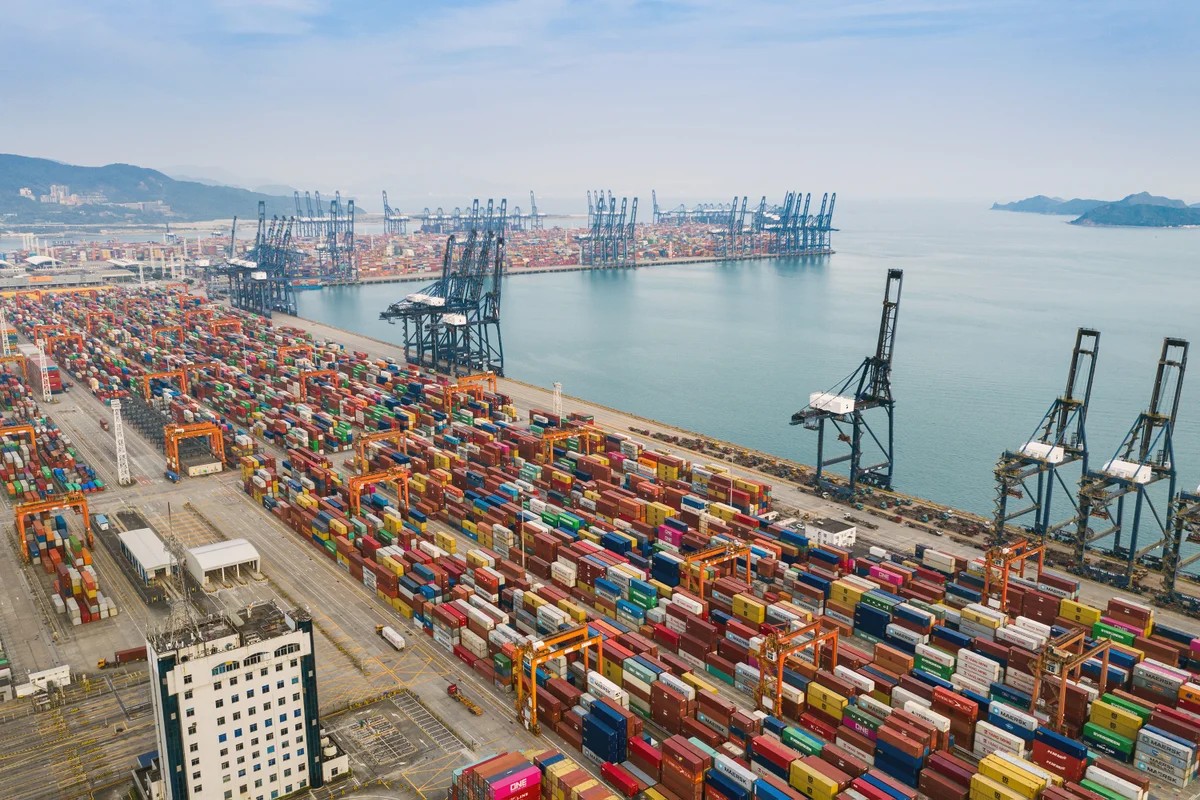
Shipping containers promise a world of frictionless logistics. They are the steel atoms of global commerce, stacked in neat, immaterial towers. But the sea is a stubborn thing. It doesn’t care about just-in-time delivery. It doesn’t respect schedules.
Every year, storms and shipwrecks send hundreds of containers overboard. Nobody tracks the exact loss. Insurance companies and shipping lines guard these numbers. Estimates suggest thousands vanish into the deep.
These containers are lost. But their contents? Sometimes, they find a way back.
If a container washes ashore intact, the game is simple. Every standard unit carries a BIC code. A global registry links that code to its history, its cargo, and its intended recipient. With luck, the goods can be delivered, albeit late.
But when a container breaks?
When the hull cracks on the high seas, the freight enters a different realm. The contents scatter. The wind takes them. The waves claim them. They rarely reach their destination.
This seems like a pure loss for the industry. Hundreds of millions in damage.
Yet, for oceanographers, a broken container is a goldmine.
It provides data points. Specifically, it helps map ocean surface currents with unprecedented precision.
The Great Shoe Spill of 1990
Consider May 1990.
The Hansa Carrier was crossing the Pacific from Korea to the US. A storm north of Japan hit hard.
Twenty-one containers went overboard. Four broke open.
Inside was more than 60,00 pairs of Nike sneakers. They poured into the ocean like a dark tide.
Nine months later, the shoes returned.
1,600 of them washed up along the Oregon coast, the Queen Charlotte Islands, and other northern Pacific beaches. This event became known colloquially as the “Great Shoe Spill.”
For Curtis C. Ebbesmeyer, a Seattle-based oceanographer, it was a miracle.
Ebbesmeyer didn’t see waste. He saw probes.
With the help of local beachcombers—who are often more numerous than researchers—Ebbesmeyer mapped where the shoes landed. He documented every sighting.
He worked with James Ingraham to use the Ocean Surface Currents Simulation program. They fed the sneaker data into the model. The results matched reality.
“The sneakers, though unintentionally released, became data fed into the ocean system.”
The shoes weren’t just litter. They were tracers. They revealed how currents move in the northern Pacific.
From Buoys to Flotsam
Sneakers aren’t unique in this role.
Oceanographers have tracked toy cars, Lego figures, beer cans, hockey gloves, and even sealed Riesen chocolate eggs. Each spill adds a data point.
Comparing these real-world journeys with simulations has refined our maps. The maps now account for shipping routes, wind patterns, and unpredictable drift.
This practice isn’t new. It has deep roots.
In 1885, Albert I, Prince of Monaco, launched 1,675 buoies into the Atlantic. He was a sailor, explorer, and amateur oceanographer. He wanted to map the Gulf Stream.
Each buoy held a message in seven languages, sealed in glass. It asked finders to return the note to their government.
The buoies drifted. They ended up from Europe to Africa, from the Antilles to Central America.
Their data helped map the Atlantic flow.
Today, we use sophisticated ocean drifters. They transmit location via satellite. They measure salinity, pressure, and wind.
But damaged containers still hold an edge.
The Accidental Experiment
Modern buoies are expensive and carefully placed. They follow a research protocol.
A lost container is different. It is a mass experiment. Nature staged it. No research grant approved it.
It sends thousands of objects into the ocean simultaneously.
These objects travel on hidden pathways. They cross basins. They hit coasts far from their origin.
By tracking where they land, we chart the currents they passed through.
This isn’t just academic. It exposes a deeper truth.
If plastic objects help us understand ocean mechanics, then nature and culture are entangled. Human manufacturing meets natural flow. Trade routes intersect with storm patterns.
A lost shipment is a message.
What does a pile of stranded shoes tell us? It reveals the speed and direction of a current that moves invisibly through global trade.
It interrupts the fiction of frictionless transit.
The Logic of Transit
We tend to view containers as bits of data. Moving across land and sea like electrons in a wire.
In this view, the loss of a few is statistically insignificant. The system absorbs the shock.
But accidents matter.
When a container breaks, the flow stops. The system becomes visible. It becomes archaeological.
We have to rescue the contents. Raise them. Examine them.
This moment illuminates the logic of global consumer capitalism. A system that ignores local conditions. It doesn’t care if it’s night or day. Winter or summer. Storm or calm.
It follows its own clock.
Lost containers disrupt this clock. They force us to look at what’s inside.
They show us that the global flow isn’t seamless. It’s punctured by storms, by failures, by chance.
And in those punctures, we find new knowledge.
The ocean doesn’t just take. It reveals.