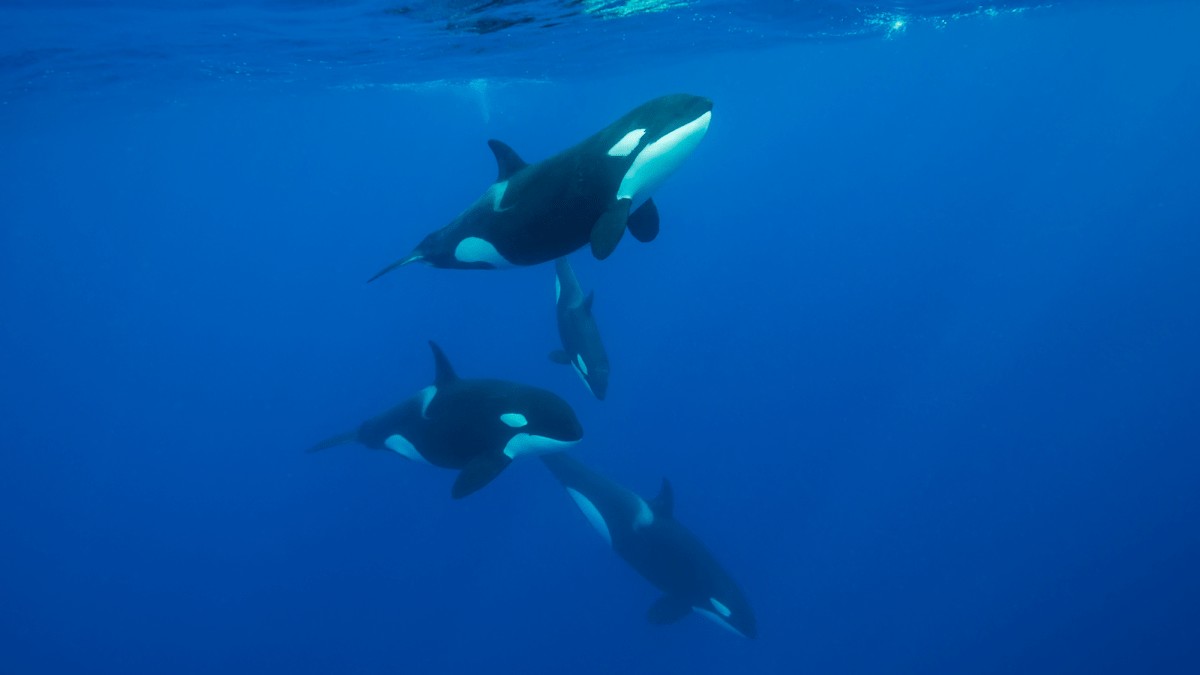
The movies lied. Sure, Jaws gave us a terrifying image of a great white shark as the apex predator. But in the real ocean, that title belongs to the orca (Orcinus orca ). These hunters don’t just chase. They plan. They hydroplane onto beaches to snag seals. They corral bait balls. Now, they have a new trick up their sleeve.
In the Gulf of California, scientists have captured something bizarre on camera.
A massive mola mola—a sunfish that can weigh over 4,000 lbs—is floating lifeless on the surface. It’s huge. It’s gelatinous. An orca grabs its tail fin. Holds it steady. Another whale approaches. Accelerates. And slams into the carcass at high speed.
The result isn’t a clean kill. It’s an explosion of fish meat. Hundreds of tiny fragments scatter across the water. The baby orcas dive in. They eat the small pieces. The adults stick to the larger chunks.
This isn’t just sloppy feeding. It’s a specific, coordinated technique. And it reveals a lot about how these smart mammals interact with their environment.
The Hold-and-Ram Technique
Dr. Katy Ayres, a researcher with Beneath The Waves and Orcas Mexico, was there when it happened. She saw the prey clearly for once. Usually, identifying what orcas eat is a guessing game based on stomach contents or scraps. Not this time.
“I wasn’t expecting the sunfish to fragment so much,” Ayres told Popular Science. “As it happened, it became clear we were watching something special.”
The event was detailed in a study published in Frontiers in Ethology. Ayres and her team analyzed two separate incidents, spaced about a year apart.
In July 2024, a group of orcas, including a juvenile, tackled a dead sharp-tail sunfish (Masturus lanceolatus ). A female held the tail. A male swam fast and rammed it. The impact shattered the body. The juvenile ate the debris.
Then came September 2025. Filmmaker Héctor Franz recorded nearly the same scene. Hold the tail. Ram the body. Shatter the flesh.
Why do this?
The sunfish was already dead. This wasn’t predation in the traditional sense. It was processing.
Breaking Down the Barrier
Sunfish are heavy bony fish. They surface to rest, warm up, or let cleaner fish eat their parasites. It’s a vulnerability. Orcas in this region exploit it. Their diet is wildly diverse. Whales? Yes. Dolphins? Yes. Sharks? Sure. And these massive, gelatinous sunfish.
The sunfish’s outer layer, called a capsule, is thick. It’s full of distinct microorganisms. When orcas ram it, they break this barrier. The microbes spill into the water.
Ayres believes this fragmentation changes the nutrient profile. It might help the orcas ingest specific microbes. These microbes could boost their immunity. Or provide other health benefits we don’t fully understand yet.
Think of it as eating fermented food. You break down the structure to access the nutrients inside.
Parenting or Play?
The juvenile orcas in the footage are key here.
Adults usually avoid the small fragments. They leave them for the babies. This aligns with what we know about parental investment. Adults teach young whales how to hunt. They make prey accessible.
“It was really lovely to see the young orcas taking advantage of the smaller pieces,” Ayres says. “It raises interesting questions about whether adults were making the prey easier to eat for them.”
But there’s another angle. Orcas are social. They play.
Maybe the ramming is just fun. A high-energy game of tag with a giant fish. The coordination required—timing the release, aiming the impact—suggests a level of playfulness that matches their complex social structures.
We don’t know for sure. But it’s possible.
A Species-Specific Reaction?
The sunfish in the videos were sharp-tail sunfish. That’s specific.
Other sunfish species are larger. Heavier. Do they shatter the same way? Probably not. Their tissue structure might be tougher. Or more resilient.
Fragmentation so far is only documented in Masturus lanceolatus. This suggests a species-specific response to high-energy impacts. We’ll need more footage to know for certain. More data. More eyes in the water.
And here’s the problem.
Seeing these orcas is rare. Privileged, even. Regulations are in place. But boat traffic is increasing. People want photos. They want to get in the water. Sometimes, they force encounters.
“I think it’s important that visitors come with real expectations,” Ayres says. “Appreciate these animals in their natural environment. Not just as an opportunity for a social media post.”
The orcas in the Gulf of California are still understudied. Every observation fills in a piece of the puzzle. This ramming behavior? It’s not just cool. It’s science. It’s biology. It’s nature showing off.
But will we keep watching? Or will we push too hard until they swim somewhere else?
The answer is up to us. The whales just want their dinner.