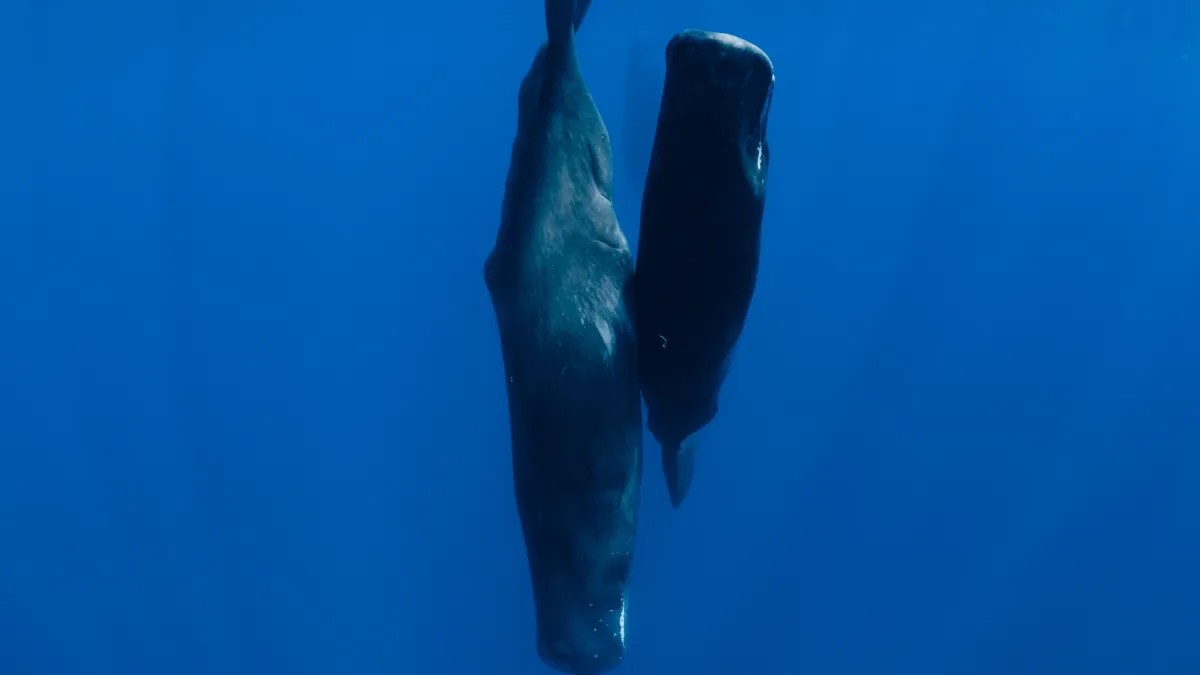
They’ve got vowels. They might have an alphabet. Now, we know they nap with a trick.
Sperm whales sleep in ways that look terrifyingly familiar to us. But there is one mechanical quirk that defies basic physics. Imagine falling asleep underwater. Your head is huge. Your head is full of air. Your head is buoyant.
You float up. You wake up. You drown.
This is the problem Noémie Freymond and her team set out to solve. The researchers at the University of Neuchâtel and the University of St Andrews didn’t just want to watch whales sleep. They needed to know how sperm whales stay submerged while their brains shut down for ten to fifteen minutes.
The answer? They blow bubbles.
It sounds silly. It isn’t. It’s a buoyancy hack refined over millennia of evolution.
The Mechanics of the Whale Nap
Sperm whales don’t just sleep on the surface. They dive. They rest at depth. They sleep vertically, heads pointed up, tails down. Or they sink tail-first. Or they dive deep, then rest on the ascent.
But when they rest close to the surface, physics gets mean. Buoyancy fights back. Without intervention, a sleeping sperm whale would drift toward the sky.
The team monitored 42 whales off Norway’s Lofoten Islands. They attached suction tags. They waited. The tags recorded sound and depth. Then they detached. Then they floated to the surface.
Lab time. Data crunching.
The result was clear. When whales rested near the surface, they blew bubbles. Specifically, they exhaled roughly 11 times per nap cycle. This small release of air counteracts their natural floatation. It’s ballast.
But the story flips when the whales dive deeper.
At depths greater than 656 feet, water pressure compresses air. The whale becomes less buoyant. The environment does the work for them. These whales only needed to release three or four bubbles per nap. They didn’t need to actively pump air out to stay down. Pressure kept them grounded.
So, when sperm whales blow bubbles to nap, they are essentially using their lungs as adjustable ballast tanks.
“This allowed us to show that sperm whalesrelease bubbles to regulate their buoyancy while restings.” — Noémie Freymond, Lead Author
Conscious Effort or Autonomic Reflex?
Here is where it gets fuzzy. Do they do this on purpose?
When a dolphin sleeps, one half of its brain stays awake. Half-alert. Half-dreaming. Sperm whales are larger. More complex. Is it possible they retain conscious control over their exhalation even during sleep?
Releasing air to control depth requires awareness. It requires a feedback loop. You can’t monitor depth and adjust lung volume if you’re in a coma.
Yet, we don’t have proof. Freymond’s team acknowledges the gap. Maybe it’s an unconscious reflex, a spinal override. Maybe they’re calculating volume in their sleep. Maybe they’re just lucky.
What we do know is that the dataset was massive. Most tag deployments fail to catch a full rest cycle. These researchers got lucky. Or they were prepared. They waited for the whales to do the thing they hadn’t seen anyone else confirm.
Patrick Miller, the co-author, had previously observed bubbles during rest but couldn’t prove the “why.” He saw the action. Freymond provided the mechanism.
The Bigger Picture
This isn’t just about sleep. It’s about adaptation.
Sperm whales live in a medium that fights their biology. Air makes them float. Water presses them down. They have to navigate the tension between the two constantly. Sleeping removes their ability to actively swim. It removes their ability to correct their position.
So they evolved a passive solution. A tiny, rhythmic exhalation. A bubble. A compromise with gravity.
Scientists are now asking weirder questions. Is whale sleep snoring? Probably not. Snoring is obstructed breathing. This is controlled release.
But will they investigate it? Probably. The data is there. The tags are ready. The whales are waiting.
And we’re left watching the bubbles rise, wondering if they’re asleep or just waiting for their next breath.