The Columbia River cuts through basalt near Malaga, Wash. Apple orchards. Old dam. Water to electricity since ’33. Now? A new power plant rises from the dirt. Not hydro. Fusion.
Helion Energy calls it Orion.
It claims 50 megawatt capacity for Microsoft. By 2029. Helion backs this with money from big tech and Sam Altman. They’re betting on AI hunger driving the demand.
“We’re 20 years late,” CEO David Kirtley says, tossing aside the old “always 20 years away” joke. “Step up. Build at scale.”
Private cash flooded in. Tech giants signed power deals before any machine sparked a watt. AI needs juice, round the clock, clean and firm. Fusion start-ups sell the dream.
Physics doesn’t care about your Series B funding.
The Plasma Problem
Stars fuse easily. Earth resists.
You must heat hydrogen nuclei past 100 million degrees. Plasma forms. It must stay hot. Dense. Stable. Long enough to react. Easy to say.
Deuterium-tritium fuel is the standard. It shoots neutrons everywhere. These particles smash the machine walls, degrading them. Tritium is also radioactive, decays fast (12 years), and is nearly extinct in nature. Reactors must breed their own supply. Nobody really has the full supply chain ready yet.
Helion ignores the traditional tokamak donut. They use a field-reversed configuration (FRC).
It’s a spinning smoke ring. Self-organized. Needs fewer magnets. Cheaper, supposedly.
“Like spinning a top,” says John Slough, an experimental physicist. “Mess with it, you mess it up.”
Slough kept this niche idea alive for decades. Federal money dried up. NASA gave him crumbs for space propulsion. Then came a key idea: slam two plasma rings together. Fast. Up to 1.6 million km/h. The collision itself creates the heat needed for fusion. It happens in fractions of a millsecond.
Around 2008, Kirtley joined Slough’s lab. He saw a start-up potential Slough missed. They left. Joined Y Combinator. Helion launched. Public science death spiral, private rebirth.
Skipping the Heat
Here is where Helion differs wildly from other designs.
Most plants use heat to boil water. Spin a turbine. Make electricity. Low efficiency. Lots of waste heat.
Helion skips the turbine.
The plasma expands against the magnetic field after each pulse. It induces current directly into surrounding coils. They claim 95 percent electrical efficiency.
“If you can do that,” Troy Carter of Oak Ridge notes, “it lowers the bar significantly for how much gain you need.”
Kirtley insists direct electricity recovery is the core technology. No steam plants. No thermal loss.
Does it work?
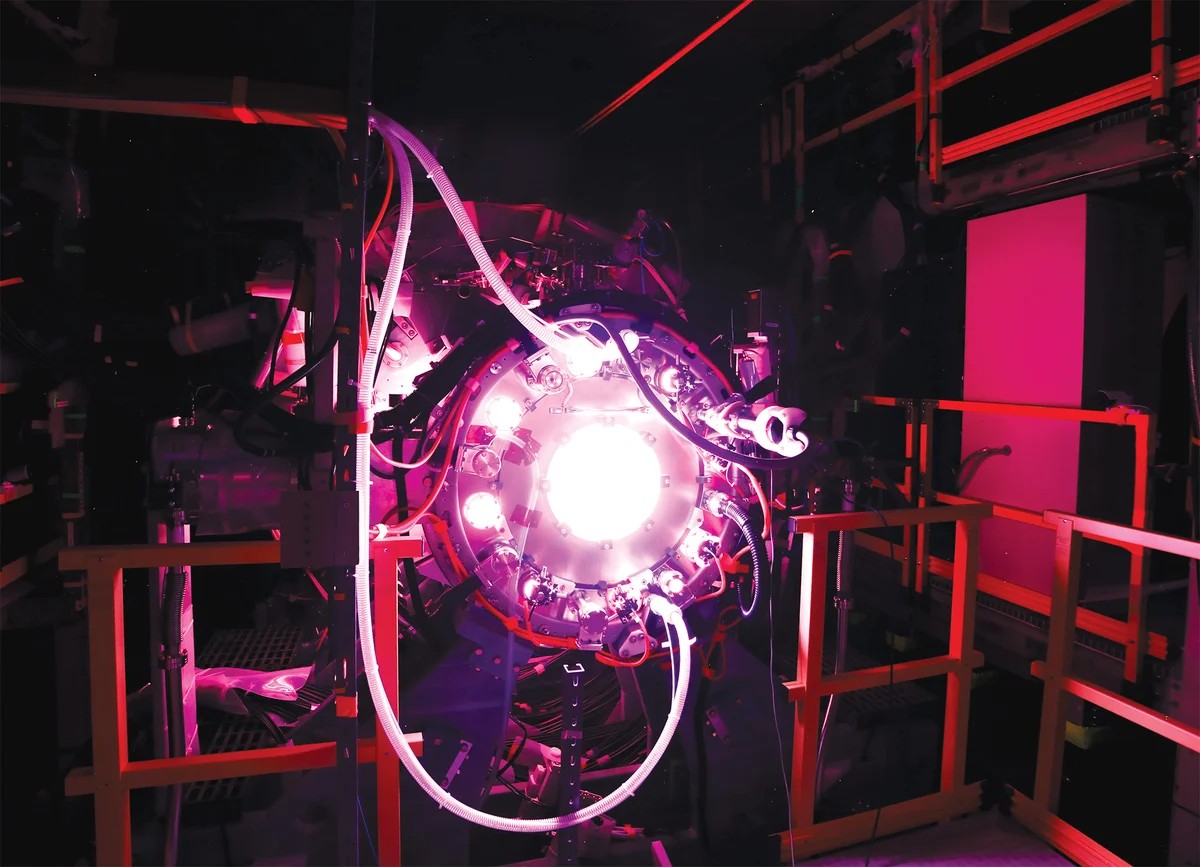
Seven prototypes built so far. The latest is Polaris. Nineteen meters long. It holds capacitors filled with enough oil for 150 shipping containers This machine recently hit 150 million Celsius. Helion says it demonstrated deuterium-tritium fusion.
But engineering is brutal. They replaced research switches with solid-state hardware capable of hundreds of millions of shots. Everything must sync within nanoseconds. Each pulse is a flash. Fusion occurs, energy recovers, before your eye blinks.
The Skeptics Rise
Helion wants to build many modular generators. Factories. Shipped like server racks.
They announced a deal with Microsoft. Financial penalties for missing the 2028/2029 dates. A deal with steel giant Nucor. 500 megawatts promised.
Missed deadlines are their history. Net electricity projected for 2024? No data published yet to confirm net gain.
The criticism isn’t just about timing. It’s physics.
Slough, the co-founder, turned harsh critic. He says their high-speed merging causes instabilities. Plasma flux lost catastrophically before fusion can help. At those speeds?
“You’ve run up against a fundamental aspect,” he says.
Worse, Helion aims to eventually run on helium-3, not just deuterium. Helium-3 is rarer. Needs 200 million Celsius. Produces fewer neutrons, helping their direct-capture system.
Slough calls this physically implausible. Heat and confinement required? Doesn’t exist in their model.
Kirtley disagrees. He claims Slough uses “dated” models that ignore pulse speed. Instabilities need time to grow, he argues, and there isn’t enough time. Helion plans to breed their own helium-3 from trit decay, aiming for over 85% conversion efficiency.
But they publish almost nothing. No peer-reviewed plasma performance data.
“It is hard to fully assess where we’re headed,” says Carter.
Then Karl Lackner stepped in. He published comments targeting a 2023 Kirtley paper on helium-3.
Helion assumed plasma ions could stay much hotter than electrons. This lowers energy input needs. Lackner argues normal collisions force that energy to equilibrate. The requirements become far tougher.
Helion retorts. The pulse evolves faster than the thermal transfer. It’s not about forever states. It’s about speed.
The Endless Wait
Fusion has overpromised since the Cold War. Private money changes nothing but the speed.
Helion changes the mindset. They treat it like manufacturing. Thousands of technicians. Building components in-house, like their ultrahigh-pressure ceramics.
But one company can’t build an industrial base.
ARPA-E recently dropped $135 million to help with these technical barriers. Largest public investment so far. Carter sees a pilot plant in the early 2030s as possible. But not alone.
The construction cranes turn near the dam. Orion rises.
Microsoft waits for its clean power.
The physics will dictate the reality. The grid may not be ready by the thirties. Maybe the forties. Maybe never at this scale. Helion forces us to look at fusion not as a distant laboratory dream but a present manufacturing headache.
That counts for something, if not for a billable kWh.