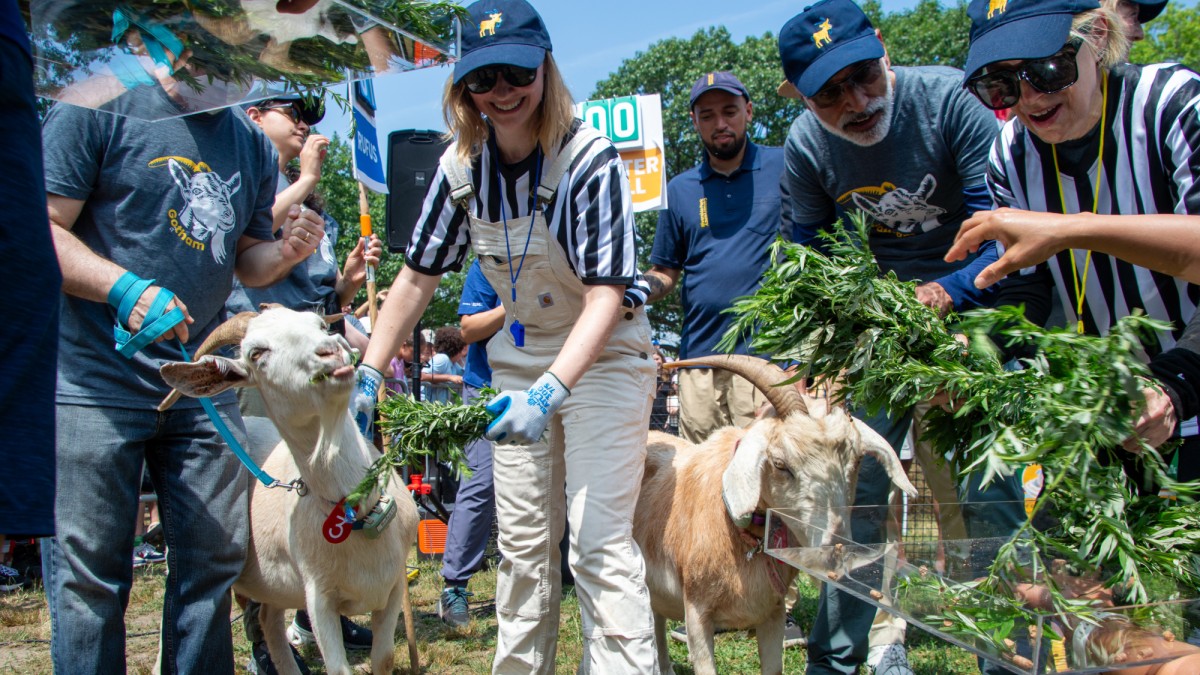
July is usually reserved for fireworks and questionable time capsules. But in New York City? It’s also the season of the Great Goat Graze-Off. For the second year running, the world’s only professional eating competition for caprines has descended upon West Harlem.
The stakes were high. The competitor: Mallomar.
The defending 2025 champion had to prove he wasn’t a fluke. He faced off against Romeo and Big Buddy in a three-minute sprint to see who could consume the most invasive weeds. According to the Riverside Park Conservancy, which organized the event, Mallomar didn’t just participate. He defended his title.
He cleared 1.5 packets of problematic flora. Fast.
Hosted by George Shea—the man also responsible for the Nathan’s Hot Dog Eating Contest—the event drew crowds to Riverside Park. But let’s get one thing clear immediately. No goats are being eaten. The goats are the ones eating. This distinction matters if you’re planning to bring lunch to the park.
Why Urban Goats Are Better Than Chemicals
You might be asking yourself: why are goats doing this instead of tractors or herbicides?
It’s about efficiency. And soil health.
The Riverside Park Conservancy uses these animals to manage invasive greenery in areas that are difficult for standard machinery to reach. It’s targeted clearing. Goats munch everything down to the roots. They stunt the plant’s growth cycle, forcing it to restart only to be eaten again. After a few seasons, the invasive species weakens. In some cases, it disappears.
The benefits stack up quickly.
- No chemical runoff: Goats don’t spray toxins into the groundwater.
- Natural fertilization: Their manure enriches the soil as they work.
- Continuous service: Goats eat nearly all the time. You can’t clock them out.
“Throughout the season, the animals continuously consume the weeds all the way down… making them start all over,” the Conservancy noted on their site.
The Human Side of the G.O.A.T.
Mallomar isn’t the loudest goat in the herd. He’s calm. Steadfast.
According to the Conservancy, his demeanor provides a sense of security for the humans and other animals around him. He has their back.
This reliability has earned the caprine crew a official spot on the city’s maintenance roster.
“At NYC Parks, we’re always looking to care for green spaces. These goats have earned their place.” — Tricia Shimamura, NYC Parks
Sheimamura, who spoke to Popular Science, emphasized that whether the animals are competing in the Graze-Off or working the slopes of Harlem, they make parks healthier. They give New Yorkers a reason to smile, which is currency in this city.
The Verdict on Mallomar
Mallomar won the 2026 title.
He beat Romeo. He beat Big Buddy. He ate 1.5 packets in under three minutes.
His performance highlights a shift in urban management. We’re moving away from brute force and toward biological solutions. Goats are low-cost, high-efficiency weeders. They don’t require gas. They don’t pollute. They just eat.
Next time you’re staring down an invasion of Japanese knotweed or kudzu in your local park, consider the four-legged alternative. The bees—err, beehives—are buzzing, but the goats are getting the job done.
And Mallomar? He’s still grazing.