By [Staff Writer]
They’ve been teaching us the whole time.
The students don’t need new teachers. They need the old ones—rappers, poets, producers who’ve been shaping young minds in community centers, after-school programs, and underground cyphers—for decades. The only problem? They lack the one piece of paper that makes institutions feel safe. The bachelor’s degree.
It’s a ridiculous mismatch. Hip-hop emerged from exclusion. It grew in the streets where traditional schools weren’t looking. Now, those same culture-bearers want to bring their expertise into formal classrooms. They face a brick wall of accreditation.
Unless you’re part of College Unbound and the Hip Hip-Education Center.
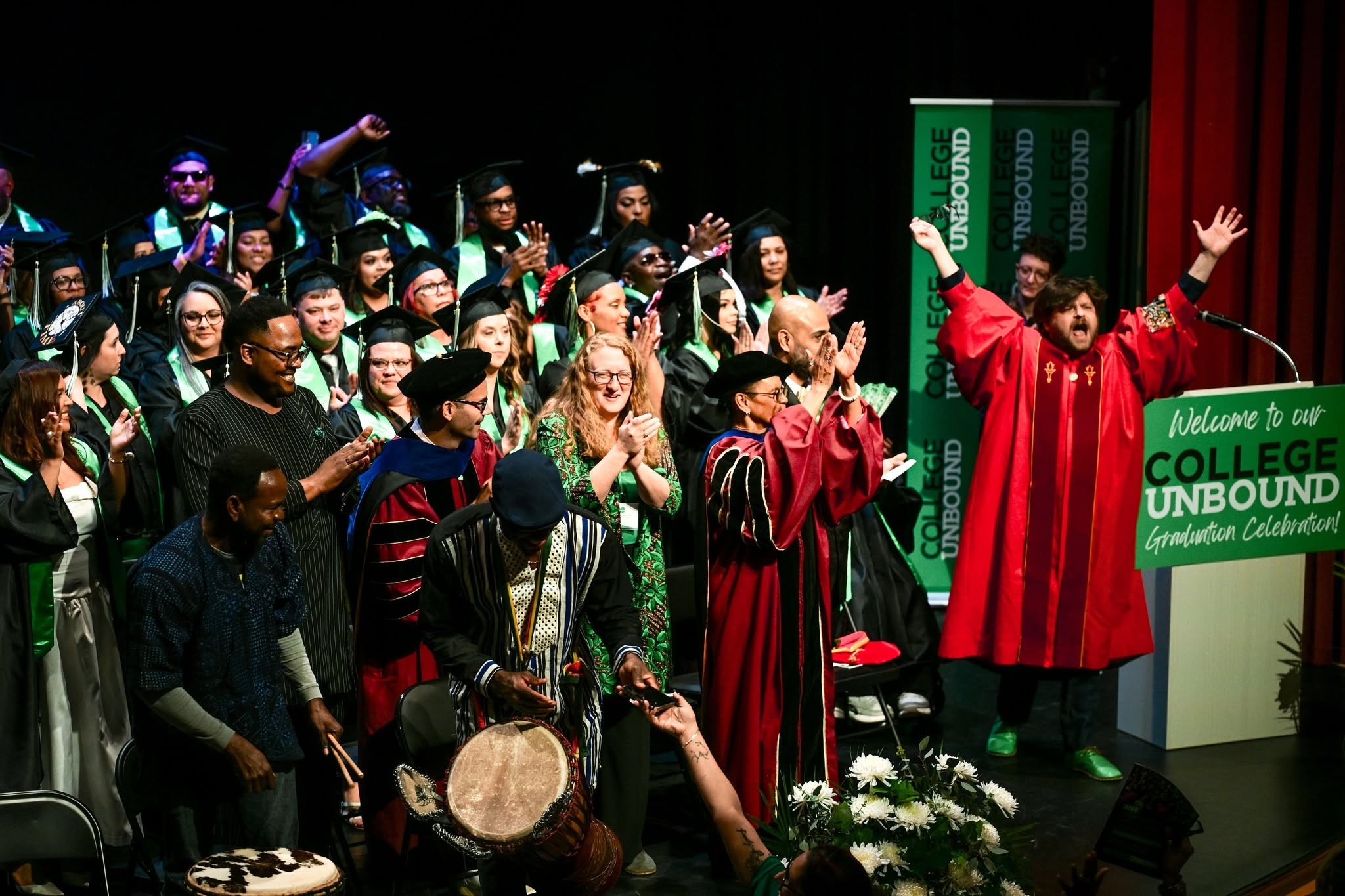
This partnership doesn’t try to fix the artists. It fixes the credential. They’ve created a Bachelor of Arts in Organizational Leadership and Change specifically for cultural leaders. It isn’t a “easy” version of college. It is the exact same degree every other student at the university receives.
“It’s the same degree. It’s simply lived differently,” says Adam Bush, College Unbound’s president.
The goal here is simple yet radical: Validate expertise that exists outside the classroom.
Why traditional credentials exclude hip-hop educators
For years, hip-hop education operated in the shadows of academia. Educators wrestled with a central tension: How do you bring hip-hop into the classroom without stripping it of its authentic, counter-cultural power?
Martha Diaz, founder of the Hip-Hop Education Center, and Sam Seidel, a scholar who has documented this movement for decades, realized the issue wasn’t about curriculum design alone. It was about access.
“People have been mentoring young people, creating art, and leading communities for thirty years,” Diaz points out. “But systemic barriers block them from holding full-time teaching jobs. They don’t have the paper.”
Bush, Seidel, and Diaz spent years discussing this before a single curriculum was written. The question remained constant: Who decides what expertise looks like?
Traditional institutions demand you leave your experience at the door. You sit in a chair. You take tests. You prove you know the material in a controlled setting. That system works for many. But for artists who have spent their lives learning through doing? It feels like a punishment.
College Unbound flipped the model. Instead of asking candidates to prove they can learn, the school starts with the work they have already done.
From the stage to the classroom: Real educators
Consider Sebastien Elkouby. He grew up in France. He spent years working in the music industry. He moved to the U.S., became a citizen, raised a family, and earned his CTE credentials. Today, he teaches Global Awareness Through Hip Hop Culture and beatmaking at a charter school in Los Angeles.
He is already teaching.
“Finally,” Elkouby says of finding College Unbound. “I couldn’t design a better opportunity than getting my degree while staying immersed in hip-hop culture.”
He wasn’t ready to give up the mic. He realized the skills transfer directly. Standing on a stage is like standing in front of a class. You capture attention. You tell a story. It is a performance.
He applies this to lesson planning too. Writing a track with a distinct beginning, middle, and end mirrors how he structures a semester-long project. He isn’t just playing rap tracks; he’s connecting music to politics, history, and social movements.
Asante Burks, also known professionally as Asante Amin, agrees. The rapper and member of Soul Science Lab sees teaching and performing as two sides of the same coin.
“On stage, I want to educate and inspire,” Burks says. “In the classroom, it is the same exact thing.”
His classroom operates like a cypher—the circle where emcees and beatboxer share ideas. In a cypher, there is no single lecturer. Everyone learns. Everyone teaches. This is hip-hop pedagogy: learning is communal, participatory, and deeply tied to identity.
“It’s a whole lot more than just playing music in class,” Diaz corrects. “It’s understanding the student as a human being.”
How the program actually works (no fluff)
Students in this program don’t write essays on why they should be trusted with a degree. They document what they have achieved.
The project-based model mirrors how artists naturally operate. You research. You create. You revise. You share. You repeat.
Anjel Newmann knows this well. She was a member of the inaugural graduating class of the hip-hop artist bachelor’s degree program. Now, she serves on the College Unbound faculty. She also leads the arts organization AS220 and sits on a school board in Rhode Island.
She sees the shift happening.
“It helps people move from being a guest speaker to being the lead teacher,” Newmann says. “They already know how to connect with youth who have checked out of the system. They have the community knowledge.”
By recognizing this lived experience as academic capital, the program bypasses the need for students to relearn things they already know. It validates the years they spent organizing nonprofits, mentoring kids, and solving community problems as evidence of college-level learning.
Rethinking the value of a degree
Why does this matter now? Because higher education is under pressure. Colleges need adult learners. Employers question what a piece of paper actually measures.
College Unbound offers a tangible alternative. It suggests that we start asking students what they’ve already built before we decide they deserve entry.
“We are recognizing lived experience for the value that it truly is,” Diaz explains.
The success of this bachelor’s degree in organizational leadership for educators won’t be measured just by the number of diplomas handed out. It will be measured by the sustainability of the careers built and the communities strengthened by graduates like Newmann, Elkouby, and Burks.
Seidel imagines a future gathering where these graduates are still talking, still collaborating, still building their families’ legacies through art and education. That connection doesn’t end when you receive the parchment. It starts there.
Burks thinks this shift in educational accreditation is inevitable. If we want education to stay relevant, we need to start thinking more like artists. Experimental. Risky. Deeply rooted in real-world application.
“The educational process has to become like music,” he says.
It has to allow for the jam. The improv. The shared stage. Because that is where the real learning has been happening all along. We just forgot to write it down.