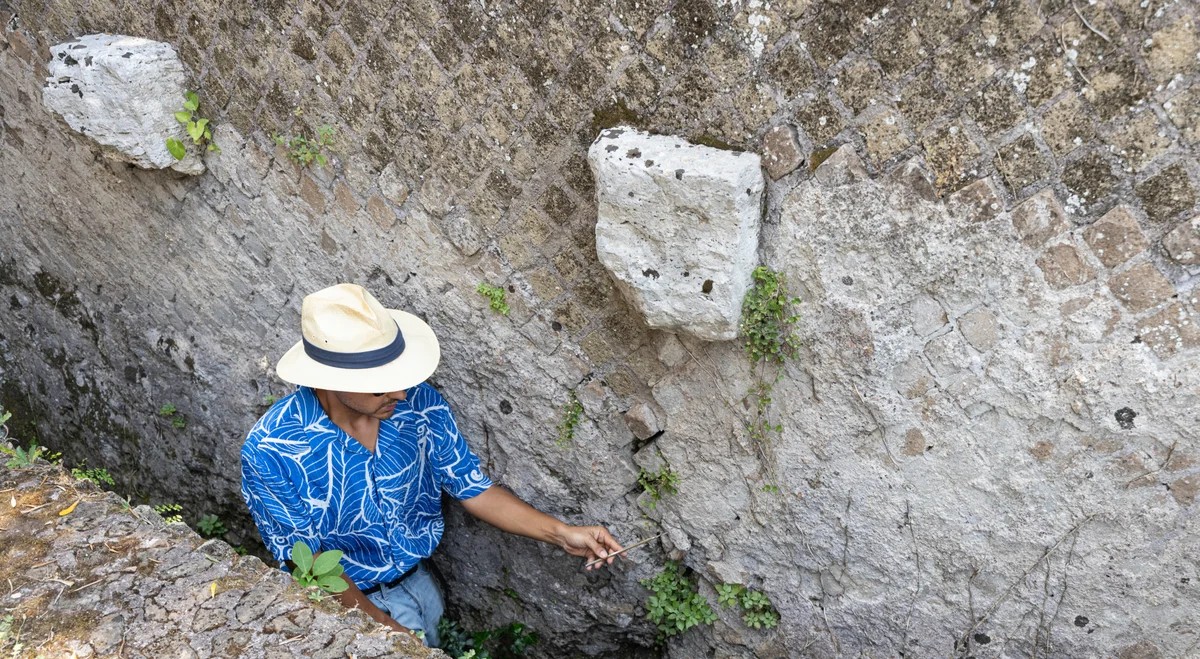
27 kilometers east of Rome sits a communal toilet.
The concrete there is nearly 1900 years old. It outlasted the empire. It survived centuries of weather. It even lasted longer than Italy’s streak of World Cup failures.
Impressive for a bathroom.
Scientists are using this specific latrine to solve a puzzle. Why does some Roman concrete survive millennia? A new study in Science Advances explains it. The material keeps changing. It actually gets stronger after being poured.
For years researchers thought it was just good chemistry. Romans mixed lime with volcanic ash.
“You can think of it as them using volcanoes,” says Maria Juenger. “Instead of our high-temperature kilns.”
But there was more. In 2023 researchers looked at the white chunks in the mix. They were dismissed before as sloppy work. Wrong. They called them lime clasts. They heal cracks.
Here is how it works. Water hits a crack. It dissolves calcium from the white chunks. That calcium turns back into calcium carbonate. It seals the gap. Self-repair.
Studying this is hard. Most ruins are patched up by conservators. You need untouched material.
That is the beauty of this spot.
“Nobody restores a latrine.”
Paulo Monteiro works at Berkeley. He wrote the new paper. He points out that the material sat alone. No humans bothered it for 19 centuries. Nature ran the experiment.
Xiaohong Zhu from Beijing University led the actual study. The team used X-rays. They looked down to nanometer scale.
They saw something new.
Carbonation. Carbon dioxide from the air entered the concrete. It reacted with calcium compounds. It created calcite. Hard crystals. Woven through the mix. Binding everything tight.
“We finally see how it binds.”
This changes how we view carbonates. Admir Masic from MIT notes the shift. They aren’t marginal players. They are fundamental.
The findings promote carbonates to main cast.
So can we just build better concrete now?
Not quite.
There is a big problem. Steel.
Modern concrete holds steel bars. Romans did not. Fresh concrete protects that steel with high alkalinity. But carbonation lowers pH.
It ruins the protection.
“The same reaction that strengthened Rome is a threat to us,” says Monteiro.
There is a trade-off. The construction industry emits 8 percent of global carbon. Capturing that carbon in concrete is smart. But the process is slow. At Hadrian’s Villa it took centuries.
Engineers have a choice now. Durability or speed?
The balance is tricky. The hope is that these scanning techniques will help. They can optimize the mix.
Back in Tivoli the latrine remains. The experiment is still running.
Nobody is checking it today. Which is fine.
The concrete knows what to do.