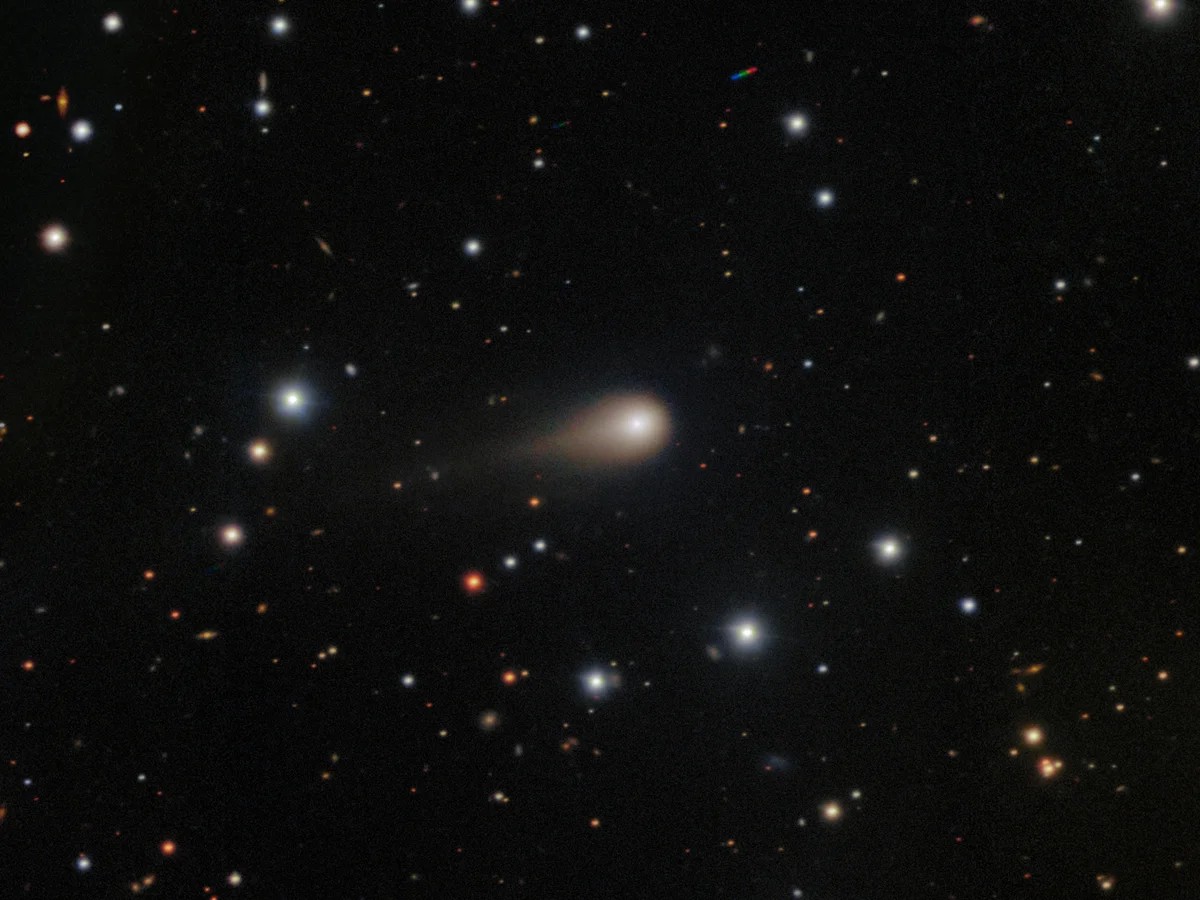
As the interstellar visitor 3I/ATLAS retreats into the darkness of deep space, it leaves behind a scientific puzzle that suggests our own solar system might be an outlier in the cosmos. Recent observations of this comet have revealed chemical signatures so unusual that they force astronomers to reconsider how planetary systems form and evolve.
The “Heavy Water” Discovery
Using the Atacama Large Millimeter/submillimeter Array (ALMA) in Chile, astronomers analyzed the gas being vented by the comet as it passed near the sun in late 2025. By studying radio waves, they detected a massive concentration of “heavy water.”
While standard water consists of two hydrogen atoms and one oxygen atom, heavy water contains deuterium —a heavier isotope of hydrogen that includes a neutron. The presence of deuterium acts as a cosmic “thermometer”:
– High deuterium levels indicate that the water formed in extremely cold environments.
– Low deuterium levels suggest warmer, more thermally active environments.
The findings, published in Nature Astronomy, revealed that 3I/ATLAS possesses a heavy water fraction approximately 30 times greater than that of typical comets found in our solar system. This discovery was later bolstered by independent observations from NASA’s James Webb Space Telescope (JWST).
Why This Matters: A Different Kind of Birth
The extreme enrichment of deuterium suggests that the environment where 3I/ATLAS originated was fundamentally different from our own. Scientists have proposed two primary theories for this anomaly:
- A Colder Cradle: The comet may have inherited its composition from a “primordial prestellar environment”—the gas cloud that formed its host star—which was much colder and more isolated than the cloud that birthed our sun.
- Limited Thermal Processing: Unlike our solar system, where heat from the sun and moving protoplanetary disks “cooks” and alters comets, 3I/ATLAS likely experienced very little thermal change, preserving its primitive, icy state.
Furthermore, the comet’s age is a staggering factor. Estimates suggest 3I/ATLAS is between 7 and 10 billion years old, making it significantly older than our solar system, which formed only about 4.5 billion years ago.
A Growing Pattern of “Interstellar Weirdness”
3I/ATLAS is not the first visitor to defy expectations. Astronomers have noted a pattern of strange behavior among interstellar objects:
– 1I/ʻOumuamua (2017): Its bizarre shape and movement led scientists to speculate it might be a frozen nitrogen iceberg from a frigid system.
– 2I/Borisov (2019): While more similar to our own comets, it still provided a rare glimpse into external chemistry.
The fact that these visitors continue to show “alien” characteristics suggests that the chemical blueprints of other star systems do not always match our own.
The Future of Comparative Astronomy
The ability to perform such precise spectroscopic measurements is a relatively recent breakthrough. As next-generation facilities like the Vera C. Rubin Observatory come online, the frequency of interstellar detections is expected to rise. This will allow astronomers to move from studying “oddballs” to conducting systematic, direct comparisons between our solar system and the rest of the galaxy.
“Either the solar system is weird and unique or planet formation in other stars is not quite understood,” says astronomer Darryl Seligman.
Conclusion
The anomalous chemistry of Comet 3I/ATLAS serves as a profound reminder that our solar system’s composition may be an exception rather than the rule. As we continue to intercept these interstellar messengers, we may find that the “standard” model of planet formation requires a significant rewrite.