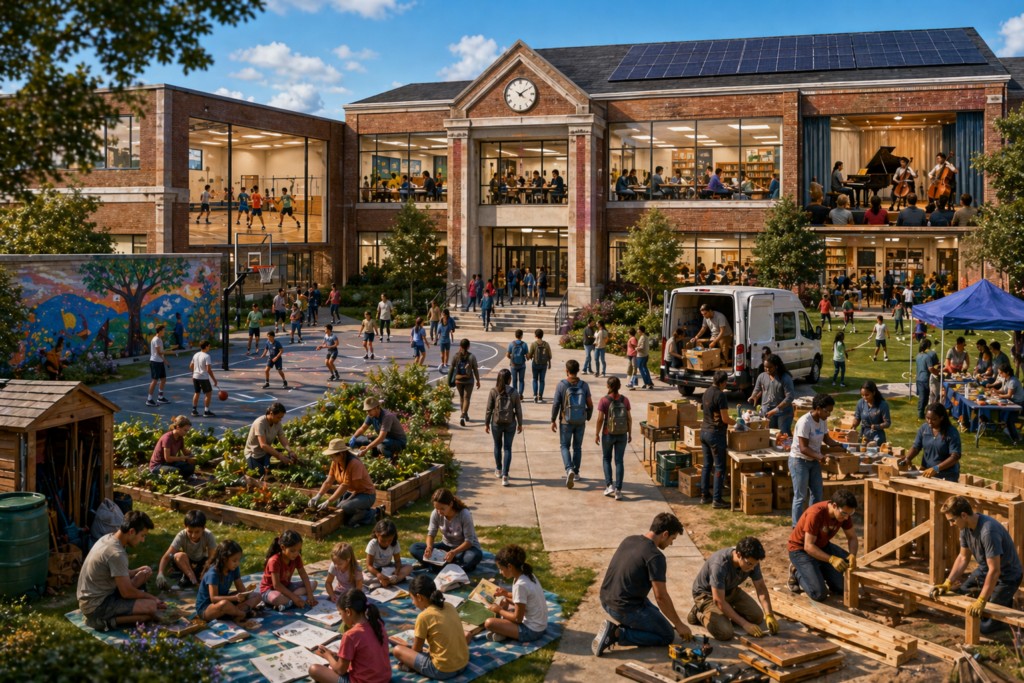
For most children, school is the most significant environment outside of the home. Over fifteen thousand hours are spent within these walls from kindergarten through high school—a period that fundamentally shapes who they will become. Yet, despite this immense responsibility, the physical design of the modern school is often fundamentally at odds with its mission.
The Crisis of Underutilization and Isolation
The traditional American school building is a relic of a “factory model” of education, designed for efficiency and control rather than inspiration or community integration. This design has led to two critical failures:
- The “Prison” Effect: Driven by increasing security concerns, modern schools are often characterized by perimeter fences, gates, and scanners. While intended to protect, this architecture creates a sense of isolation, turning schools into fortresses rather than community pillars.
- Wasted Potential: Because of this rigid, high-security design, the average school building is utilized only 20% of the time. For four out of every five hours, these massive investments in infrastructure sit idle, failing to serve the people who need them most.
If we aim to foster critical thinking, creativity, and individuality, we cannot continue to house students in rows of identical, lifeless rooms. To truly evolve, we must move toward a “Baaham” learning ecosystem.
The Baaham Philosophy: Mutual Influence
The term Baaham describes a relationship of reciprocity—the idea that we shape our environment, and in turn, our environment shapes us. A Baaham school is not a closed loop; it is a permeable entity that breathes with its neighborhood.
Designing such a space requires “zooming out” to view the school as part of a larger social fabric. Instead of building redundant facilities, a Baaham school asks:
* What local businesses can provide internships or hands-on learning?
* What public libraries, parks, or laboratories can students access?
* How can the school utilize existing community infrastructure to deepen the educational experience?
A Collaborative Design Process
Building a Baaham school moves away from arbitrary decisions—like choosing hallway colors—and toward “emotional ergonomics.” This means designing spaces that prioritize how people feel and how they interact.
The process is deeply inclusive, involving students, teachers, parents, and administrators. Rather than copying existing models found online, educators are encouraged to reflect on the specific experiences they want to create. This collaborative approach ensures that architects, lighting designers, and engineers work from a single, unified vision: a master list of criteria that prioritizes learning outcomes over aesthetic trends.
The School as a Community Pillar
A Baaham school functions as a hub for the entire community, creating symbiotic relationships that benefit all generations:
1. Intergenerational Connection
By integrating senior housing onto campus, schools can foster unique social dynamics. Students gain experience in caretaking and administration, while elders benefit from social engagement and vitality. This creates a cycle of mutual respect and shared learning.
2. Economic and Professional Synergy
Schools can act as incubators for local growth. For example, hosting startup offices on campus allows students to work alongside entrepreneurs, gaining real-world experience in marketing, finance, and design in exchange for subsidized space.
3. Wraparound Social Services
A school can serve the practical needs of its neighborhood by hosting health clinics, food pantries, or adult education workshops. When parents can access essential services on-site, they are more likely to remain engaged in their child’s educational journey.
4. Ecological Living Labs
Rather than just teaching environmental science from a textbook, a Baaham school is the textbook. Through rainwater collection, composting systems, and visible energy sensors, the building itself becomes a didactic tool, teaching students how to live sustainably through daily interaction.
Breaking the Mold: Variety and Agency
Inside the walls, the Baaham model rejects the “one-size-fits-all” classroom. To prevent the school day from feeling like a monotonous grind, the design emphasizes variety :
- Diverse Learning Zones: From quiet corners for solitary study to open areas for collaborative projects, spaces are differentiated to match different learning styles.
- Movement and Agency: Instead of rigid, straight-line hallways, the architecture encourages “meandering paths,” giving students a sense of agency over how they move through their day.
- Stimulating Environments: By varying the atmosphere—using different textures, lighting, and layouts—the design keeps students alert and engaged, preventing the mental fatigue common in traditional settings.
Conclusion
The transition from a closed institution to a Baaham ecosystem transforms the school from a static building into a dynamic community engine. By breaking down the walls between the classroom and the real world, we create environments that don’t just house students, but actively empower them.