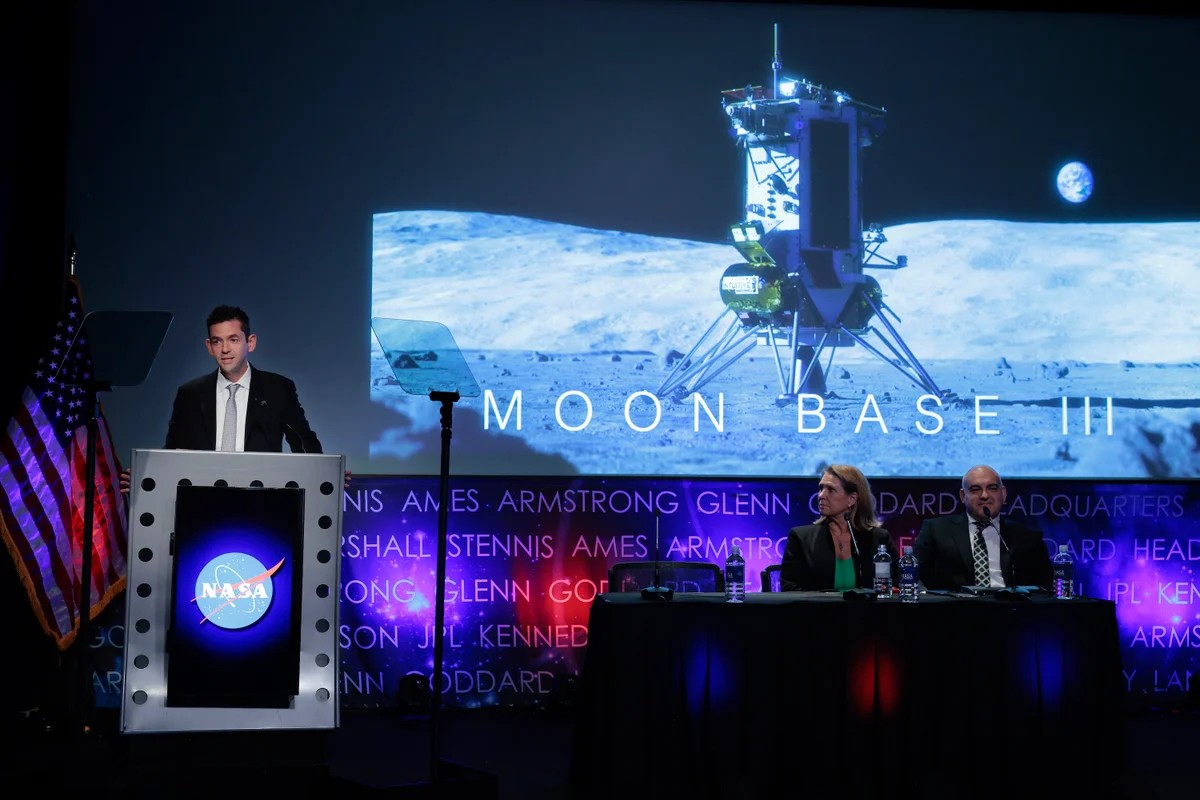
The stage lights hit hard Tuesday at NASA HQ. Jared Isaacman was there. The administrator, not an astronaut this time, though he has that background. He unveiled the next step for a permanent home on the Moon. Not next week. The 2030s still. But the gears are turning.
It isn’t just talk anymore.
Isaacman promised confidence. Purpose. The kind only NASA can muster. And we are just getting started, he said. It’s a line that sounds better on a stage than in a press release.
This approach is loud. Deliberate. A far cry from the obscure bureaucratic memos of years past. NASA wants the public watching. It wants the private sector to know who’s calling the shots. And it’s handing out checks to prove it.
Bezos Takes the Lead
The big news? Jeff Bezos’ Blue Origin is suddenly everywhere.
For years, everyone thought SpaceX and Elon Musk would dominate the lunar landscape. Starship was the presumed champion. Then Starship delayed. Starship stumbled. Now Blue Origin’s Mark 1 lander is ferrying science gear to the Moon’s south pole. The intended site for the future outpost.
Blue Origin isn’t just doing cargo.
Its Mark 2 crew lander is on the table for Artemis IV in 2028. That’s the mission that sends astronauts to stay. SpaceX still has a variant of Starship in the mix, sure. But uncertainty has grown. Who wins the contract remains fuzzy. The race feels different now.
We’re trying to stay humble. Things are looking good.
John Couluris at Blue Origin knows the stakes. Their Mark 1 lands in Shackleton Crater this fall. A tech demo for NASA, labeled “Moon Base I.” It carries a 3D camera system and laser arrays. It checks the ground. If it works, the Mark 2 for astronauts gets a massive vote of confidence. The parts are identical, after all.
Rovers and Deadlines
The White House pushed harder last December. A Trump administration executive order demanded a crewed landing by 2028 and a lunar outpost by 20 nuclear-powered base. That nuclear detail matters. It implies scale.
To meet this, NASA handed over $200 million each to two firms: Astrolab in California and Lunar Outpost in Colorado.
They’re building rovers. Lunar terrain vehicles (LTVs) for the Artemis missions. Solar-powered. 10 kilometers an hour. 200 kilometers range. Autonomous. Robert Pickle runs the LTV program. He hopes to fly both vehicles. One to scout ahead of Artemis IV. Maybe one after. Blue Origin will drop them off.
It’s a rush.
Artemis III next year? No astronauts landing yet. Just a test flight. High-stakes orbit check for whichever lander wins the trust. The four astronauts will be named on June 9 in Houston. The clock is ticking.
The Surge Continues
It doesn’t stop with Blue Origin.
NASA also outlined “Moon Base II” and “Moon Base III.” Launches later this year. Another cargo surge. Astrobotic’s Griffin lander brings an Astrolab rover, called FLIP. Then Intuitive Machines sends its Nova-C lander up. It carries the Lunar Vertex from Johns Hopkins. Studying those strange bright spots. Lunar swirls. Places shielded from radiation. Maybe good for shelter.
Why do we do this?
We are experimenting on the things we need to build permanent infrastructure.
Carlos García-Galán, NASA’s moon base chief, gets real. The plan covers hundreds of square kilometers eventually. He admits the next phase is the hard part.
Delivering on time. Keeping the missions successful, back to back, without failure. It is supposed to be easy on paper. The moon does not care about timelines.