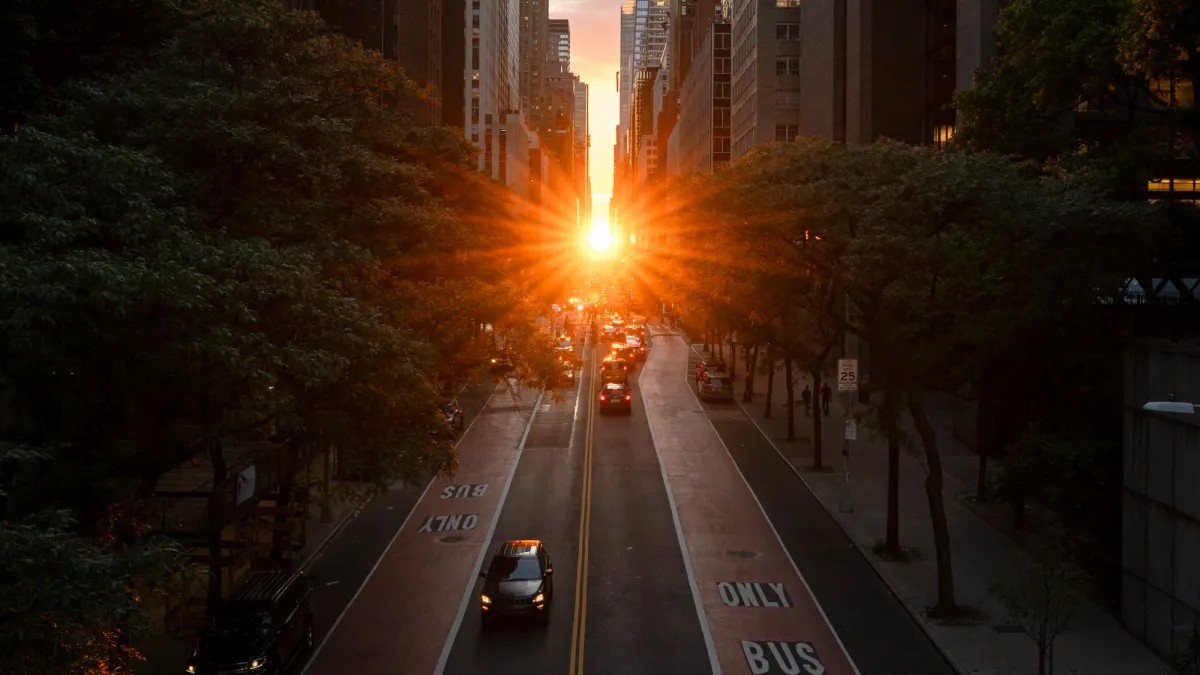
Stop scrolling if you think this solar trick belongs exclusively to the boroughs. 🚫
You can find the sun aligning with the street grid where you live. You just have to know where to look.
For a handful of nights in late spring, Manhattan gets washed in gold. The light hits the avenues straight on. Tourists swarm. Locals take selfies. We call it Manhattanhenge. It starts May 28 and runs through July 12.
But here is the thing.
You do not need to be in New York.
You do not even need to be in America.
Hengefinder can tell you when your local street hits the sweet spot.
Meet Hengefinder
Data scientist Victoria Ritvo built the site. John Pribyl, a software engineer, handled the app side of things. They wanted to make the math accessible. Because the math is actually… well. It involves angles.
Specifically. Three of them.
- Road bearing – The angle of your street relative to true north.
- Sun azimuth – Where the sun sits on the horizon at sunset.
- The Match – When those two angles intersect.
It sounds like homework. It is. But Ritvo and Pribyl did the heavy lifting for us.
“Having Hengefinder active means hences are now explorable outside of Manhattan,” Ritvo notes. “I’m intrigued by the Haarlemkertrekvaart… a canal which traces the southern edge Westerpark Amsterdam.”
You don’t have to solve for X. You just type in an address. The tool handles the rest.
Interestingly? Much of Europe gets skipped.
Medieval streets are a mess for this kind of thing. They twist. They turn. They rarely offer a clean grid line for the sun to shoot down like a laser. Canals, though? Canals work. Water reflects light beautifully. Amsterdam might have had this event twice a year for 400 years. No one really looked before the algorithm.
How it works
The sun never sets in the same place twice. Not really. Its path shifts with the seasons. Drifts north. Then south.
Usually? That arc misses your street completely.
But if your street is angled right, there is a day. Or maybe two. When the sun drops exactly behind the buildings ahead. Or reflects straight down a canal.
Neil deGrasse Tyson named the original one “Manhattanhenge” in 1997.
He drew a line between those steel canyons and Stonehenge in England. Ancient humans stacked those massive rocks between 3100 and 1600 BC. They wanted the solstice sun to hit the altar stone. Deliberately. Carefully.
The guys who built Manhattan’s grid in 1811? They didn’t plan for light shows. It is just geometry. Happenstance. Urban luck.
But the phenomenon isn’t limited to NYC.
Chicagohenge hits around the equinoxes in spring and fall. Baltimore has its own window in March and September. Torontohenge swings by in February and October.
The sun is moving now.
Your street might catch it next Tuesday.
Or not.