On May 1, 1893, Chicago transformed into a city within a city. Two hundred thousand spectators crowded the grounds to witness the opening of the “White City,” a sprawling complex of gleaming structures that signaled a new era for America. The event was not merely a celebration; it was a deliberate showcase of industrial might and cultural confidence, drawing dignitaries from around the globe and even President Grover Cleveland.
The official inauguration occurred at precisely 12:08 p.m. When President Cleveland pressed a single golden telegraph key, he did more than start a ceremony—he triggered a cascade of machinery across the 630-acre site. As The Salt Lake Herald reported, this small act “started the mighty machinery, rushing waters and revolving wheels,” effectively ushering in the electric age. The World’s Columbian Exposition was officially open, marking a pivotal moment where technology moved from experimental novelty to public utility.
A Showcase of Firsts
The 1893 Fair is often remembered for its grandeur, but its true significance lies in its innovations. It served as a testing ground for technologies that would define the 20th century. The exposition featured a staggering list of “firsts” that reshaped daily life:
- The Ferris Wheel: The first of its kind, offering a new perspective on amusement and engineering.
- Electric Lighting: The first large-scale use of electric lights, demonstrating the reliability and beauty of electricity over gas.
- Commercial Cinema: The first commercial movie theater, introducing motion pictures as a public entertainment medium.
- Household Conveniences: The debut of the first automatic dishwasher and even the first brownies (created by a hotel cook to satisfy a request for a portable, easy-to-eat dessert).
These innovations were not isolated curiosities; they represented a shift toward efficiency, leisure, and mass consumption. The fair proved that technology could be both powerful and accessible to the general public.
The Vanishing Legacy
Today, the physical remnants of the White City are scarce. Most of the fair’s buildings were temporary, constructed from a plaster-like material called “staff” over steel frames, designed to be dismantled after the event. The only permanent structure built specifically for the fair was the Art Institute of Chicago.
However, the fair’s influence persists in ways that are often overlooked:
* The Palace of Fine Arts, one of the fair’s most stunning buildings, was reconstructed and now houses the Museum of Science and Industry.
* In Jackson Park, where much of the fair took place, only a small wooded island and a 24-foot replica of the Statue of the Republic remain. These quiet markers are often passed by daily commuters who are unaware of their connection to one of history’s most impressive spectacles.
Why It Still Matters
The 1893 World’s Fair did more than display inventions; it embedded them into the fabric of American culture. Its legacy is not just in the few remaining structures, but in the mundane actions of modern life. Every time you turn on a light switch, zip up a jacket, or chew a piece of Juicy Fruit gum, you are interacting with technologies or concepts that found their public debut or significant boost at this event.
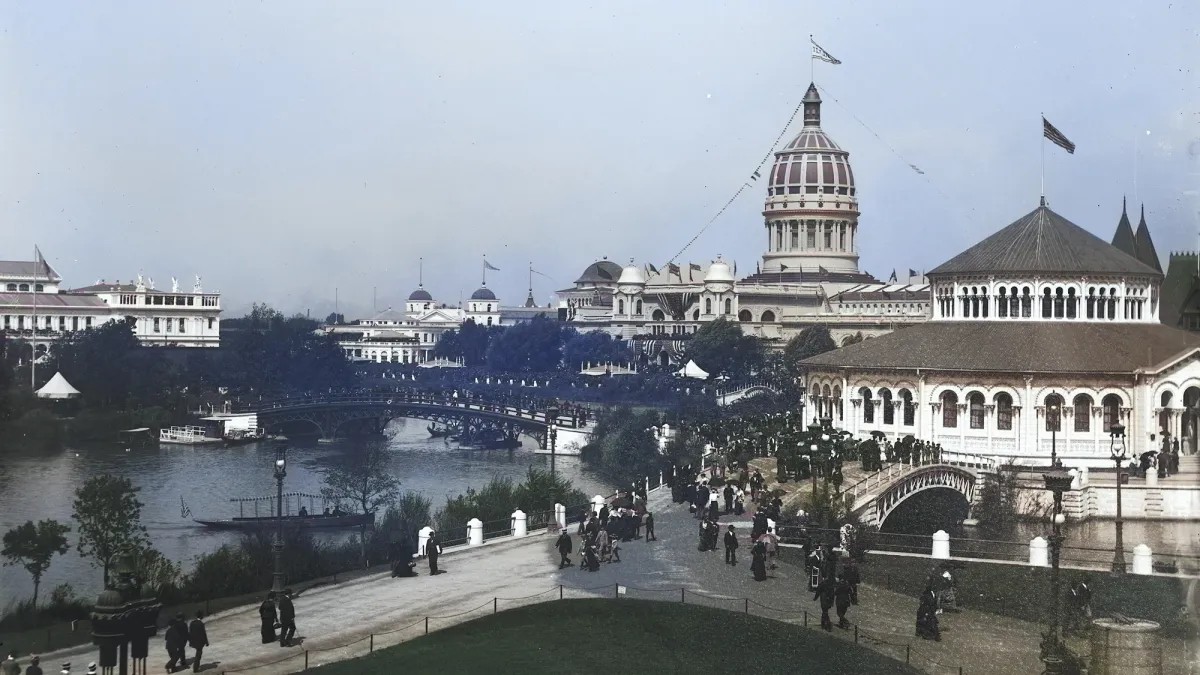
Rare colorized photographs of the fair offer a glimpse into this vanished world, allowing us to visualize the scale and ambition of the Chicago Fair. These images remind us that the modern world was not inevitable, but constructed—literally and figuratively—by the visionaries of 1893.
The White City was a temporary illusion, but its impact on technology, culture, and urban life was permanent. It remains a testament to the power of innovation to reshape society in a single moment.