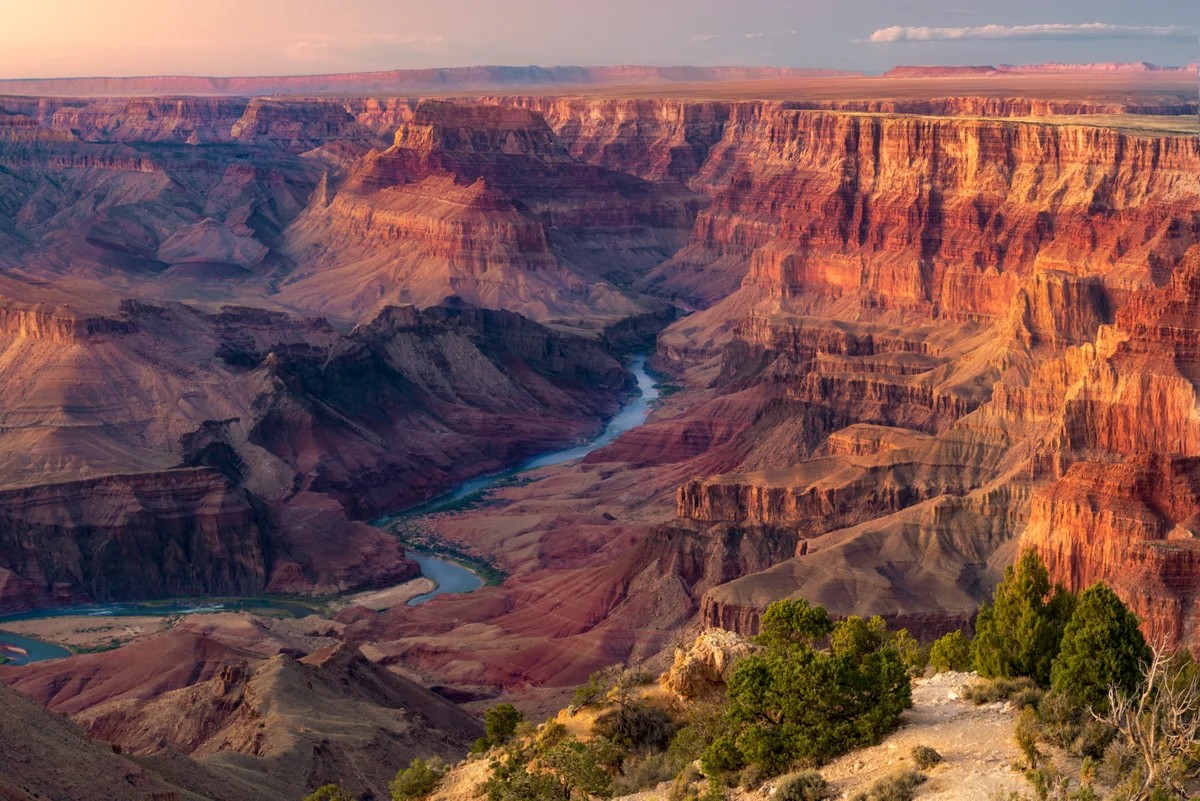
The origin of the Grand Canyon has long been one of geology’s most enduring mysteries. While the canyon is a global icon of natural beauty, scientists have spent decades debating the fundamental mechanics of its creation: How did the river find its path, and when did it begin carving such a massive chasm?
A new study published in the journal Science provides a compelling piece of the puzzle, offering fresh support for a controversial theory known as the “spillover hypothesis.”
The Spillover Hypothesis: A Massive Lake as a Catalyst
For years, geologists have debated whether the Colorado River carved its path through gradual erosion or through a sudden, dramatic event. The new research suggests a middle ground involving a massive ancient lake.
The study proposes that approximately 6.6 million years ago, an ancestral version of the Colorado River was flowing into the Bidahochi basin in northern Arizona. As this basin collected water, it formed an enormous lake. Eventually, the water level rose high enough to breach a geological barrier—the Kaibab uplift—and “spilled over” into a new channel. This overflow would have established the river’s current course, providing the massive volume of water and energy required to begin sculpting the Grand Canyon.
The “Pink Grain” Clue
The breakthrough came from a keen observation by geologist Brian Gootee of the Arizona Geological Survey. He noticed a striking similarity between sand deposits found downstream of the Grand Canyon and those located in the Bidahochi basin: both contained distinctive, rounded pink grains.
To verify this connection, researchers used a sophisticated method:
– They dated durable zircon crystals found within the sand.
– The results confirmed that both sets of grains originated from the same source: the rocks throughout the Colorado River watershed.
– This link proves that the Bidahochi basin once held water from the same river system that eventually carved the canyon.
“It’s clear that this lake had to have played a role in the formation of the canyon,” says co-lead author Ryan Crow, a geologist with the U.S. Geological Survey.
A Scientific Debate: Sudden Flood or Gradual Flow?
While the evidence for the lake is strengthening, the scientific community remains divided on the nature of the event and the sequence of geological changes.
The Arguments for Spillover
Proponents like Crow argue that the spillover mechanism is the most “simple and likely” explanation compared to other theories, such as:
– Cave Collapse: The idea that water dissolved underground networks until the surface collapsed.
– Stream Capture: The theory that a smaller drainage system eroded upstream until it “captured” the Colorado River.
The Skeptics’ View
Not all geologists are convinced. Karl Karlstrom of the University of New Mexico notes that while a proto-Colorado River certainly entered the Bidahochi, it is unproven that a lake large enough to cause such a spillover ever existed.
Furthermore, Karlstrom suggests the existence of a “paleocanyon” —an older canyon that may have already cut through the Kaibab uplift. If an existing path already existed, the river would have flowed through it rather than pooling into a massive lake, potentially invalidating the spillover theory.
Filling the “Missing Five Million Years”
Regardless of whether the spillover was a singular catastrophic flood or a gradual process, this study solves a significant chronological problem.
Geological records show that the Colorado River was flowing through western Colorado 11 million years ago, but it didn’t appear at the edge of the Grand Canyon until 5.6 million years ago. This left a five-million-year gap in the river’s history. By placing the river in the Bidahochi basin 6.6 million years ago, researchers have finally found where the river was “hiding” during that missing epoch.
Conclusion
By linking the Bidahochi basin to the Grand Canyon through ancient sand deposits, this research provides a vital piece of the geological puzzle, narrowing down the timeline and location of the river’s journey toward its current path.