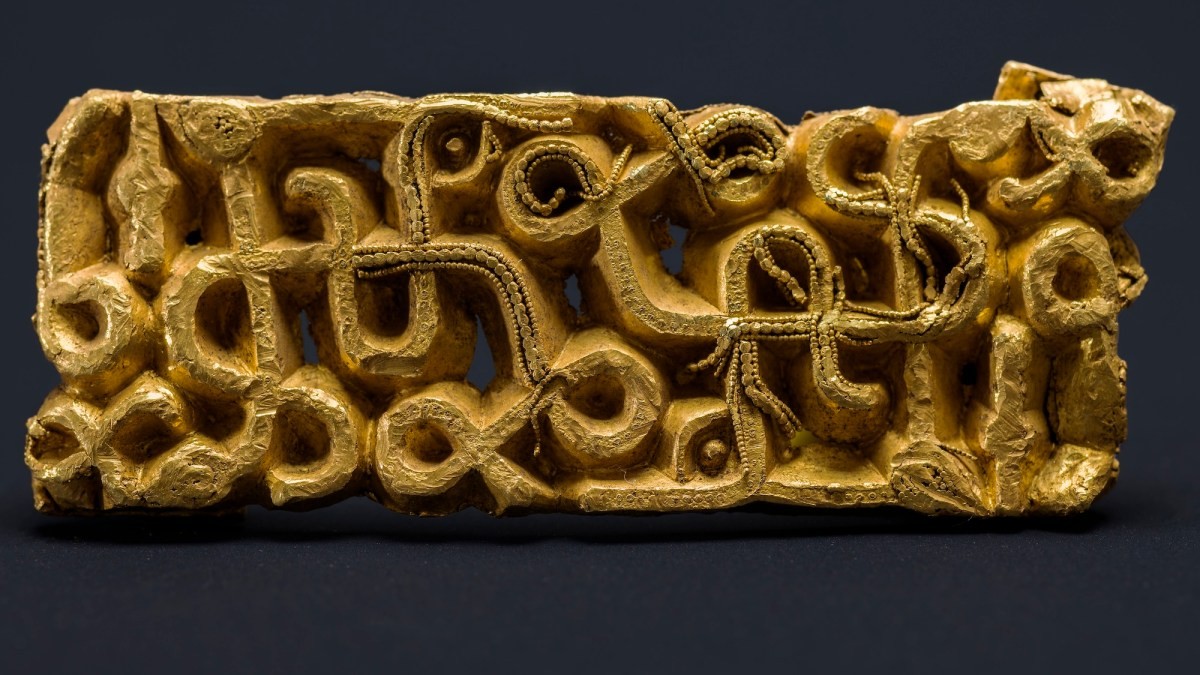
A casual morning walk in the hills of Norway has yielded a rare archaeological treasure: a 1,500-year-old sword scabbard crafted from gold. Discovered by a hiker examining an uprooted tree, the artifact offers new insights into the power structures and religious practices of the Migration Period (300s–600s CE).
According to archaeologists from the University of Stavanger, the find is not just a piece of jewelry, but a significant historical marker. The scabbard belonged to a high-status individual—likely a chieftain or prominent leader—and provides evidence that such leaders actively wielded their status symbols in daily life and battle, rather than keeping them solely for ceremonial display.
A Rarity in Northern Europe
The discovery was made in the district of Austrått, near Norway’s southwest coast. The artifact itself is small but dense with historical value:
- Dimensions: Approximately 2.4 inches wide and less than one inch tall.
- Weight: Roughly 1.15 ounces of gold.
- Rarity: Only 17 similar pieces are known to exist across all of northern Europe.
“The odds of finding something like this are minimal,” said Håkon Reiersen, an archaeologist at the University of Stavanger. The sheer rarity of the object underscores its significance; it is not merely a lost accessory, but a surviving fragment of elite identity from a turbulent era in European history.
Signs of Power and Use
Despite centuries underground, the scabbard retains intricate details that speak to its craftsmanship and purpose. Researchers identified artistic styles characteristic of the Migration Period, including:
- Symmetrical illustrations of animals and potential human-animal hybrids.
- Remnants of filigree embellishments.
- Finely beaded gold wiring designed to create a shimmering effect.
What makes this specific find distinct from other similar relics is the evidence of heavy usage and wear. While many decorative swords from this era were purely ceremonial—symbols of status kept in storage or displayed during rituals—this scabbard shows signs that its owner regularly carried it. This suggests the leader who possessed it did not just parade his wealth but likely wielded the weapon in battle or wore it prominently in public settings to assert authority over his followers.
A Religious Offering, Not an Accident
The context of the discovery is as important as the object itself. Archaeologists determined that the scabbard was not accidentally dropped or discarded. Instead, it had been carefully placed inside a crack in the bedrock.
This deliberate placement strongly indicates that the item was a religious offering to the gods.
The 6th century was a time of significant instability for communities in this region, marked by economic, agricultural, and cultural trials. For a leader to give up such a valuable and power-signifying object was a profound act. It served a dual purpose:
1. Reiterating Power: The ability to sacrifice such wealth demonstrated the leader’s immense resources.
2. Seeking Divine Aid: The offering was likely a plea for protection and stability during difficult times.
Why This Matters
This discovery provides a tangible “puzzle piece” for understanding the social dynamics of the Hove region during the Migration Period. It challenges the assumption that elite weaponry was strictly ceremonial, suggesting instead that power was performed actively through daily use. Furthermore, the ritual deposition of the item highlights the complex relationship between political authority and religious belief in early Norwegian society.
“We just have to say a big thank you to a very attentive hiker for the fact that we now have a new puzzle piece linked to the power center at Hove,” said Kristin Armstrong-Oma, museum director at the University of Stavanger.
The find reminds us that history is often hidden in plain sight, waiting for the right moment—and the right observer—to bring it back into the light.