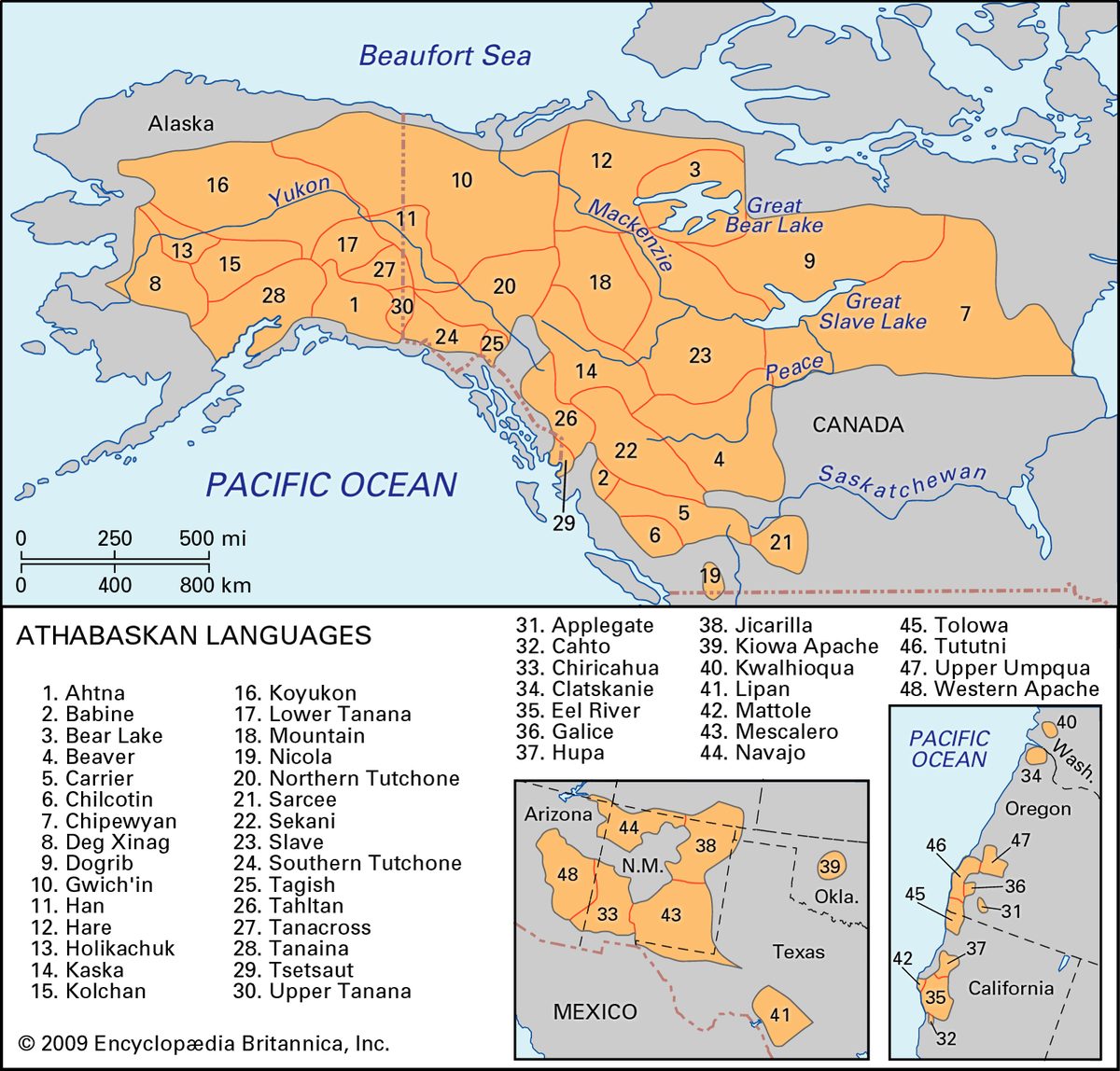
Athabaskan languages are a sprawling family of North American indigenous tongues. The count is messy, but roughly 200,000 speakers use these languages across the continent today. That number sounds significant, but it hides a stark reality: one language, Navajo, carries the weight of the entire family in terms of raw numbers.
The geography of Northern Athabaskan
This is the biggest chunk of the family. More than 20 languages are scattered across a massive stretch of subarctic North America. The map starts in western Alaska, pushes east to Hudson Bay, and drops south into Alberta and British Columbia. It is an immense region. The languages are distinct yet related, serving communities that have navigated these landscapes for millennia.
Where did Pacific Coast Athabaskan go?
Gone. Or nearly so. This branch consisted of six languages. All are now extinct or on the brink of disappearance. This highlights a painful truth about language survival: geographic spread does not guarantee longevity. The Pacific Coast branch serves as a cautionary tale for the rest of the family.
Why Navajo stands out
Apachean languages make up the final major branch. These are closely related tongues spoken in the southwestern U.S. and northern Mexico. The group includes Navajo and the various subdivisions of Apache.
In the early 21st century, Navajo had approximately 150,000 speakers.
That is a massive disparity. Navajo has more speakers than every other indigenous language in the U.S. and Canada combined. Why? Historical resilience, community revitalization, and the sheer demographic density of Navajo Nation territory compared to the dispersed, often isolated communities of Northern Athabaskan speakers.
What does this mean for learners?
If you are looking to study an Athabaskan language, Navajo is the only one with a robust, modern infrastructure for learning. Textbooks, online courses, and media exist. For the Northern Athabaskan or Apachean languages, resources are scarcer, often reliant on community-led projects and elder-led teaching.
The family is alive, but it is unevenly so. Understanding this landscape helps explain why some indigenous languages thrive while others fade into silence.