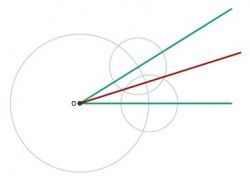
A bisector is the ray that splits an angle into two equal halves, starting from its vertex. In geometry, this line creates two angles of identical measure. It divides the original angle with precision.
Why the bisector matters in basic geometry
Think of a corner in a room. If you want to place a shelf exactly in the middle of that corner, you are looking for the bisector. It is not just a theoretical concept. It solves real spatial problems.
Why do we care about this division? Because symmetry often simplifies calculations. When you know an angle is bisected, you instantly know the relationship between the two new angles. They are congruent. No guessing required.
This property holds true regardless of the original angle’s size. A 90-degree right angle becomes two 45-degree angles. A 120-degree angle becomes two 60-degree angles. The math is straightforward, but the construction method requires careful tool use.
The bisector ensures an exact division of the angle original.
Which tools do you need to construct one?
You need two things: a compass and a straightedge. No protractor. That is the key. We are not measuring; we are constructing.
Here is the standard process:
- Place the compass point on the vertex of the angle.
- Draw an arc that intersects both sides of the angle.
- Without changing the compass width, place the point on one intersection mark and draw an arc inside the angle.
- Keep the same width, move the point to the other intersection mark, and draw a second arc.
- The two new arcs will cross at a point.
- Draw a ray from the vertex through that crossing point.
That final ray is your bisector.
Does it look complicated? It is not. Each step relies on the fixed radius of the compass. The arcs ensure that the distances from the vertex remain consistent, which guarantees the equality of the resulting angles.
Where does this apply in real-world scenarios?
Beyond classroom exercises, bisectors appear in navigation, engineering, and design. Think about how a lighthouse beam might be divided to cover specific sectors. Or how a carpenter checks if a miter cut is exactly 45 degrees for a picture frame.
In digital design, bisectors help with aligning elements. When you are adjusting a logo or a layout, finding the exact center of a visual angle ensures balance. It is a practical skill for anyone working with spatial relationships.
The core idea remains simple. You start at the vertex. You create reference points. You find the intersection. You draw the line. The result is two equal parts.
Understanding how to draw a bisector is a foundational step in geometry. It teaches precision. It reinforces the link between physical construction and mathematical proof. And it gives you a reliable method to split any angle, no matter how large or small.
How to draw an angle bisector with a compass
The most straightforward method uses a compass. Precision matters here, but the process is mechanical.
- Place the compass point on the vertex of the angle.
- Draw an arc that crosses both sides of the angle. You now have two intersection points, one on each side.
- Keep the compass opening exactly the same. Move the point to the first marked intersection. Draw an arc.
- Move the point to the second marked intersection. Draw another arc.
- These two new arcs will cross. That crossing point is your reference.
- Draw a straight line from the original vertex to that crossing point.
That line is the bisectrix. It splits the angle into two identical halves.
Think of an 80-degree angle formed by two meeting lines. The bisectrix cuts it right down the middle. You end up with two 40-degree angles. Simple geometry. No guesswork.
Why triangle bisectors intersect at the incenter
The logic stays the same in a triangle, but the scope expands. You can bisect internal angles or external ones.
When you bisect all three internal angles of a triangle, the lines don’t just float there. They meet at a single point. That point is the incenter.
The incenter is the center of the circle inscribed within the triangle.
It touches all three sides. This specific property distinguishes it from other centers. The incenter is equidistant from all three sides of the triangle.
Bisectrix versus perpendicular bisector
People mix these up constantly. They are different tools for different jobs.
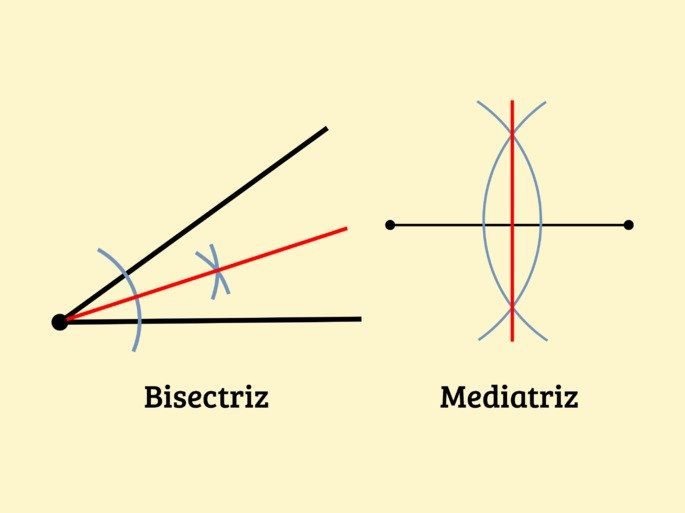
An angle bisectrix splits an angle into two equal parts. It starts at a vertex.
A perpendicular bisector (mediatriz) is different. It cuts a line segment in half at a 90-degree angle. It doesn’t care about angles at vertices. It cares about the midpoint of a side.
Which one do you use?
– Need to split an angle? Use the bisectrix.
– Need to find the center of a circle passing through three points? Use perpendicular bisectors of the triangle sides.
The intersection of perpendicular bisectors is the circumcenter. The intersection of angle bisectors is the incenter. One deals with circles touching sides. The other deals with circles passing through vertices.
Understanding that distinction saves hours of frustration in geometry problems.
How to draw a perpendicular bisector with a compass
You need a compass and a straightedge. That’s it. No fancy tools required. Just remember the compass stays open the exact same distance for both arcs. Change it, and your line won’t be perpendicular.
Here’s the process:
- Place the compass point on one end of your segment.
- Open it wider than half the segment’s length.
- Draw an arc that crosses over the line.
- Keep the compass width exactly the same.
- Move the point to the other end.
- Draw a second arc so it cuts through the first one.
- You’ll have two intersection points.
- Draw a straight line through them.
That line is your perpendicular bisector. It cuts the segment into two equal halves at a 90-degree angle.
Why the perpendicular bisector matters in triangles
This isn’t just about splitting lines. The property becomes powerful when you look at triangles.
Take any triangle. Draw the perpendicular bisector for each of its three sides. They all meet at one single point. That point is the circumcenter.
What makes the circumcenter special? It’s equidistant from all three vertices. That means if you draw a circle from that center with a radius equal to the distance to any corner, the circle will pass through all three corners exactly.
That’s the circumcircle.
So why does this matter for students? Because it connects two concepts: segment properties and circle geometry. If you understand how the bisector works, you understand where the center of the circumcircle lives.
Practical tips for accuracy
Compass drift is the biggest enemy here. If your compass point slips, your arcs won’t intersect where they should. Use a steady hand. Press firmly but don’t twist the tool.
Also, make sure your arcs actually cross. If they don’t, your compass wasn’t open wide enough. Redo it.
You might wonder which point to start with. It doesn’t matter. Either endpoint works. The result is identical.
The key is consistency. Same opening, same pressure, same care.
The perpendicular bisector is the only line that both cuts a segment in half and meets it at a right angle.
That definition covers everything. If a line does both, it’s the bisector. If it does only one, it’s not.
For parents helping kids: don’t rush this. Let them practice with short segments first. A 5cm line is easier to master than a 15cm one. Build confidence with small steps.
For lifelong learners: this construction shows why geometry isn’t just memorized rules. It’s about relationships between shapes. Once you see how the bisector leads to the circumcenter, you start seeing patterns everywhere.
The next time you see a triangle, look for that hidden point. It’s always there, waiting.