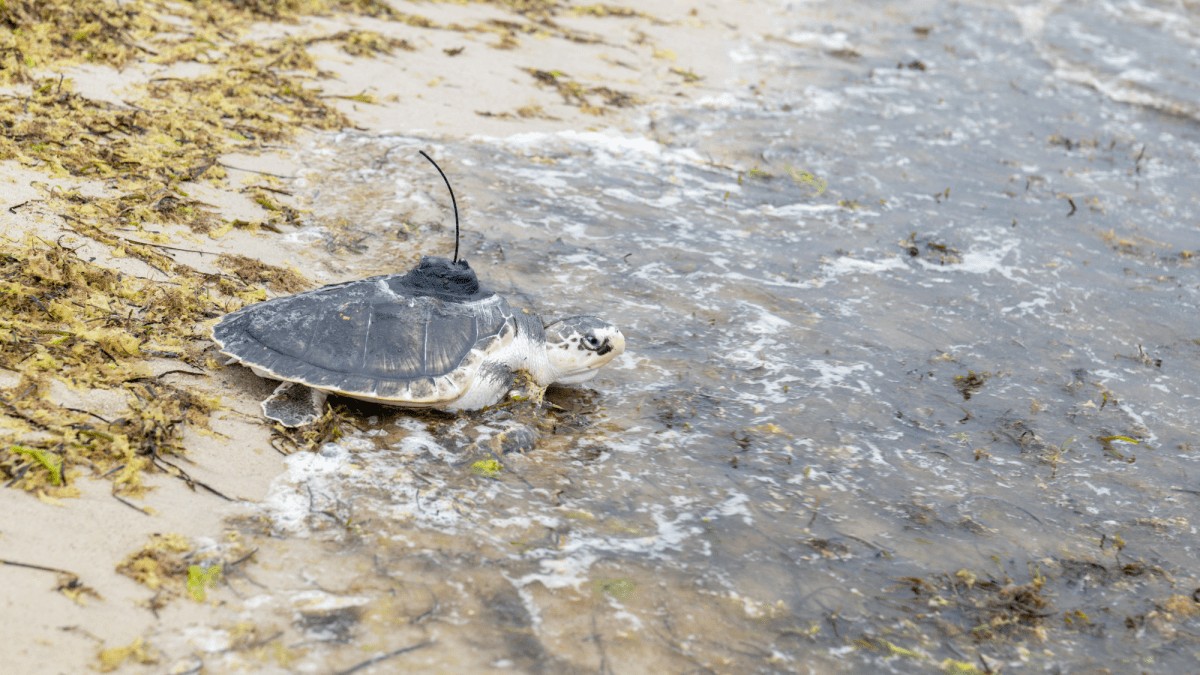
Five Kemp’s ridley sea turtles just got their freedom.
They are swimming away from Cape Cod. Their names? Typography.
It’s a strange coincidence. Or maybe just a quirk of the New England Aquarium staff. The turtles were named Times New Roman, Papyrus, Gigi, Walter Turncoat, and Punk Kid.
This batch spent seven months in rehab at the aquarium’s Sea Turtle Hospital in Quincy. They came back from the brink. Pneumonia, dehydration, trauma — the kind of things that kill cold-stunned turtles every winter. Now they are gone. Back in the Atlantic.
Which turtles were released and where did they strand?
The names tell a story about how they were found. Each one has a file number. A location. A date in late December 2024 or early 2025.
Here is the breakdown:
- Times New Roman (#512). A classic serif font. This turtle washed up on December 3 in Dennis, Massachusetts.
- Papyrus (#579). The controversial font. It stranded on December 5 in Wellfleet, Massachusetts.
- Gigi (#590). A chic typeface. Found December 5 in Brewster, Massachusetts.
- Walter Turncoat (#644). A handwritten style. It came in on December 10 in Truro, Massachusetts.
- Punk Kid (#659). A grungy stencil font. Also found in Truro, but on December 11.
Why fonts? It’s the annual tradition. Staff pick a theme for the year’s rescues. This year it was typefaces.
Why Kemp’s ridley turtles are vulnerable to cold-stunning
Kemp’s ridley sea turtles (Lepidochelys kempei ) are endangered. They are small. They are slow. And they hate the cold.
When water temperatures drop, they get “cold-stunned.” Their metabolism crashes. They stop moving. They sink. Often, they wash ashore. If nobody picks them up, they die.
The New England Aquarium handled nearly 500 live turtles this season. Most were Kemp’s ridleys. Mass Audubon volunteers in Wellfleet Bay found them between November and December. The aquarium treated them.
Dr. Melissa Joblon, the Director of Animal Health, watches them closely. She adjusts care as needed.
“These five turtles are now strong enough survive entirely on their own in the wild.”
That is the goal. Always.
How tracking data helps protect sea turtles
These turtles didn’t just swim out. Scientists tagged them first.
A team from the Anderson Cabot Center for Ocean Life attached data collectors. The tags record behavior. Habitat use. Survivorship.
This matters. Conservation isn’t guesswork. It’s data.
Where do they go? How long do they swim? Do they stay in the area or migrate? The answers shape protection efforts.
The aquarium has released 35 turtles so far this cycle. Some are still in treatment. They aren’t ready yet. Medically cleared means more than just being awake. It means being strong enough to eat. To fight. To survive.
Once cleared, some go on the Sea Turtle Tracker. Fans can watch them move through the Atlantic.
Is Papyrus safe now? Probably. It has a tag. And it has the ocean.