Get the Popular Science daily newsletter 💡
Breakthroughs. Discoveries. DIY tips sent six days a weekly routine.
Email address Thank you!
By signing up you confirm you are 16+ agree to the Terms and accept our data practices. Unsubscribe anytime.
Edwin Link was 12. He sat in his dad’s workshop. Binghamton. 1916. He drew a submarine. Not a sketch. A plan. Annotations everywhere. He wanted his own Nautilus. He wanted it to fight German U-boats. His father ignored it. Just a kid’s fantasy. The man behind Link Piano didn’t care.
Link dropped out of high school. He went into the organ business. Bellows. Pneumatics. He figured out how to fake motion. By 1929 he had built the world’s first flight simulator. It looked like a box on top of an organ. It shook. It rolled. It pitched. WWII came. 10,000 simulators followed. Half a million pilots trained inside. He sold the company in ’54. He went back to the sea.
Not for war this time. For living there.
He wasn’t crazy. Alone. But stubborn. The 1960s were dizzying. Aquanauts moved into labs on the floor. Hotels. Transit. It looked like the ocean would be the new space. Then the Moon won. America picked stars.
Link didn’t pick up. Neither did the rest. Now. Climate stress. Mineral hunger. The dream returns. But not for fun. For need.
Tracks under the sea
The continental shelf. Six hundred feet deep. Sunlight reaches. Seven percent of the ocean. Bigger than North America. Life packs tight here. Shallow water. Reefs. Lagoons. No gear needed. Just swim. This is where the living-in-ocean idea started.
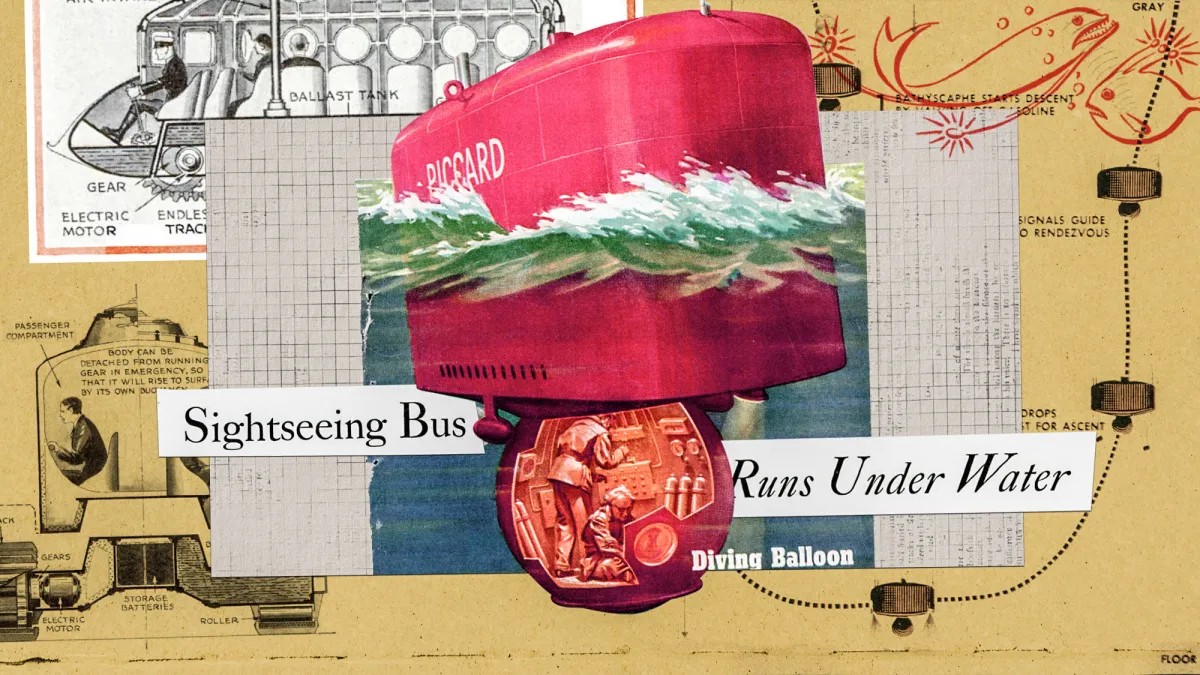
June 1932. Popular Science reported a French engineer’s wild idea. An electric submarine car. Not just a sub. A car. Passengers crawled down a hatch. Into a cabin. Tractor treads below. They would watch fish swim by.
“The inventor is primarily interested… as an amusement device,” wrote the magazine. Submarine buses. Touring under beaches.
Then. Bolder. A railroad. Tracks under the sand. Wheels flanged for rails. Pulling cars beneath the waves. Infrastructure. Not just transport. Homes. The seed was planted in the ’30s.
How space helped the sea
Auguste Piccard. Swiss. Explorer. Inventor. He flew a balloon to the stratosphere. 1931. Pressure holds life up there. He turned it upside down. Steel sphere. Buoyancy tanks with gasoline. Lighter than water. He called it the Trieste.
- His son Jacques. Plus U.S. Navy Lt. Don Walsh. They went down. Nearly seven miles. Mariana Trench. Challenger Deep. The bottom. They touched “inner space.” Outer space was out there. Inner space was right here. Deep. Dark. Pressured.
The tourism tide
Disney got there first. 1959. Disneyland’s Submarine Voyage. Nautilus. Skipjack. Atlantis recreation. The subs never submerged. You just sat below the waterline. It fooled you. You wanted it real.
- Switzerland. Lake Geneva. Jacques Piccard launched the mésoscaphe Auguste Picard. For tourists. 45 passengers. Summer dives. 33,000 people saw the bottom. They weren’t scientists. Just people. Paying to look down.
Meanwhile Link worked. 1962. France coast. Inflatable chamber. Diver Robert Sténuit inside. 200 feet deep. 24 hours straight. The body adjusted. Pressure became normal. Saturation diving. You stay down for days. Weeks. Come up once. No stop.
Of astronauts and aquanauts
Jacques-Yves Cousteau. 1962 too. Mediterranean. Marseille. Conshelf I. Two men. 33 feet deep. A week.
Then Conshelf II. Red Sea. A month.
Then Conshelf III. Nice. 1965. 325 feet deep. Three weeks.
He proved it. The floor holds. Humans adapt.
America reacted. The Navy answered with Sealab. 1965 California coast. Sealab II. 10 men. 205 feet down. 15 days. Then came Scott Carpenter. He’d been in space. He went down too. Astronaut and aquanaut. First of his kind.
Tektite came later. Virgin Islands. Joint project. NASA watched. 60 days on Lameshur Bay bottom. Not to train spacewalks. But isolation. Small crews. Alone together. Exactly like Mars missions would need.
Tektite II. First women. Led by Sylvia Earle. She grew up to lead NOAA. An advocate. A legend.
The tide ebbs
July 1969. Apollo 11 lands. Flags plant.
Also July. Sealab III dies. Berry Cannon. 600 feet down. A repair went wrong. CO2 poisoning. The Navy quit.
Link finished his Nautilus in ’71. Fifty years after that drawing. Acrylic sphere. Clear view. But fate repeated itself. Key West. Cable snag. Son Clayton died there. Also CO2.
Ed Link lost a son to the ocean he loved. He kept working anyway. Died in 1981. But the fervor ended. The government money dried up. NASA looked up again.
But the ocean dream lingered
-
Dennis Hurd built a real tourist sub. Grand Cayman. Atlantis Submarines. Still running. Big. Long-running.
-
Jules’ Undersea Lodge. Florida. Hotel room underwater. Scuba required. Guests swim down 21 feet to sleep. Named after Jules Verne. Finally.
NASA tried again. 2001. NEEMO program. Aquarius habitat. Florida Keys. Astronauts lived there. Weeks. Practicing for space.
-
Bruce Jones proposed Poseidon. A resort. 40 feet deep. Wedding chapel. Library. Restaurant. Acrylic walls. Four inches thick. He couldn’t get funding. Still trying.
-
Maldives. The Muraka. One room. 16 feet down. Pressure balanced. No scuba needed. $50,00 a night. You just walk down stairs into your bedroom.
A missed opportunity
Now enthusiasts fund the deep. Not nations. James Cameron dove to Challenger Deep in 2012. Alone. It cost $8 million. That’s a third of the entire NOAA annual budget that year.
Mining interests rise too. International Seabed Authority signed contracts. 30 companies. Rare earths. Cobalt. Manganese. We need it. They take it.
The gap grows. NASA’s budget crushes NOAA’s. 175 to one. We spend on stars. We barely glance down.
If we had invested even a bit more. Maybe we’d live there now. Maybe we’d understand the climate regulator beneath the waves. We know so little.
Ed Link’s boy-drawer dreamed big. The man who survived his grief proved we could live there. He’d be amazed by our tech. And baffled by our priorities.
In A Century in Motion revisits transportation history. Hybrid cars. Moving sidewalks. Ideas return.
Related ‘Century in Motion’ stories