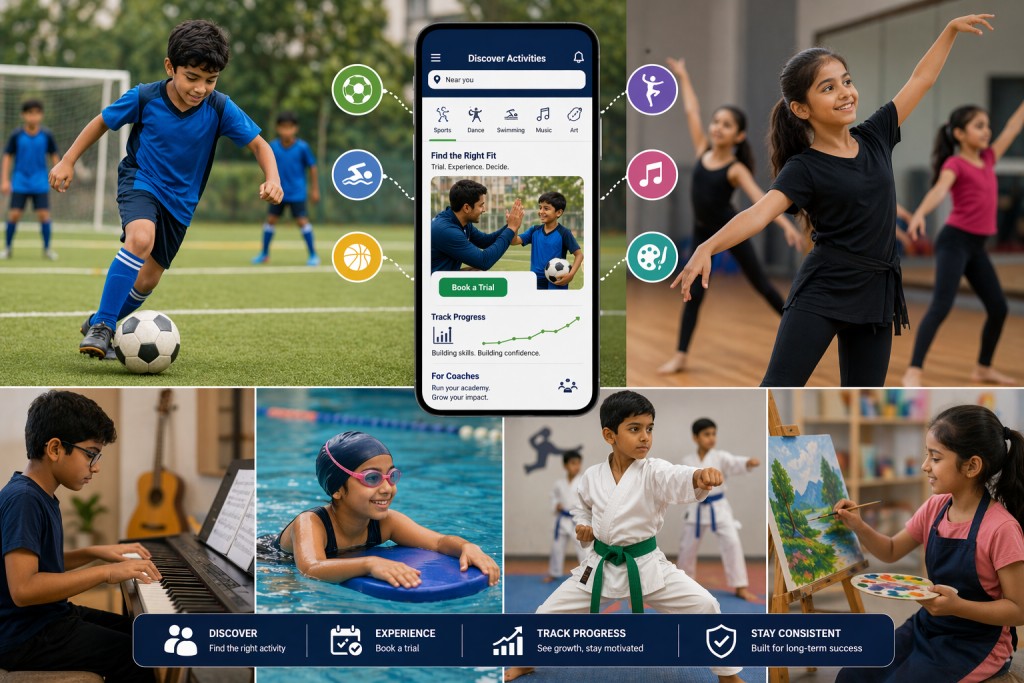
India is witnessing a massive structural shift in how families approach child development. Beyond textbooks and exams, a vibrant “extracurricular economy”—encompassing sports, dance, music, martial arts, and swimming—is booming. With over 10 million active children participating, this market is estimated to be worth between $3 billion and $3.5 billion.
Yet, despite high demand and significant spending, the sector lacks a dominant platform. While digital platforms have revolutionized academic tutoring and communication skills, the physical activities market remains fragmented, unorganized, and underserved.
The Perfect Storm: Why the Market is Exploding
Several powerful trends are converging to create a massive opportunity for growth in this sector:
- The Millennial Parenting Shift: Today’s parents are not just looking for academic excellence; they are investing in “holistic development.” Activities like swimming or martial arts are no longer seen as optional hobbies but as essential tools for building discipline, confidence, and social skills.
- The Rise of Gated Communities: Urbanization is creating high-density pockets of demand. In India’s top 50 cities, millions of households live in gated communities. These clusters act as natural “catchment areas,” where many families within walking distance share identical needs for structured activities.
- Institutional Validation: The National Education Policy (NEP) 2020 has officially moved the needle toward experiential learning, legitimizing extracurricular activities within the broader educational framework.
The Digital Divide: Why “Online-Only” Models Fail Here
We have seen platforms scale in other children’s niches, but they follow a different logic. For example, communication skills (public speaking, creative writing) have thrived online because they can be taught effectively via a screen. A student can debate a teacher via Zoom just as well as in person.
However, the core of the activities market is fundamentally physical. You cannot learn gymnastics, football, or swimming through a laptop. This creates a “platform gap”: the most lucrative segments of the market cannot be digitized, making them much harder to aggregate and manage.
The Failure of the Traditional Marketplace
In the Indian consumer internet playbook, the standard model is: Aggregate supply $\rightarrow$ Generate demand $\rightarrow$ Take a commission. In children’s activities, this model hits a structural ceiling for three reasons:
- The “Leaky Bucket” Problem: Platforms like Swiggy’s Pyng (which recently struggled with retention) highlight a fatal flaw: once a parent finds a coach through a platform, they move the relationship to WhatsApp. The platform facilitates the first connection but loses all future value, leading to high customer acquisition costs and zero long-term loyalty.
- Lack of Control: Unlike food delivery, where the platform controls the “last mile,” a platform for physical activities has no control over the actual experience. If a coach is late or a facility is unsafe, the platform suffers the reputational damage without having the power to fix it.
- Complexity of Choice: Parents aren’t just looking for a “service”; they are looking for a “fit.” They need a coach their child trusts, a schedule that works with siblings, and a sense of community. A simple directory of listings cannot satisfy these emotional and logistical requirements.
Moving Beyond Listings: The Path to a Category Leader
To win this market, a company cannot simply be a middleman; it must become the operating system for the entire ecosystem.
The winning model will likely mirror the distinction between Zomato (the marketplace) and Petpooja (the restaurant management software). Instead of just connecting parents to coaches, a successful platform must empower coaches to run professional businesses.
The Three Pillars of Success:
- For Coaches (Operational Infrastructure): Replacing the “WhatsApp chaos” with tools for automated fee collection, attendance tracking, batch scheduling, and lead management. The goal is to let coaches focus on teaching rather than administration.
- For Parents (Visibility & Trust): Moving beyond “attendance logs” to “progress tracking.” Parents need to see tangible evidence of their child’s growth—confidence, skill levels, and discipline—to justify ongoing investment.
- For Children (Experiential Discovery): Creating structured “trial experiences” that allow a child to find a sense of belonging before a parent commits to a long-term subscription.
The Bottom Line: In this category, parents aren’t buying a time slot; they are buying consistency and progress. The platform that succeeds won’t be the one that merely lists coaches, but the one that manages the entire relationship and makes the invisible progress of a child visible.
Conclusion: India’s children’s activities market is primed for a breakout moment. The opportunity lies not in building a simple directory, but in creating a sophisticated infrastructure that solves the operational headaches of coaches and the trust requirements of parents.