“This planet may represent the transition between small gas giants and large rocky planets.”
49 light-years.
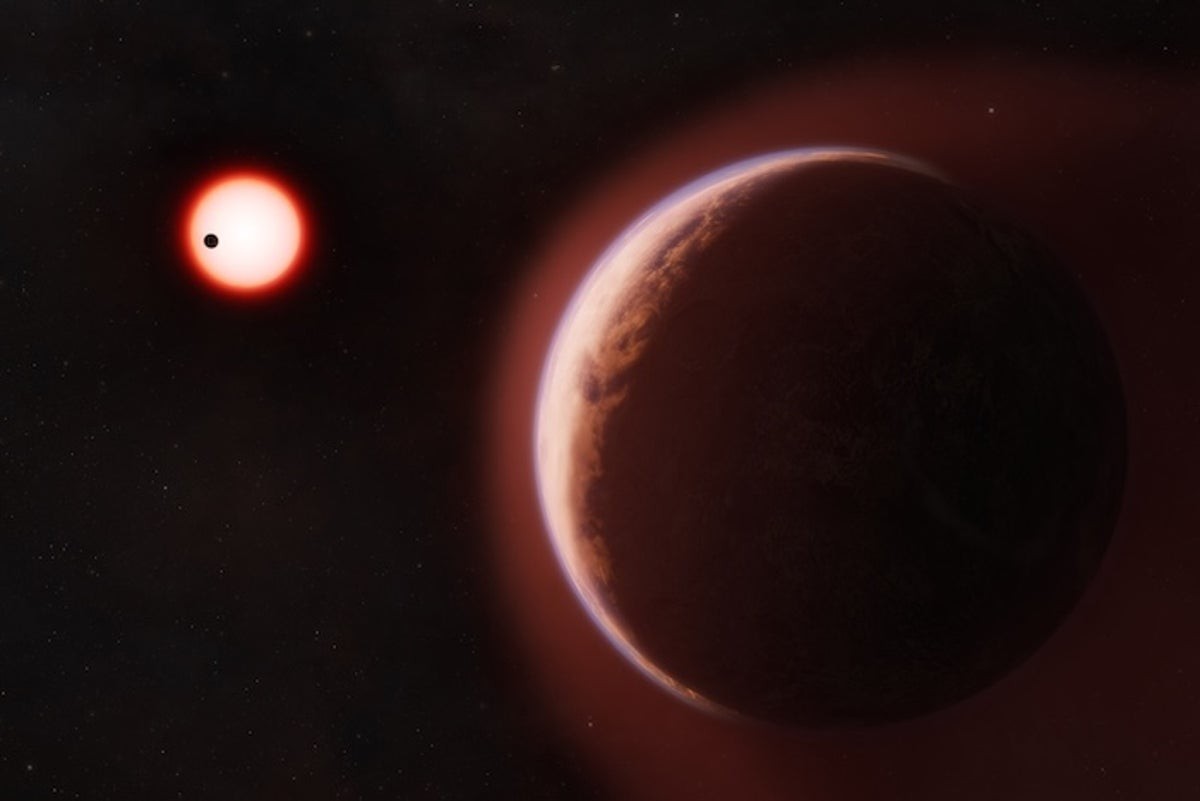
That is close enough for a cosmic neighbor, but distant enough to require patience. LHS 114 b sits there in the dark. Found in 2017.
Researchers had long considered it prime real estate.
Why? It hits the big three.
- Rocky.
- Right temperature for liquid water.
- An atmosphere.
Collin Cherubim. Postdoctoral fellow at Harvard. He leads the charge. Published in Science. He says this discovery raises the odds that life might exist there. Not certainty. But likelihood.
Another point.
The star itself? Quiet. No violent eruptions. No coronal mass ejections to strip the planet bare. A gentle host for a rocky guest.
“Another huge thing … is that it happens to orbit a relatively quiet star.”
Mars can’t hold helium. Too light. Floats away.
But if LHS 1 b leaks helium into space it implies something else. Something deeper. A thicker atmosphere below it. One that traps heavier gases.
Water likely hides near the surface. Shielded by the air. Protected from radiation.
Cherubim looked at the light. Specifically, the infrared. The Magellan Clay Telescope caught wavelengths absorbed by helium atoms heated by stellar x-rays.
Data came in.
He saw it.
Then came the shock.
He looked again in 25.
Gone.
Did he miss it? Did he invent it?
Laura Kreidberg from the Max Plan Institute calls it a “tummy rumble”. Skeptical? A little. But she allows it. Variability happens. Atmospheres shift.
Maybe.
The helium shows up when excited. When the energy state changes it might hide itself from our sensors. Even if the amount of escaping gas is identical we see different pictures.
Temperature.
Magnetic activity.
Orbits.
All possibilities.
This goes against the old idea. The one saying such a planet should have lost its helium billions of years ago. It should be barren. Bare.
It is not bare. It is in the middle of becoming bare. Shrinking. From sub-Neptune to super-Earth.
A snapshot.
We watch a world evolve in real time. Or what looks like it.
Kreidberg puts it plainly. We are looking at the gap. The bridge between smallest gas giants and the biggest rocky worlds.
Next stop: Hubble and Webb. The Rocky Worlds program wants to take a closer look. They have their own targets. Their own priorities.
But Cherubim has already done it. He beat them to the punch.
So what now? We wait.
Do we see it again next time? Maybe. Maybe not.