The universe likes to mess with you.
It found a planet where one shouldn’t be.
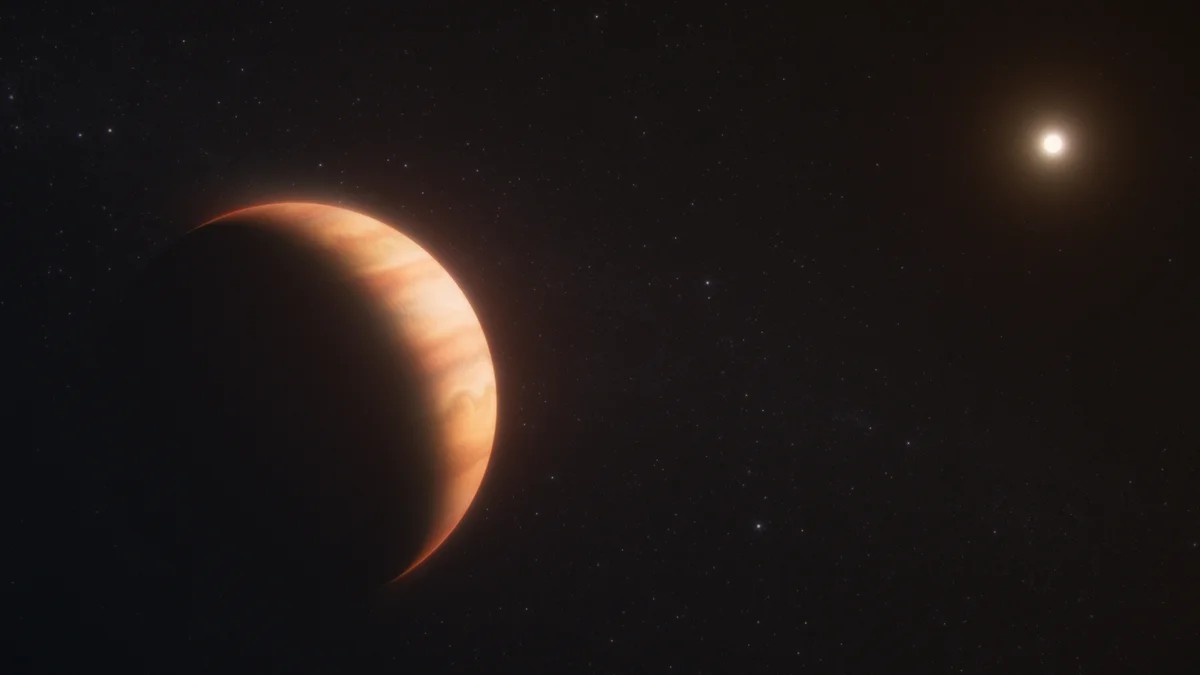
WD 1856b. A gas giant. Circling a dead thing. A white dwarf, really—the charred skeleton of a sun-like star. It wasn’t until 2020 anyone realized it was there, and back then the mystery was simple. How does a planet stick around when its parent star collapses into a dense, cooling ember?
Now?
Now we have new data. Published today in Nature, and honestly? It gets weirder. The planet didn’t just survive. It kept its atmosphere. And that atmosphere is warm. Not hot, not freezing, just stubbornly present.
Ryan MacDonald from St Andrews led the team. He admits it threw them for a loop.
“It was unlike any other exoplanet we’ve ever looked at.”
That caused some scratching of heads. Good ones too.
To get the shape of this, you need the basics of stellar suicide.
Our sun isn’t big enough to go boom in a supernova. No fireworks for us. Instead it will puff up. Swell. Turn a bruised red color. It becomes a red giant, bloating until it eats the inner planets. Then the outer layers fall off, and what’s left shrinks down hard. A white dwarf. Tiny, but heavy.
For a planet nearby?
Catastrophic. You get eaten, or you get flung away, or maybe, just maybe, you drift into a tighter orbit if gravity allows it. Most worlds don’t make it. WD 1856b did. It orbits in roughly thirty-four hours. That is close. Too close.
Which brings us to the two theories about how it ended up here.
Christopher O’Connor from Northwestern lays out the options.
Option A: The star swallowed the whole thing when it went giant, and the planet somehow floated inside the stellar atmosphere long enough to survive the collapse.
Option B: The planet sat safe and distant for a while, then migrated inward later, pushed by gravity.
Heat is the key.
The researchers looked at how fast giant planets cool down over eons. They ran the math on WD 1856B’s temperature.
If Theory A were true? The planet should still be boiling with residual heat from its time inside the red giant.
It isn’t.
It’s too cool. So O’Connor’s second theory likely wins. The planet lived out there in the cold for over a billion years. It waited. Then it drifted inward.
Every time it swooped past the white dwarf, gravity stole a bit of its orbital energy. That energy turned into heat. The orbit tightened. The path shrank. You could probably watch it glow if you had the right camera, MacDonald notes. It’s a slow dance of decay, spiraling toward a compact star that used to burn bright.
Why does this matter?
Five billion years. Give or take. Our sun does this exact dance. Earth gets cooked. Dust. But Jupiter?
Jupiter lasts.
“Jupiter has a long life ahead,” MacDonald says. “Even when the sun is just a smoldering cinder.”
If someone is there to see it—if alien eyes or robot probes survive the dark ages—they can read Jupiter’s clouds. Like WD 18566b. Like reading a book written in wind and pressure, detailing the history of a system that refused to vanish entirely.
We want to know what happens when the lights go out. It turns out the story continues in the dark, warmer than we expected, orbiting a ghost.