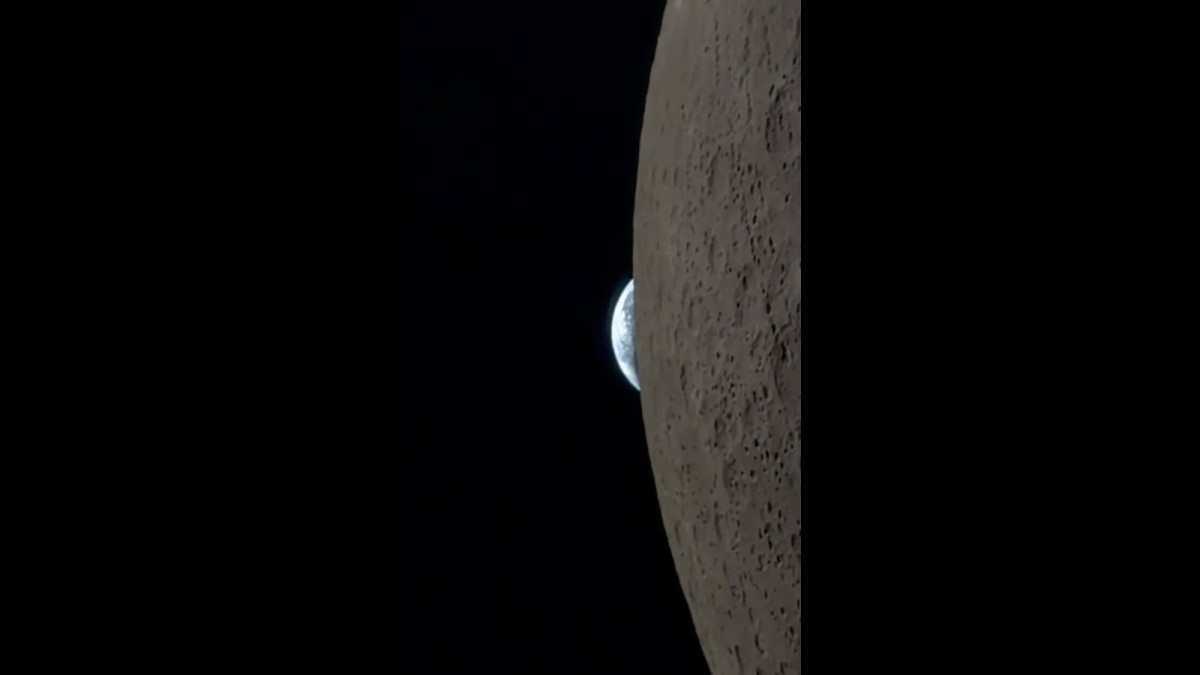
The Artemis II mission has provided more than just scientific data; it has offered a rare, intimate look at our home planet from the lunar frontier. In a recent social media update, Mission Commander Reid Wiseman shared a breathtaking video captured on his personal iPhone, documenting an “Earthset”—the moment Earth disappears behind the lunar horizon.
A View Through a Consumer Lens
Unlike the high-fidelity, specialized cameras typically used by NASA, Wiseman’s footage was captured using an iPhone 15 Pro Max (noted as 15 Pro Max in technical context) with an 8x zoom. This choice of equipment provides a unique perspective for the public:
– Human-like Scale: The 8x zoom offers a view comparable to what the human eye would perceive.
– Relatability: Using consumer technology bridges the gap between complex space exploration and everyday life, making the vastness of space feel more tangible.
The video mimics the sensation of a sunset over a terrestrial ocean, as the blue marble of Earth gradually sinks beneath the rugged, gray edge of the Moon.
Breaking Records and Exploring the Dark Side
The Artemis II mission was defined by several historic milestones that push the boundaries of human spaceflight:
- Distance Records: The crew traveled 4,111 miles farther from Earth than the crew of the Apollo 13 mission did in 1970, marking a significant leap in deep-space navigation.
- Lunar Topography: During a historic one-hour lunar flyby, the crew—comprising Wiseman, Victor Glover, Christina Koch, and Jeremy Hansen—documented the Moon’s “dark side.” They captured high-resolution imagery of ancient lava flows, surface cracks, and ridges, providing a visual history of the Moon’s geological evolution.
- Orbital Solar Eclipse: In a striking moment of celestial alignment, the crew observed a solar eclipse from orbit. Using specialized glasses, they studied the solar corona —the Sun’s outermost atmosphere—as it glowed around the Moon’s edge.
Why This Research Matters
The mission was not merely about sightseeing; it served a critical scientific purpose. By observing the corona and monitoring for flashes of light caused by meteoroids striking the lunar surface, the crew gathered vital data on environmental hazards.
Understanding these impacts is essential for the next phase of lunar exploration. As NASA prepares to establish permanent bases on the Moon, knowing how frequently and intensely meteoroids strike the surface is a prerequisite for designing safe habitats and landing sites.
Looking Ahead: The Path to Artemis III
After a 10-day journey covering nearly 700,000 miles, the crew successfully splashed down on April 10, 2026. This mission serves as the foundational stepping stone for Artemis III, currently scheduled for 2027.
The upcoming mission will be significantly more complex, focusing on the critical ability to rendezvous and dock the Orion spacecraft with commercial lunar landers. This capability is the “missing link” required to safely deliver astronauts from lunar orbit down to the surface of the Moon.
The Artemis II mission has successfully transitioned from a feat of navigation to a vital source of environmental intelligence, paving the way for a sustained human presence on the lunar surface.