


The coronavirus didn’t just change how we eat or travel. It broke the standard rhythm of work. Originating in Wuhan, China, Covid-19 spread fast. The World Health Organization and the UN declared it a pandemic. Why? Because it met specific criteria. A new disease emerged. It spread to humans easily. It caused serious harm.
Turkey reacted quickly. The government needed to protect citizens.
On March 16, 2020, the Ministry of Interior issued a directive. It was titled “Coronavirus Measures.” The order was clear. Close the doors. Cafes, internet lounges, game centers, swimming pools, and spas had to stop operations. Even closed-game areas inside malls were not exempt.
Then came more restrictions. Long-distance bus travel got limited. Air travel required permission. International travel bans followed. Some local areas went into quarantine. Curfews started. People over 65 were told to stay home. The “Stay at Home” (evde kal ) campaign took hold.
The result? Commercial life froze.
Many businesses had to shut down because the government said so. Others closed voluntarily for a bit. Some kept their doors open but lost so much money they had to fire staff. This created tension. Employees and employers started disagreeing. What are the rights here? Who owes what to whom?
This guide breaks down the legal reality. It looks at health responsibilities first. Then it tackles employment contracts.
Employer and Employee Health Responsibilities Under Turkish Law
It’s not just about masks. It’s about the law.
The Turkish Code of Obligations, Article 417/2, lays it out. Employers must take every necessary measure to ensure health and safety at the workplace. They must provide the right equipment. It has to be in good condition. Employees, on the other hand, must follow these safety measures.
The Occupational Health and Safety Law (Law No. 6331) expands on this. Article 4 lists employer duties. Article 19 lists employee duties.
But here is the tricky part. Training.
Regulations on Occupational Health and Safety Training say training isn’t a one-time thing. It happens before work starts. But it also must repeat during employment. Why? Because risks change.
“Changing and newly emerging risks” covers the coronavirus.
Employers must provide training on how to protect against Covid-19. It’s not optional. It’s part of the safety protocol.
So what happens if an employer ignores this?
If you believe your workplace isn’t taking necessary precautions against Covid-19, you have options. Under Article 13 of the Occupational Health and Safety Law, you can formally request the employer to take action. You can ask for the situation to be documented.
There is a powerful right here: the right to refuse work.
If the employer doesn’t fix the safety issues, you can stop working until they do. You don’t have to sit there and risk infection if the law says you should be protected.
How Coronavirus Affects Employment Contracts
Let’s get to the money and the contracts.
In Turkish labor law, the coronavirus is considered a force majeure event.
This is a legal term. It means an unavoidable accident or occurrence. It’s not just bad luck.
The Court of Cassation’s 9th Civil Chamber made this clear in a decision (Case No. 2016/26112, Decision No. 2019/8165). They listed examples. Floods. Heavy snow. Earthquakes that cut off transport. Quarantines due to epidemics.
Covid-19 fits right in.
When force majeure exists, things get volatile. It gives both the employee and the employer the right to terminate the contract immediately. This is a “just cause” termination. No notice period needed.
For employees, this is covered under Article 24 of the Labor Law. For employers, it’s Article 25.
But let’s look at a specific scenario. What if the business just closes for a while?
Temporary Closure of the Workplace
When a workplace shuts down temporarily, the rules shift.
The government might force it. Or the employer might choose to. Either way, the contract doesn’t just vanish. But the obligations change.
If the closure is temporary, does the employer still pay? Does the employee still have to be available?
This is where disputes start. Many workers assume they get full pay even if there is no work. Many employers assume they can pause payments entirely. The law tries to find a middle ground, but it depends on who caused the closure.
If the state orders the closure, it’s a shared burden. If the employer chooses to close due to losses, it’s their decision. But if they can’t pay, they might have to lay people off.
Which is better for the worker? Being on leave with some pay? Or being fired and claiming unemployment benefits?
It depends on your savings. It depends on how long the virus lasts.
The law provides the framework. It doesn’t provide the comfort.
What happens if your boss shuts the door without an official order?
Here is the tricky part. If the government hasn’t issued an administrative order closing your workplace, the virus itself isn’t enough to stop the paycheck. The employer chose to close up shop. That is a decision. Not a force majeure. So the obligation to pay wages continues. You stay on the payroll.
But if the state does step in? Or if a natural disaster hits? Then we enter the zone of force majeure. This changes everything.
Can you quit immediately under force majeure?
Yes. And it matters how you do it.
Under Article 24 of the Labor Law, if force majeure stops the work, the employer must pay half a week’s wages upfront. That is your buffer. After that week ends, you have a choice. You can quit. This is called just cause immediate termination by the employee.
If you quit:
– You get your severance pay (kıdem tazminatı ).
– You do not get notice pay (ihbar tazminatı ).
If you stay? The contract continues. But the employer stops paying you after that first week. They can’t fire you just because the crisis lasts longer than seven days. Only you can pull the trigger on the termination if you want out.
What about unemployment benefits?
If you quit under these rules, you might still get unemployment allowance. But you need to check the boxes:
– Worked under an employment contract for the last 120 days before ending.
– Paid unemployment insurance premiums for at least 600 days in the last three years.
Can the employer fire you due to force majeure?
They can. But the clock starts the same way.
Article 25/3 gives the employer the right to terminate for just cause if force majeure keeps you from working for more than a week. First, they must pay you that same half-week wage. Then, if the disruption lasts beyond those seven days, they can end the contract.
Crucial detail: The force majeure must come from outside. Not from the employer’s bad management. It has to be external. A natural disaster. A curfew. A pandemic. If the boss creates the problem, this right doesn’t exist.
Forcing unpaid leave is illegal (mostly)
Listen closely. An employer cannot shove you into unpaid leave against your will. Never.
If they do, you can sue for reinstatement. Or demand compensation.
The only way unpaid leave works is if you agree to it. In writing.
– The boss makes the offer.
– You have 6 working days to say yes.
– If you sign off, it’s valid.
The Court of Appeals is clear on this. Consent is key.
The rules of the road for unpaid leave
If you are navigating this, keep these boundaries in mind:
- Written consent is mandatory. No paper trail? It counts as a dismissal by the employer. You get notice pay, severance, and maybe reinstatement.
- Time limits matter. If the leave lasts longer than three months, or no end date is set, you have the right to quit for just cause.
- Silence is not acceptance. If you don’t reply in 6 days, the offer expires. The boss can’t force it. They might switch to paid leave or try a termination due to change of working conditions. But for that, they must prove a valid reason. If they fail, you get severance and notice pay, but lose the right to be reinstated.
- Good faith doesn’t save them. Even if the business is struggling, even if the boss means well, they cannot unilaterally pause the contract. The reason doesn’t override the law.
How short-time working allowance works
This is the safety net for when work drops, not just when it stops.
Short-time working allowance kicks in if:
– Weekly hours drop by at least one-third.
– Or activity stops completely or partially for at least four weeks.
It applies to general economic crises, sectoral issues, or force majeure. The goal? Income support for up to three months. (The President can extend this to six months.)
Who qualifies for short-time working pay?
You need to meet strict criteria:
– Paid premiums for at least 450 days in the last three years.
– Worked continuously for 60 days before the short-time working period starts.
How much do you get?
The calculation is straightforward but capped.
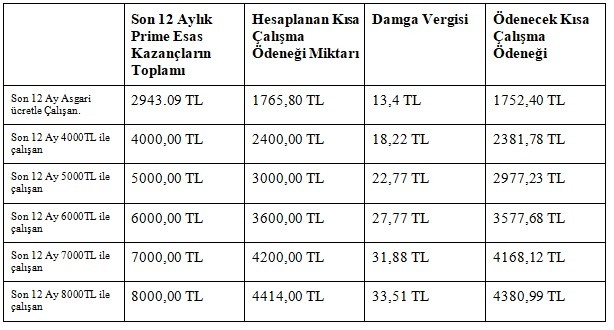
You receive 60% of your daily wage. This is based on your earnings in the last 12 months.
But there is a ceiling.
– The amount cannot exceed 150% of the minimum wage.
For 2020, the numbers looked like this after stamp duty:
– Maximum payment: 4,380.99 TL
– Minimum payment: 1,752.40 TL
It is not a full salary. It is a bridge. And it requires the employer to apply on your behalf. They have to prove the crisis is real, external, and unavoidable.
If the employer drags their feet, or if the situation is their fault, you are left hanging. The law provides the structure. It does not provide the initiative.
Short-time work and employee consent
Here is the thing about short-time work allowance. The employer does not need the employee’s written consent or approval to apply for it. It’s an administrative decision on the employer’s side.
This often leads to confusion. Some workers think they can quit and claim constructive dismissal just because the company switched to short-time work. They can’t. Using short-time work as a reason to terminate the employment contract is not considered a valid legal ground for the employee. The job itself isn’t ending, just the hours and the pay structure shifting temporarily.
Forcing annual leave on employees
Now let’s talk about vacations. Or rather, who gets to decide when you take them.
Many people assume they have the right to pick their holiday dates. The law says otherwise. According to the Annual Paid Leave Regulation, the employee must submit a written request to the employer at least one month before the desired start date. That’s just the application. The actual decision? That belongs to the employer.
You can’t just show up and say, “I’m off next week.” The management right to schedule work includes managing who is there and who isn’t.
But there are rules for the boss too. They can’t chop your annual leave into tiny, useless fragments. Splitting the leave is generally prohibited unless both parties agree otherwise. Even then, there’s a catch. Any split portion must be at least 10 days long. So if you have 14 days of leave, the employer can’t make you take one day off here and another there. They have to give you blocks of time, or a single continuous period.
When can employers mandate group holidays?
There is one specific exception where the employer has more power. They can force a group leave period. But this comes with strict conditions.
First, it requires the employee’s consent? Actually, the regulation allows the employer to apply a group leave scheme for all or part of the workforce between April 1st and October 31st.
Wait, does that mean they can force it without asking? The text cites Article 10 of the regulation, which grants the employer the right to provide annual leave in bulk. However, in practice, this usually implies a mutual agreement or a collective bargaining context, but the legal authority rests with the employer to set the period within that window.
If the employer decides to do this:
– The leave committee creates a schedule.
– Everyone going on group leave starts at the same time.
– The schedule must clearly show when each person’s leave ends, accounting for their total entitlement and any travel time allowances.
Here’s the tricky part. This group leave can even include employees who haven’t actually earned that year’s annual leave yet. Yes, you can be put on vacation before you’ve technically qualified for it.
Does that mean you lose those days? No. If the employer doesn’t use this group leave method in the following years, those employees will earn their regular annual leave entitlement based on the general rules. It’s just an advance on your time off.
Legal duties: It’s not just a suggestion
The citations provided highlight that this isn’t just corporate policy. It’s law.
Article 4 puts the burden squarely on the employer. They must prevent occupational risks. They must organize safety measures. They must provide the right tools. And crucially, they cannot pass the cost of safety measures onto the employees.
Article 19 flips it to the worker. You have to follow the safety training. You have to use the personal protective equipment correctly. If you see a serious danger, you have to tell the boss or the worker representative immediately.
These sections were likely included to remind readers that the employment relationship is a two-way street of legal obligations. The employer manages the schedule and safety; the employee follows the rules and communicates risks.
So, back to the short-time work and leave issues. The law provides a framework. The employer has the right to manage operations, including reducing hours without consent or setting group leave periods. The employee has the right to fair scheduling, with minimum blocks of leave, and protection against arbitrary safety costs.
It’s not perfect. But it is the structure we work within. Knowing the difference between a right and a privilege helps when you’re negotiating your own time or understanding a pay slip that looks different than usual.


