


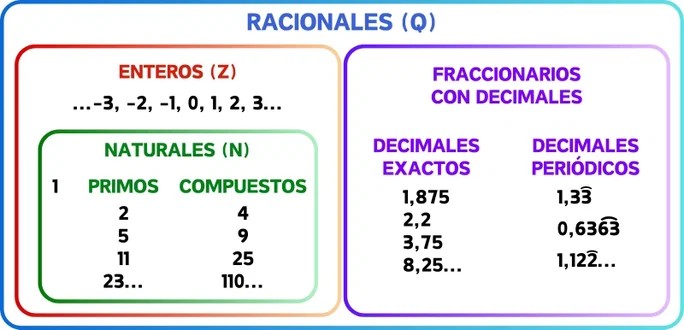
You divide 30 by 15. You get 2. Simple enough. That 2 is a rational number. So is 0.333 repeating. So is -4.
But pi? No. Pi is messy. It goes on forever without repeating. That makes it irrational.
The symbol for rational numbers is Q. If you see a number that can be written as a fraction of two integers (where the bottom number isn’t zero), it belongs in Q.
This matters more than you think. You use these numbers to measure ingredients, split bills, and calculate speed. They are the backbone of basic math, physics, and chemistry. If you can write it as a / b, it’s rational. If you can’t, it’s irrational.
Here is how to tell the difference without pulling your hair out.
How to spot a rational number in three types
Not all rational numbers look the same. Some are whole. Some have decimals that stop. Some repeat forever. All three count.
1. Whole numbers (Integers)
Yes, whole numbers are rational. Every single one of them.
Take 5. It looks like just “5”. But you can write it as 100 / 20. You can write it as 10 / 2. You can write it as 5 / 1. As long as you can express it as a ratio of two integers, it fits the definition.
Negative numbers work too. -15 is rational. It’s just -15 / 1. The sign doesn’t disqualify it.
2. Terminating decimals
These are the numbers that end. They don’t go on forever.
Think about 1.575. Or 0.24. These look like decimals, but they are just fractions in disguise. 0.24 is really 24/100. You can simplify it to 6/25. Since 25 and 6 are integers, 0.24 is a rational number.
If the decimal stops, it’s rational. Always.
3. Repeating decimals
This is where people get confused.
Take 1/3. In decimal form, it’s 0.33333… It never ends. But it repeats. The pattern is clear. One digit, over and over.
Because it repeats, it’s rational. The infinite length doesn’t scare it out of the club. The pattern saves it.
“A number with infinite decimals is still rational if it has a periodic pattern.”
Why pi is not rational (and why that matters)
Let’s look at a number you definitely know: pi (π ).
We usually write it as 3.14. But that’s a lie. A useful lie, but a lie.
Pi is 3.1415926535… and it keeps going. The digits never repeat. There is no pattern you can lock onto. You can’t write pi as a / b using integers.
That makes pi irrational.
It’s not a mistake. It’s a different category. When you see a decimal that goes on forever without repeating, run. It’s irrational.
Quick comparison: Rational vs Irrational
| Feature | Rational Numbers (Q) | Irrational Numbers |
|---|---|---|
| Fraction form | Can be written as a / b | Cannot be written as a / b |
| Decimal form | Terminates OR repeats | Never terminates, never repeats |
| Examples | 5, -2, 0.75, 1/3 | π, √2, e |
So how do you check?
- Can you write it as a fraction? Yes -> Rational.
- Does the decimal stop? Yes -> Rational.
- Does the decimal repeat? Yes -> Rational.
- Does it do both? (Stop and repeat?) Impossible.
- Does it go on forever with no pattern? -> Irrational.
It’s not magic. It’s just rules.
You don’t need a calculator to know if 0.123123… is rational. It repeats. It’s in.
You don’t need a calculator to know if √2 is rational. It’s a classic irrational number. Its decimal never settles.
Most numbers you meet in daily life are rational. Prices, distances, time, scores. They are clean. They are predictable.
The irrationals are the outliers. They exist. They are important in advanced math. But for your grocery list? Stick to the rationals.
What about square roots? Some are rational (√4 = 2). Most are not (√2). How do you tell which is which? That’s a problem for next time. For now, just remember: if it divides cleanly or repeats, you’re good.
Why decimals repeat (and why some don’t)
You already know the basics. Now let’s look at the messy middle. The part where students usually get stuck.
Rational numbers aren’t just whole integers. That’s easy. The real work happens when you split things up.
Integers (Z) are the clean ones. No decimals. Just 0, negatives, and naturals (N). Inside naturals, you have primes and composites. Simple.
Then you hit the fractions.
Here is the split you need to memorize:
- Exact decimals. They stop. Like 0.5. Done.
- Periodic decimals. They loop forever.
If the loop starts right after the decimal point, it is pure periodic. The whole thing repeats.
If a few digits hang out before the loop starts, it is mixed periodic. The pattern shifts.
This pattern recognition is the key. If it repeats, it is rational.
The density trap: what sits between numbers?
This is where intuition fails.
Pick any two rational numbers. Say 1 and 2.
How many numbers are between them?
Infinite.
There are infinite rational numbers there. 1.2. 1.745. 1.00001. You can always squeeze another one in.
But here is the kicker.
There are also infinite irrational numbers hiding in that same gap.
Take the square root of 2. It is approximately 1.41. It sits between 1 and 2. But it is not rational. It has infinite decimals that never settle into a pattern. We don’t even know all the digits. They just go on.
So the number line is crowded. Really crowded.
Operations keep you safe (mostly)
Do basic math with rationals and you stay rational.
Add two fractions? Rational. Subtract? Rational. Multiply? Rational. Divide? Rational (as long as you don’t divide by zero).
The system is closed. It protects itself.
But take the root.
Apply a square root or cube root to a rational number and the door opens.
You might get a rational result. Or you might get an irrational one. It is a gamble.
Spotting the difference: pattern vs. chaos
How do you tell them apart?
Irrational numbers cannot be written as a simple fraction of two integers a and b.
They are the rebels.
Their decimal parts are endless. But crucially, they do not repeat. No pattern. No loop. Just chaos.
Rational numbers with infinite decimals have a secret.
They have periodicity.
Look for the repeat.
If you see a digit or a group of digits that cycles continuously, it is rational. The pattern is the proof.
If the digits wander aimlessly without ever repeating the same sequence, it is irrational.
The line is drawn by the pattern.
Find the loop. You found the rational.


