Real numbers. You see them everywhere. In the price tag at the store. In the distance to the next exit. In your bank account balance. They are the foundation of practical math.
The symbol for real numbers is R. It is a big umbrella. It covers two main groups: rational numbers and irrational numbers. Put simply, it includes every number you can think of that has a decimal point. Or no decimal point at all.
Why do we care? Because real numbers let us measure the world. We use them to quantify things. To solve problems. To build the bridge that holds your car. Calculus and analysis rely on them heavily. You cannot do modern engineering without them.
They show up in different forms. Sometimes they are simple integers. Like 2. Or -15. Other times they have decimals. Like 5.41. They can be fractions, such as 7/3. Or square roots, like √5. All of these belong to the set of real numbers.
Visualizing them helps. Imagine a straight line. A ruler that stretches infinitely in both directions. That is the real number line. Also called the number line for real numbers. Every point on that line is a real number.
Real numbers allow us to quantify, measure, and solve problems. They are the base of calculation and mathematical analysis.
Why the Real Number Line Has No Edges
Think of the real number line as a road with no stops and no end. It stretches endlessly in both directions. There is no starting point. There is no finish line. This is because there are infinite positive and negative real numbers. We label the positive side as R+ and the negative side as R-.
The Dense Nature of Real Numbers
What makes the set of real numbers unique is its continuity. You cannot find gaps in this set. It is an integral collection. Between any two numbers, no matter how close they are, there is always another number.
Take the space between 4 and 5. You might think it’s a simple gap. It isn’t. You have 4.1, 4.6, and so on. But look closer at the space between 4.1 and 4.2. There are more numbers hiding there. 4.13 exists. 4.1592752 exists. You can keep splitting that space infinitely.
This means the domain of real numbers runs from negative infinity to positive infinity. We do not include the infinity points themselves. They are limits, not actual numbers you can reach.
Key Arithmetic Properties
Understanding how real numbers behave helps you solve problems faster. Here is what happens when you manipulate them.
- Closure under basic operations : If you add, subtract, or multiply any two real numbers, the result is always another real number. Division works too, as long as you are not dividing by zero. Division by zero is undefined. It breaks the system.
- Commutativity : Order does not matter for addition and multiplication.
- 3 + 5 equals 8.
- 5 + 3 also equals 8.
- 3 x 5 equals 15.
- 5 x 3 also equals 15.
- Associativity : Grouping does not change the outcome.
- (3 + 5) + 8 is the same as 3 + (5 + 8). Both give 16.
- (3 x 5) x 8 is the same as 3 x (5 x 8). Both give 120.
- Identity elements :
- Zero is the identity for addition and subtraction. Add zero to any number, and it stays the same. 3.3 + 0 = 3.3.
- One is the identity for multiplication and division. Multiply any number by one, and it remains unchanged. 4 x 1 = 4.
- Opposites : Every real number has a counterpart with the opposite sign.
- The opposite of 10 is -10.
- The opposite of -45 is 45.
- The opposite of 2.25 is -2.25.
- Square roots of negatives : You cannot take an even root of a negative number within the real set.
- The square root of 2 (√2) is a real number.
- The square root of -2 (√-2) is not defined in this set. It belongs to complex numbers.
Concrete Examples of Real Numbers
Real numbers are everywhere. They are not just abstract concepts. Here is what they look like in practice.
- Zero : Just 0.
- Positive Integers : 0, 5, 27, 81, 1027, 41263.
- Negative Integers : -8, -40, -555, -3050, -87654.
- Finite Decimals : Numbers that stop. Like 0.47, 12.78, or -27.904.
- Repeating Decimals : Numbers that cycle endlessly. 1.6666… or -8.636363…
- Non-repeating Decimals : Numbers that go on without a pattern. 0.1234321845… or 6.834967394…
You can also express these numbers as fractions, radicals, or powers. The form changes. The value remains real.
How to Classify Real Numbers
You might wonder how to categorize these numbers effectively. Classification helps organize your understanding.
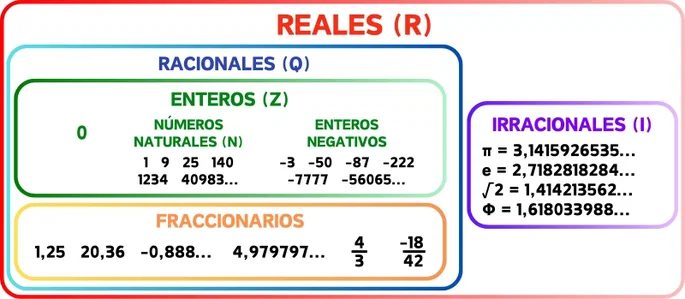
Start with integers. These are whole numbers. They include zero, positive whole numbers, and negative whole numbers.
Next, look at fractions. Any number that can be written as one integer divided by another (where the denominator is not zero) is a rational number. This includes terminating decimals and repeating decimals.
Then there are irrational numbers. These cannot be written as simple fractions. Their decimal expansions neither terminate nor repeat. Examples include pi (π) and the square root of 2 (√2).
Every number falls into one of these buckets. Or none. If it doesn’t fit the rational or integer definitions, it’s irrational. Together, rational and irrational numbers make up the entire set of real numbers.
The Great Divide: Rational vs. Irrational Numbers
Real numbers split into two distinct camps. You have the rationals. You have the irrationals. It is a binary classification that dictates how a number behaves in your calculations and how it appears on the number line.
Understanding this split isn’t just academic trivia. It determines whether a number can be written as a simple fraction or if it defies that structure entirely.
Breaking Down Rational Numbers
The set of rational numbers, marked as Q, is surprisingly inclusive. It captures every value that can be expressed as a fraction. Specifically, these are numbers written as the quotient of two integers.
This includes numbers with no decimal part. It includes those with finite decimals. It even grabs the ones with infinite, repeating decimals. If there is a pattern to the digits after the decimal point, the number belongs here.
Within Q, we find several familiar subsets:
- Integers: These are whole numbers. No decimals attached. This group contains zero. It contains positive integers (natural numbers). It contains negative integers.
- Fractions: Any number that represents a part of a whole. This includes terminating decimals like 0.5 (which is 1/2) and repeating ones like 0.333… (which is 1/3).
The key takeaway? If you can write it as a/b, where a and b are integers and b is not zero, it is rational.
The Wild Card: Irrational Numbers
Then there is I. The set of irrational numbers.
These numbers break the rules. Their decimal expansions are infinite and non-repeating. There is no pattern. No cycle. You can zoom in forever and never find a sequence that repeats itself.
Because of this chaotic structure, they cannot be expressed as a fraction of two integers. You cannot write pi as a simple ratio. You cannot write the square root of 2 as a clean fraction.
This is why they are called irrational. They do not fit the ratio model.
Why The Distinction Matters
You might wonder why we bother separating them. The difference affects everything from basic arithmetic to advanced calculus.
Rational numbers are predictable. They stabilize. Irrationals introduce continuity. They fill the gaps between rational points on a line. Without them, the number line would be full of holes.
Consider pi. It is approximately 3.14159. The digits go on forever. They never repeat. It is irrational.
Consider 22/7. It is a fraction. It is rational. It approximates pi, but it is not pi. The distinction is precise. It is not about approximation. It is about exact representation.
Common Examples in Context
Knowing which category a number falls into helps you predict its behavior.
- Square roots: The square root of 4 is 2. Rational. The square root of 5 is approx 2.2360679… It goes on forever without repeating. Irrational.
- Transcendental numbers: Pi and Euler’s number (e ) are famous irrational numbers. They are not roots of any polynomial with rational coefficients. They are fundamentally different from algebraic irrationals.
Where This Leads
You can see the