The education sector is currently flooded with promises. New AI-powered tools claim to revolutionize teaching by automating assessments, generating personalized curricula, and drafting multilingual communications for parents. Meanwhile, students have access to an unprecedented array of technologies: personalized AI tutors, automated writing assistants, virtual labs, and multimodal textbooks.
The technological bounty is undeniable. Yet, there is a glaring disconnect: the benefits of AI remain largely unfelt.
The reason is simple. While the tools have changed, the workflow of school has not. We are attempting to run cutting-edge software on an operating system designed over a century ago. To understand why this investment is failing to yield results, we must first look at the traditional classroom through an objective, almost alien lens, and then reimagine what education could look like if we truly leveraged these new capabilities.
The Industrial Classroom: A Procedural Observation
To understand the inertia of the current system, imagine an outside observer—perhaps a non-human intelligence—analyzing a typical K–12 school day. The findings would likely mirror a report from “Epsilon Eridani Education Hive” regarding Terran education systems:
- Rigid Time Segmentation: The day is divided into discrete intervals governed by external signals (bells). Students move in coordinated groups, while the teacher remains fixed in a specific location.
- Centralized Control: The teacher acts as the primary information transmitter and regulator of pacing. Communication is largely one-way, with students alternating between passive reception and prompted responses to pre-established questions.
- Standardized Compliance: Students are expected to maintain physical stillness and orient their attention toward the authority figure. Deviations are corrected, and order is maintained through continuous monitoring.
- Proxy Assessment: Understanding is inferred through written artifacts and verbal responses, which are then translated into quantitative grades. These scores determine future opportunities, regardless of the individual nuances of the student’s learning process.
In this view, the school system is a mechanism for centralized control and standardized sequencing. Individual variation exists but is managed within strict procedural boundaries. The primary function is not necessarily deep learning, but the transfer, rehearsal, and verification of knowledge within a fixed temporal structure.
The Core Problem: We are automating a manual, inefficient process without fixing the underlying logic. This phenomenon, known in digital transformation as “paving the cow path,” explains why schools are seeing frustration rather than breakthroughs.
Reimagining the Workflow: An Adaptive Ecosystem
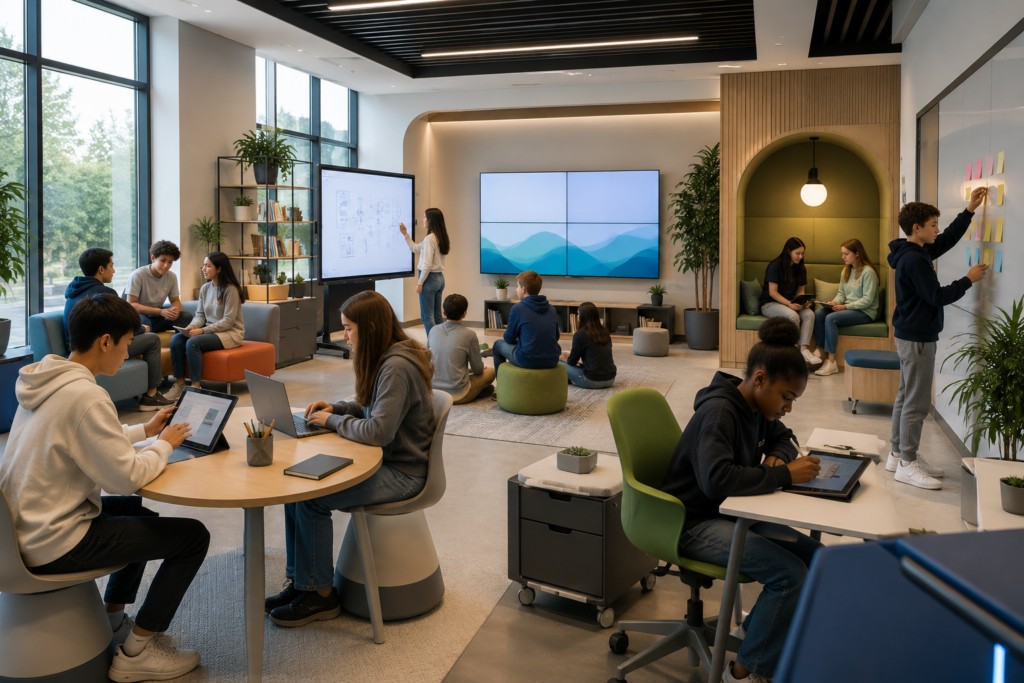
If we remove the constraints of synchronized time blocks and whole-group pacing, the potential of AI becomes clear. Instead of a rigid schedule, learners operate within a continuously adaptive learning environment.
1. From Lecturer to Systems Designer
The teacher’s role shifts from being the primary source of information to becoming a systems designer and intervention specialist.
* AI Orchestration: Tools like Khanmigo or OpenAI-based tutoring agents act as always-on guides, adjusting difficulty in real-time and surfacing misconceptions immediately.
* Data-Driven Intervention: Teachers use analytics from platforms like Google Classroom or Canvas to monitor real-time data across domains. They intervene selectively, focusing their human expertise on areas requiring ethical reasoning, emotional support, or complex judgment.
2. Interactive, On-Demand Content
Instructional content is no longer static. It becomes an interactive, multimodal experience generated on demand.
* Simulation over Description: Instead of reading about ancient irrigation systems, a learner might enter a real-time simulation powered by Unreal Engine and generative AI. They can experiment with variables in a simulated Nile environment, receiving immediate feedback on their decisions.
* Knowledge as Application: Learning becomes inseparable from experimentation. History, science, and literature are experienced rather than just consumed.
3. Continuous, Process-Based Assessment
Assessment moves away from periodic, high-stakes testing toward continuous evidence capture.
* Tracking the Journey: Every interaction with an AI system generates data on reasoning processes, decision-making patterns, and persistence. Tools like Turnitin’s AI analytics or emerging “process-based” platforms track how a learner arrives at an answer, not just whether it is correct.
* Living Portfolios: Students build automatic portfolios containing annotated transcripts, drafts, and reflections that demonstrate growth over time, providing a holistic view of their capabilities.
4. Intelligent Collaboration and Disposition Building
Collaboration is restructured through AI-driven grouping systems that analyze learner profiles to create teams with complementary strengths and perspectives.
* AI Copilots: Within these teams, learners may use personalized AI agents for specific roles, such as fact-checking or design critique.
* Metacognition: Systems are designed to explicitly measure and develop dispositions like resilience and ethical awareness. An AI tutor might intentionally introduce ambiguity, requiring the learner to evaluate sources and justify decisions, thereby cultivating habits of mind alongside academic skills.
5. Boundless Learning
Finally, learning extends beyond the institutional walls. Persistent AI companions maintain continuity between formal and informal contexts. A project begun in class can be refined at home or in a community setting, with the AI tracking progress and suggesting next steps. These tools serve as long-term cognitive partners rather than task-specific assistants.
The Dinosaur Dilemma
The shift from a delivery mechanism to an adaptive ecosystem requires more than just buying new software. It requires a fundamental redesign of how we view education.
Currently, schools are investing billions in AI tools and creating national policies for AI literacy, yet they remain unwilling to make the hard political and structural choices needed to transform the workflow. This is akin to “paving the cow path”—automating inefficiency rather than eliminating it.
The industrial workflow of K–12 education can be likened to the fate of the dinosaurs. The COVID-19 pandemic was the first asteroid to disrupt this timeless way of life, forcing a sudden, albeit temporary, shift. The birth of ChatGPT in November 2022 was the second.
Despite these massive environmental shifts, the traditional school model plods on. It is dimly aware that new conditions may ensure its demise, yet it remains unable or unwilling to adapt. If we continue to bolt smart AI onto dumb workflows, we risk not just wasted resources, but the obsolescence of an entire system. The tools are ready; the question is whether we are ready to change the path.