Human teams often collapse under the weight of their own numbers. Add too many people to a project, and you get chaos. We assume the old adage holds true: too many cooks spoil the broth.
Ants don’t.
They get better.
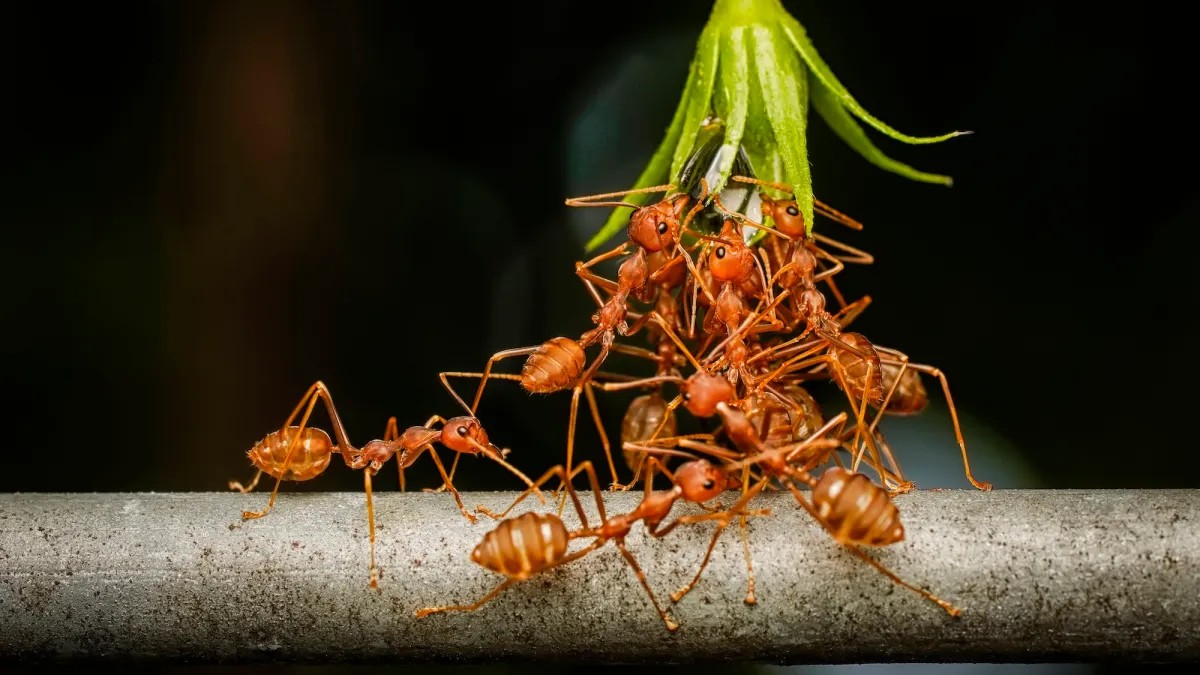
Ofer Feinerman, a behavioral ecologist at the Weizmann Institute of Science, started watching ants haul asymmetrical food back to the nest. It looked efficient. So efficient, in fact, that he wondered if the “too many cooks” rule even applies to insects.
The answer, published in the Journal of the Royal Society Interface, is no.
Adding more ants doesn’t just add muscle. It adds capability. Large groups tackle complex challenges small squads simply cannot.
How Ants Scale Their Intelligence
To test this, the lab didn’t just drop ants in a pile of sugar. They engineered a problem.
The team 3D-printed props with specific shapes and weights. To make sure the longhorn crazy ants (Paratrechina longicornis ) cared, the objects were stored in cat food overnight. The scent was irresistible.
Then came the mazes.
Laser-cut labyrinths of varying difficulty. The ants were placed inside. The key here was control. The weight of the objects scaled consistently with the number of ants.
Why? To isolate cooperation. If the load got heavier but the ants stayed the same, you’d just measure fatigue. By scaling both, Feinerman’s team could measure coordination.
They left the bait-laden mazes near the nests. Then they filmed.
Which Groups Succeed?
Small mazes? Easy.
Nearly every group size, regardless of member count, navigated the straightforward paths with small objects. No distinct advantage for the larger numbers here.
But change the variables, and the dynamic shifts.
Increase the maze complexity. Increase the load weight. Suddenly, the small groups flailed. They couldn’t synchronize. The larger teams? They thrived.
Larger ant colonies were far more efficient.
This held up even when gravity became a factor. When the maneuvers required the ants to account for physical forces rather than just brute force, the large groups still outperformed the small ones.
It’s not just about strength. It’s about distributed problem-solving.
Can Machines Mimic Ant Wisdom?
Feinerman’s team didn’t stop at biology. They ran computer simulations.
Could machine learning programs handle the same mazes by applying physical theories and forces?
The results offered a glimpse into why the colonies work.
Simple gravity-based models worked for the simple puzzles. As Feinerman put it:
“If one were to take the maze… tilt it and shake the whole thing, [the] load would eventually fall out.”
That’s physics. Predictable. Static.
But the complex mazes? Those failed under simple gravity models.
To solve the harder scenarios, the simulation needed to introduce “ant-like” properties. Specifically, a distributed nature. Gravity wasn’t acting on a single center of mass. It was affecting different points on the object every few seconds.
The ants don’t calculate. They react. Locally. Simultaneously.
Why It Isn’t a Hive Mind
Here’s the trap: watching ants work together feels like watching a single brain.
It’s tempting to call it a hive mind. A collective consciousness.
Feinerman’s research pushes back on this.
The simulations showed that the ants aren’t using advanced cognition. They’re using simple rules.
“The ants do not require such [outside] tuning and appear to use the same rules… without any outside information.”
Contrast that with the machine learning programs. They required outside tweaking. Designers had to adjust the code depending on the specific maze.
The ants? They just walked.
The findings suggest ant colonies scale their ingenuity based on size, yes. But it’s emergent behavior, not centralized intelligence. Each ant is random. Unknowing.
They rely on local interactions.
This distinction matters for artificial intelligence. We often look for human-like logic in our algorithms. But the ants offer a different path. A path that doesn’t require a central commander. Or a programmer.
Just rules. And numbers.
The maze is still open. The question is whether our current models of cooperation can adapt to this chaotic, distributed efficiency. Or if we’ll keep trying to fit square pegs into round holes.
The ants already know the answer. We’re just catching up.