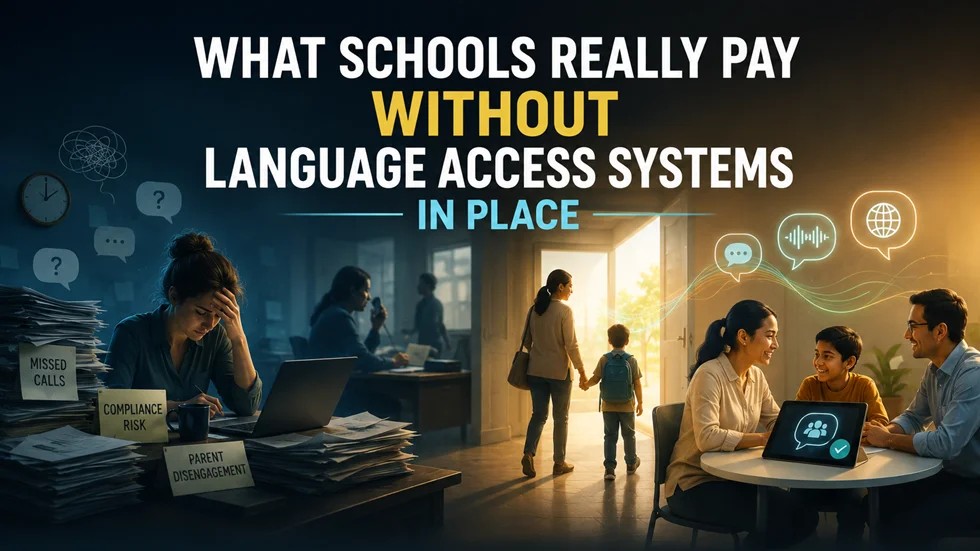
You hired one district interpreter for the big IEP meetings. Meanwhile your front office staffer fields calls in three languages she barely speaks. A bilingual teacher gets pulled out of her class again, stuck translating a disciplinary hearing she has no time for.
None of this shows up as a line item. But it costs you. Every time.
This isn’t an edge case. In England 20.8 percent of state-school pupils have a home language other than English. In London 44 percent do. In US public schools 5.3 million kids—over ten percent of the population—are English Learners.
At this scale treating language access like a staffing problem is a mistake. You hire interpreters where you can. You train staff until they break. Then you pay the hidden tax in burnout legal risk and families who stop showing up.
The Calendar Illusion
Most schools cover the calendar events. They miss the rest of the day.
Schedule an interpreter for an IEP meeting? Good job. You covered one interaction. What about the other forty moments that family has with your school this year?
In North Carolina’s Greene County Schools 35.4 percent of students are Hispanic or Latino. Principal Patrick Greene knows the drill. He has one district interpreter.
He has to schedule official meetings like disciplinary hearings around that person’s calendar. Everything else? The nurse’s calls. The daily front-desk chats. The registration desk. The parent showing up at 3 pm worried about grades? That runs on improvisation.
The Workaround Tax
Administrators look at last year’s interpreter invoice. They think that’s the cost.
They’re missing the bulk of the expense. There are four hidden lines here.
1. Bilingual Staff Burnout
Karla Vázquez Baur teaches in Miami-Dade. From 2017 to 019 she got called out of her own room to interpret for other teachers.
“I did not realize… this was against their right,” she said.
Seattle took this further. The teachers union picketed in 2022. They delayed school starts. One of their demands? Stop forcing bilingual staff to translate outside their job descriptions. Provide actual interpretation services.
A union went on strike over language access.
That’s the visible cost. The invisible cost? Turnover. Emotional exhaustion. A front-office staffer crying during an expulsion hearing because she had no training but had to interpret anyway.
2. Compliance Exposure
Title VI of the Civil Rights Act says you must communicate in a way parents understand.
The Department of Education is clear on this. You cannot rely on students or untrained staff. You must provide interpretation for IEPs disciplinary proceedings enrollment.
Dayton Public Schools learned this the hard way. In 2022 OCR forced a settlement. The district had to translate everything: report cards emergency notices IEPs handbooks.
In the UK it’s the Equality Act 2015. Fail to make practicable adjustments for language barriers and you’re committing indirect discrimination. The courts take this seriously.
3. Family Disengagement
A 2019 analysis of 448 studies covered nearly half a million families. The finding was consistent.
Parental involvement moves student achievement. It doesn’t matter what the family’s age or background is. The correlation holds.
When you ration language access to formal events you cut the cord on these everyday interactions. The parent who can’t understand why her child was sent home? She isn’t disengaged because she doesn’t care.
She’s disengaged because the system made it impossible to connect.
Building Real Infrastructure
Language access shouldn’t be a series of bookings.
It should be IT. An operational layer. Budgeted. Owned by someone. Always on.
Until recently that was impossible. Keeping human interpreters on call for every hour every language is too expensive.
AI changes the math.
Real-time voice translation is hitting human-level quality. In a 202 study journalists listened to either a human or an AI during a complex climate press conference. The human score: 4.5. The AI score: 3.7.
In a high-stakes nuance test that gap is real. But for a school nurse calling about a fever? For a front-desk question about enrollment dates? AI is good enough now.
Studies lag by a year. The tools you can use today are already past that benchmark.
Where To Start
Map the surface.
Which interactions need translation? What languages? How often?
Look at who is doing the work. Interpreters? Bilingual staff? Google Translate? Sometimes children.
Then cost the gap. Add the interpreter spend to the staff hours wasted to the legal risk. Add the value of the parents you aren’t reaching.
That number will shock your board.
Compare the patchwork to the always-on infrastructure. The question isn’t anymore about quality. It’s about whether a real-time tool for the whole day costs less than the current workaround.
For most schools it does. The tooling exists. The hard part is admitting the old way was broken.
Language access isn’t a line item. It’s the operating system of your community trust.