A breakthrough in paleontological imaging has provided the first direct evidence that the ancestors of mammals laid eggs. By analyzing 250-million-year-old fossils, scientists have bridged a critical gap in our understanding of how early mammalian lineages transitioned from egg-laying to live birth, and how they survived one of Earth’s most catastrophic eras.
Solving a Biological Mystery
For decades, paleontologists have operated on an assumption: that therapsids —the group of ancient animals from which mammals eventually evolved—laid eggs, much like modern monotremes (such as the platypus). However, despite numerous finds, a physical specimen of a synapsid egg had never been found in the fossil record.
This discovery, led by Julien Benoit of the University of the Witwatersrand, changes that. By using advanced non-invasive imaging techniques, including X-ray microcomputed tomography (CT) and synchrotron radiation computed tomography (SRCT), researchers were able to look inside fossilized rock nodules to see what was hidden within.
Evidence from the Fossil Record
The research focused on three specimens of Lystrosaurus, a pig-sized, tusked herbivore. The team identified several key indicators that these animals were preserved in or near the state of hatching:
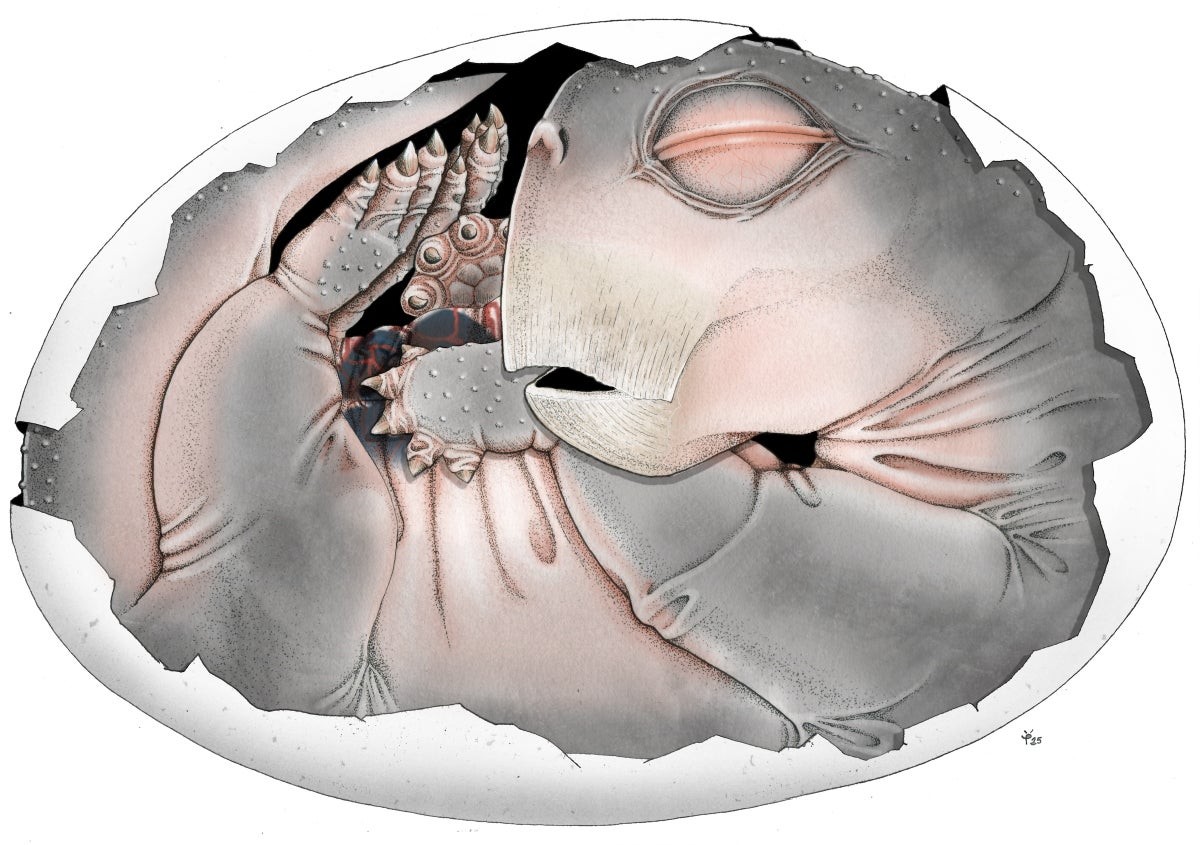
- Embryonic Posture: In the youngest specimen, the curled body of the embryo perfectly matched the ovoid shape of an egg.
- Skeletal Immaturity: The disjointed pelvis, ribs, and vertebrae suggested the animal lacked the structural strength to support its own weight on land.
- The Unfused Jaw: Most critically, the lower jaw of the youngest specimen had not yet fused. In modern birds and turtles, the jaw fuses before birth to allow the hatchling to feed immediately. The unfused jaw in Lystrosaurus strongly indicates it died before hatching.
While two of the specimens showed signs of being more mature (one even appearing to have traveled some distance after hatching), the youngest provided the “smoking gun” for their reproductive method.
An Evolutionary Advantage in a Dying World
The timing of this discovery is significant. Lystrosaurus lived around 252 million years ago, a period marked by the Permian mass extinction —an event that wiped out roughly 90% of all species on Earth.
While most life struggled, Lystrosaurus flourished, becoming the most dominant land vertebrate on a planet plagued by extreme heat and intense droughts. Scientists believe their egg-laying biology may have been a primary reason for this resilience:
- Moisture Retention: The eggs were likely large with soft, leathery shells. Larger eggs have a lower surface-to-volume ratio, making them much more resistant to drying out in arid environments.
- Advanced Development: In the animal kingdom, larger eggs typically produce more highly developed offspring. This allowed Lystrosaurus young to emerge more capable of surviving the harsh, post-extinction landscape.
The absence of previous egg fossils is likely explained by the nature of the shells themselves; soft, leathery membranes do not fossilize as easily as the hard, calcified shells of modern birds.
Conclusion
This discovery confirms that egg-laying was a vital survival strategy that allowed mammal ancestors to dominate the planet following a mass extinction. It provides a clearer picture of the evolutionary bridge between ancient reptiles and the diverse mammalian world we see today.