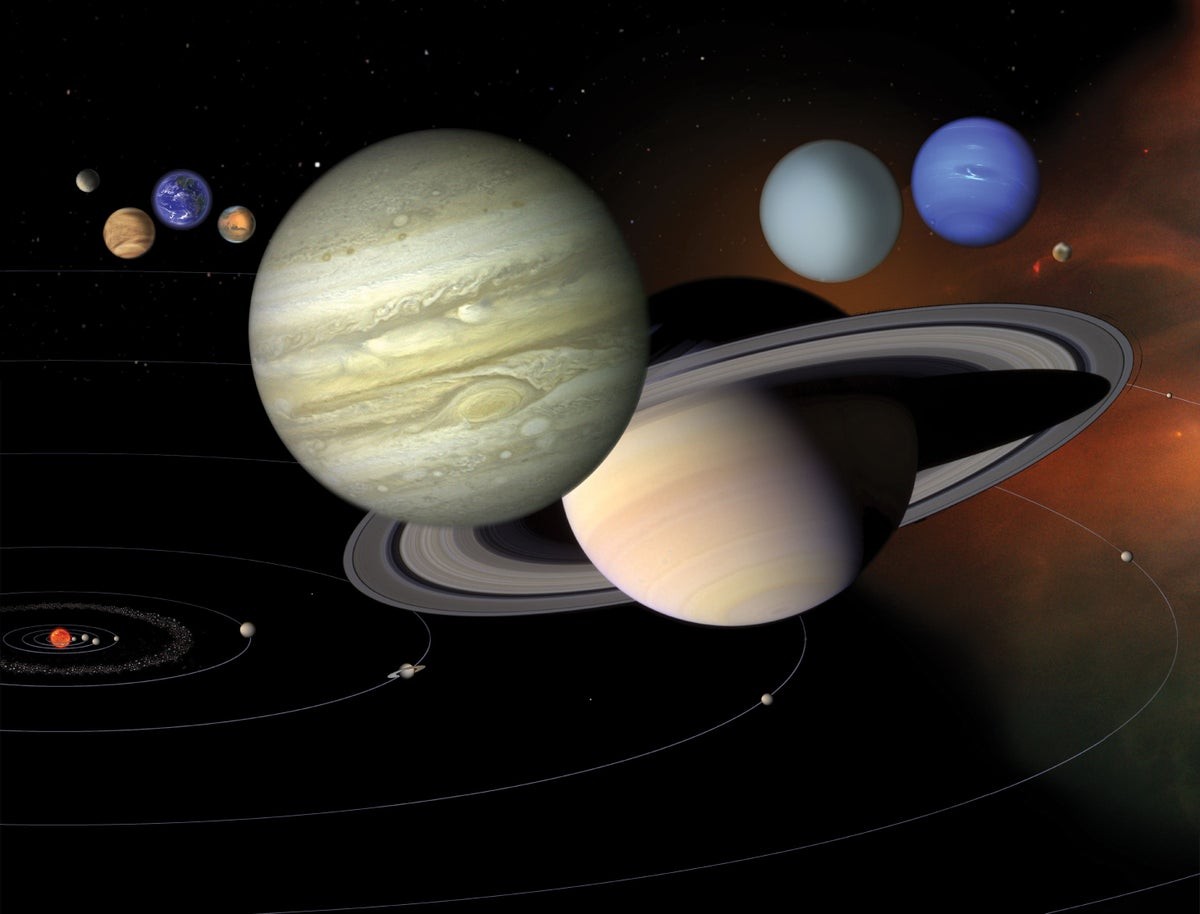
The planets in our solar system are defined by their extremes. From gas giants so massive they dwarf entire worlds to frozen rocks drifting in the dark, the diversity of our celestial neighborhood is staggering. But if we define “weirdness” by how much a planet defies our expectations of what a world should be, the title becomes a matter of intense debate.
Each planet offers a different brand of strangeness, ranging from atmospheric nightmares to gravitational anomalies.
The Contenders for Most Unusual
Depending on which scientific lens you use—chemistry, physics, or orbital mechanics—different worlds emerge as the primary candidates for the solar system’s oddest inhabitant.
Venus: The Hellish Twin
Often called Earth’s “evil twin,” Venus is a masterclass in runaway extremes. A massive greenhouse effect has choked the planet in carbon dioxide, creating surface pressures 90 times higher than Earth’s and temperatures exceeding 460°C (860°F). Its clouds are composed of sulfuric acid, making the surface a lethal wasteland.
* The Silver Lining: Interestingly, at an altitude of 50–60 kilometers, the pressure and temperature mimic Earth’s sea level, suggesting that floating habitats could theoretically exist in its upper atmosphere.
Jupiter: The Colossal Hybrid
Jupiter is less a solid planet and more a massive, chaotic bag of hydrogen and helium. As you descend into its atmosphere, the gas transitions into a bizarre liquid mix, eventually becoming metallic deep within. Unlike Earth’s clearly defined layers, Jupiter’s core is likely a “fuzzy,” mushy mix of rock and metal. Its magnetic field is so vast that if it were visible, it would appear larger than the full moon in our sky.
Mercury: The Planet of Paradoxes
Mercury defies logic through its strange relationship with the Sun. It is locked in a gravitational dance that causes it to spin three times for every two orbits around the Sun. This, combined with an elliptical orbit, creates a bizarre visual effect: in certain spots, the Sun can rise, set, and rise again all in one “day.” Furthermore, despite being scorched by solar radiation, its poles harbor deep, dark craters filled with water ice.
Uranus: The Tilted Giant
Uranus is a world defined by a catastrophic past. It orbits the Sun on its side, with an axial tilt of 98 degrees, likely caused by a massive collision eons ago. This results in extreme seasons that last 21 Earth years. To add to the strangeness, its magnetic field is offset from its center by 8,000 km, and scientists suspect it may even “rain” diamonds deep within its atmosphere.
Saturn: The Floating Hexagon
Saturn is famous for its rings, which are composed of ice particles that, if gathered together, would form a moon less than 400 km wide. It is famously less dense than water, meaning it would float in a giant bathtub. Perhaps most striking is the hexagonal vortex at its north pole—a massive, six-sided atmospheric storm so large that Earth could fit inside one of its sides.
Mars and Neptune: Extremes of Wind and Color
- Mars flips Earth’s color palette: it features a butterscotch sky and blue sunsets due to its iron-oxide-rich dust.
- Neptune hosts the solar system’s fastest winds—reaching 2,200 km/h —powered by internal heat despite receiving only 0.1% of the sunlight that Earth does.
The Ultimate Anomaly: Earth
While the other planets are spectacular in their chaos, they are all, in a sense, predictable in their extremes. Earth is the true outlier.
Our planet possesses several unique characteristics that set it apart from every other known world:
1. Plate Tectonics: Earth is the only planet known to have large slabs of rock that constantly slide and buckle, reshaping the surface.
2. A Massive Moon: Relative to its size, Earth has an unusually large moon, a ratio far higher than any other major planet.
3. The Triple State of Water: Because of our specific distance from the Sun and our unique atmosphere, water can exist simultaneously as a solid, liquid, and gas.
This “water trinity” is the engine of our world. The water cycle acts as a planetary conveyor belt, transporting minerals and nutrients that allow for complex chemistry. Over billions of years, this unique environment allowed simple molecules to organize into the most complex phenomenon in the known universe: life.
In a solar system filled with giants, storms, and acid clouds, the strangest thing of all is a world capable of supporting biological complexity.
Conclusion
While other planets boast spectacular storms or impossible temperatures, Earth remains the most unique. Its ability to maintain liquid water and active geology has created a biological miracle that remains unmatched in the vastness of our solar system.