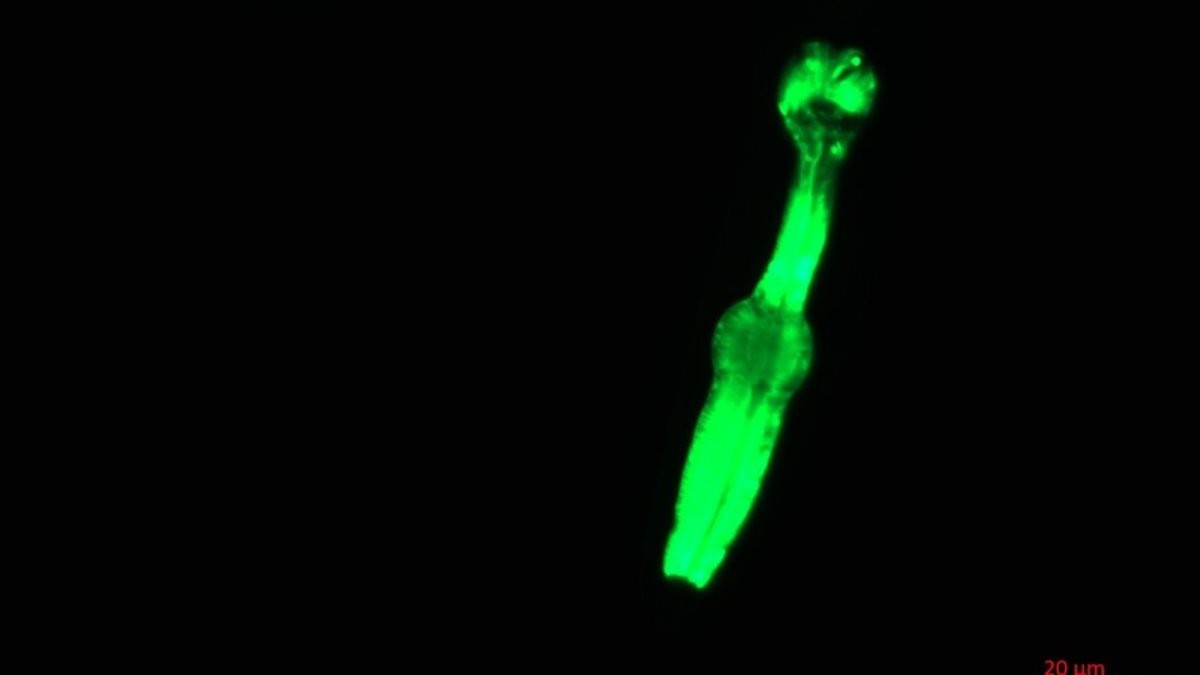
While human astronauts have recently returned to Earth, a new group of travelers is already heading back into orbit. On April 11, NASA’s Commercial Resupply Services 24 (CRS-24) mission launched from Cape Canaveral, Florida, carrying more than just supplies. Among the 11,000 pounds of cargo aboard the Northrop Grumman Cygnus XL spacecraft is a specialized biological payload: a population of tiny nematodes known as Caenorhabditis elegans.
Why “Space Worms” Matter for Human Health
At first glance, a vat of 1-millimeter-long worms may seem an unlikely substitute for human subjects. However, these organisms are vital tools for biological research. Despite their size, C. elegans share many fundamental biological processes with humans, making them an ideal model for studying how living organisms respond to extreme environments.
The primary goal of this mission is to address the physiological hurdles of long-duration spaceflight. As NASA’s Artemis program prepares to establish a permanent presence on the Moon and eventually sends humans toward Mars, scientists are facing a critical question: How can we keep the human body healthy during years of exposure to microgravity and radiation?
Current data highlights the severity of these challenges:
– Physical Degradation: Long stays in microgravity lead to significant bone density loss and muscle atrophy.
– Sensory Issues: Astronauts often experience vision changes and neurological shifts.
– Radiation Risks: Deep space lacks the protective shield of Earth’s atmosphere, exposing travelers to much higher levels of cosmic radiation.
As noted by Frank Rubio, who set a record for the longest single-person tenure in space (371 days) in 2023, even a year in orbit requires extensive physical reconditioning upon return. To move beyond short-term stays, we must understand these biological impacts at a cellular level.
The Experiment: From Lab to the ISS Exterior
The research, led by scientists at the University of Exeter, involves a sophisticated multi-stage process once the cargo reaches the International Space Station (ISS):
- Arrival and Setup: Crewmembers will move the “Petri Pod”—a multichamber housing unit—into an onboard laboratory.
- External Exposure: Using the station’s robotic arm, astronauts will mount the nematode habitat on the outside of the ISS.
- Controlled Environment: For up to 15 weeks, the worms will live in specialized containers that regulate temperature, pressure, and oxygen, while still exposing them to the harsh realities of zero gravity and space radiation.
- Observation: Researchers on Earth will monitor the worms using time-lapse photography, fluorescent optics, and high-resolution video to track their health and biological responses in real-time.
Looking Ahead
By studying how these nematodes react to radiation dosages and microgravity, the University of Exeter team aims to gather data that will inform future medical protocols for astronauts. These findings are expected to help design better countermeasures—such as nutritional interventions or medical treatments—to protect human explorers.
“It might sound surprising, but these tiny worms could play a big role in the future of human spaceflight,” remarked U.K. Space Minister Liz Lloyd.
Conclusion
By using microscopic organisms to model complex biological reactions, scientists are building the foundational knowledge necessary to protect the next generation of explorers as humanity ventures further into the solar system.