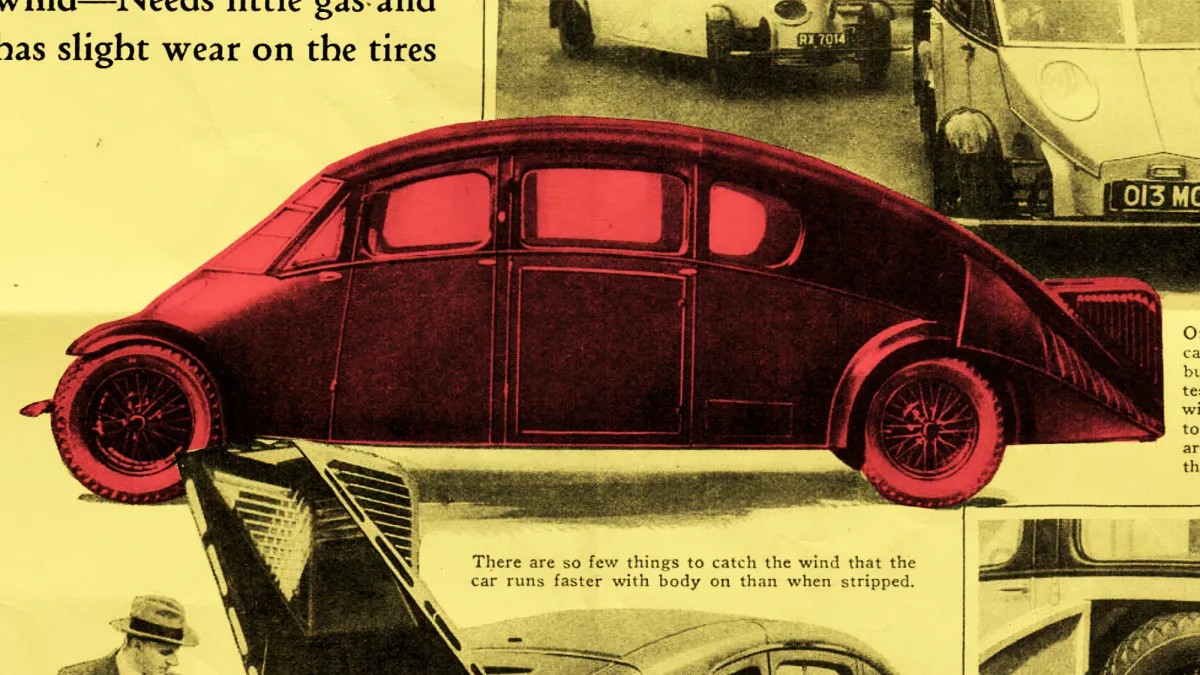
For nearly a hundred years, automotive engineers and designers have been locked in a battle against an invisible enemy: air resistance. While the laws of physics have remained constant, the way humans respond to the shapes those laws demand has changed—and yet, remarkably, not at all.
The “teardrop” shape—a blunt, rounded nose tapering into a long, sleek tail—is the aerodynamic holy grail. It allows air to flow smoothly around a vehicle and rejoin cleanly in its wake, minimizing the turbulence that drags a car backward. But as history shows, being scientifically correct doesn’t always mean being commercially successful.
The Pioneers of Streamlining
In the early 1930s, two thinkers arrived at the same conclusion from completely different directions.
The Engineering Approach: Chrysler’s Quest for Efficiency
Carl Breer, Chrysler’s head of automotive research, approached the problem through rigorous testing. After consulting with aviation pioneer Orville Wright, Breer built wind tunnels to prove a startling fact: early cars were more aerodynamic running backward than forward. His “boxy behemoths” were essentially motorized bricks.
Working with his team, known as the “Three Musketeers,” Breer developed the Chrysler Airflow. Introduced in 1934, it was a marvel of engineering designed to slice through the wind. However, the market rejected it. Critics mocked its appearance, calling it “rhinocerine” or “bug-eyed,” and consumers—unconcerned with fuel economy in an era of cheap gasoline—preferred the traditional, status-driven boxy shapes.
The Visionary Approach: Buckminster Fuller’s Dymaxion
Simultaneously, futurist Buckminster Fuller was sketching blueprints for a teardrop car based on mathematical diagrams of wind resistance. His creation, the Dymaxion, was an ambitious, three-wheeled aluminum shell designed to “do more with less.”
While conceptually brilliant, the Dymaxion was plagued by practical failures. It suffered from stability issues at high speeds and lacked basic safety architecture. Following a fatal crash in 1933, the project collapsed, proving that even the most radical designs can be undone by engineering flaws and a lack of public trust.
Why the Teardrop Failed to Take Root
If the physics were indisputable, why did the teardrop shape fail to dominate the 20th century? The answer lies in a combination of economics and aesthetics:
- The Era of Cheap Fuel: For much of the 1900s, gasoline was so inexpensive that fuel efficiency was a secondary concern. Manufacturers and drivers prioritized style, size, and presence over aerodynamic drag.
- Aesthetic Rejection: Consumers found the smooth, flowing lines of aerodynamic cars “weird” or “unnatural.” It wasn’t until the 1940s, when General Motors introduced “Sport Dynamic” fastback profiles, that a version of this shape finally gained mainstream acceptance—and even then, it was eventually discarded in favor of the wide-bodied, finned designs of the 1950s.
- The “Box” Preference: Despite the efficiency of a teardrop, the market consistently moved toward SUVs, minivans, and pickups—vehicles that prioritize interior volume and rugged looks over wind resistance.
The Electric Revolution: Physics Reclaims the Driver’s Seat
We are currently witnessing a massive resurgence of aerodynamic design, driven by a new necessity: battery range.
In the era of internal combustion, drag was a matter of convenience. In the era of Electric Vehicles (EVs), drag is a matter of survival. Every bit of wind resistance shaved off a vehicle translates directly into more miles per charge. This has led to a new generation of “teardrop-inspired” leaders:
- The Lucid Air: Currently one of the most aerodynamic passenger cars in the world, boasting a drag coefficient of 0.197.
- The Mercedes-Benz EQS: A leader in efficiency with a coefficient of 0.20.
- The Hyundai Ioniq 6: A mainstream contender that brings aerodynamic principles to a wider audience.
The Persistent Conflict: Science vs. Style
Despite these breakthroughs, the old pattern persists. Many modern EVs are criticized for looking like “jellybeans” or “eggs.” Consequently, many manufacturers are opting for boxier, less efficient silhouettes—like the Hyundai Ioniq 5 or the Rivian R2—because they know that even in the age of electricity, consumers still gravitate toward the “box.”
The teardrop wins the physics argument every time, but it continues to lose the marketing battle.
Conclusion
The history of the teardrop car is a reminder that technological progress does not move in a straight line. While we have finally mastered the science of moving through the air, we have yet to master the human tendency to prioritize familiar, boxy shapes over aerodynamic perfection.