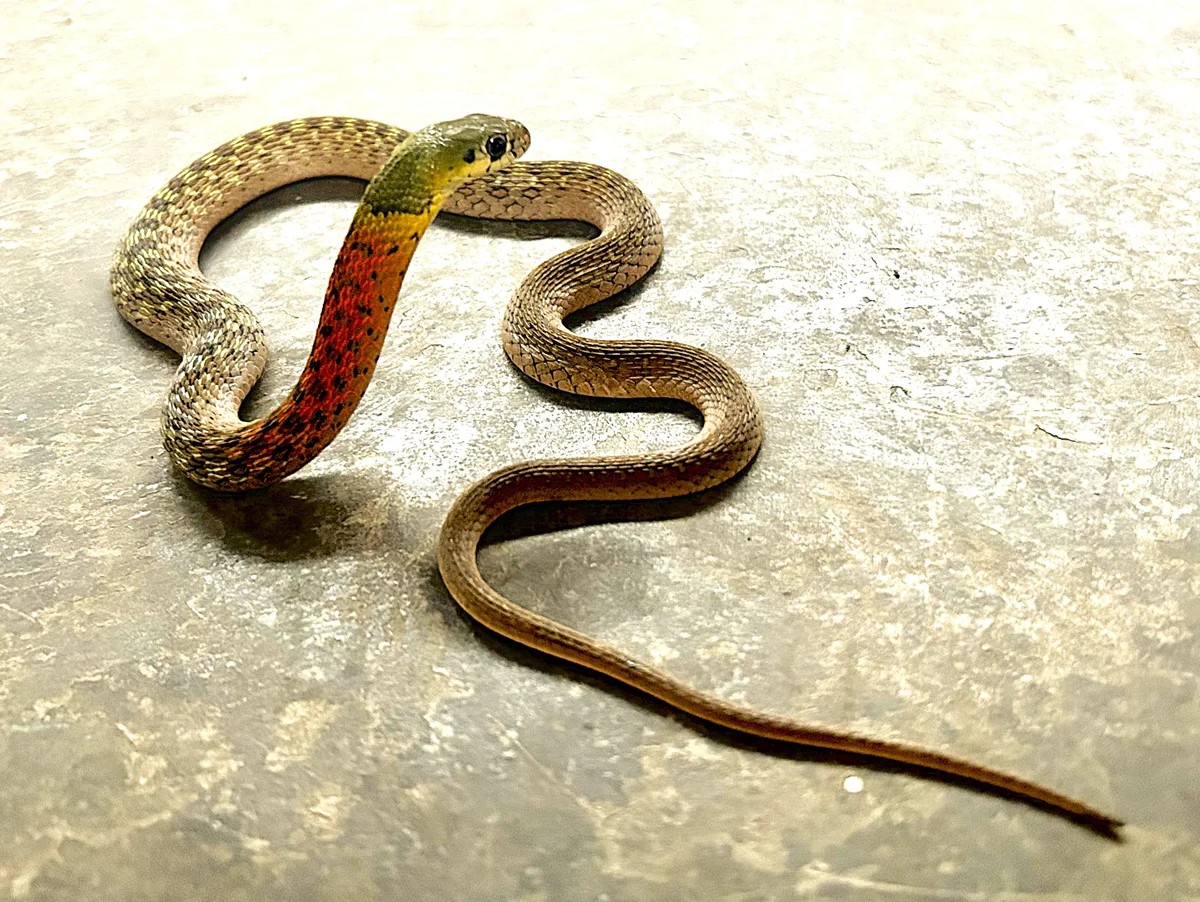
Red-necked keelback snakes, found in Asia, are notorious for their potent toxicity. However, they don’t make the poison themselves. Instead, they steal it from the poisonous toads they consume, storing it in specialized glands in their necks. This stolen toxin can incapacitate predators like mongooses with alarming speed, yet the snakes seem to operate on a surprisingly simple rule: they act fearless regardless of whether they’re full of poison or not.
The Poison-Stealing Strategy
These snakes accumulate toxins from the skin of true toads (Bufonidae family). The poison, called bufadienolide, is absorbed into the snake’s intestines and then transported to nuchal glands—storage pockets in the neck. When “loaded,” the snakes boldly confront potential threats, puffing up their necks as a warning.
For years, scientists suspected these snakes could somehow sense their toxin levels, adjusting their behavior accordingly—much like pit vipers that feel “fullness” in their own venom glands. But new research challenges this idea.
The Experiment: Fake Attacks
Researchers at Nagoya University in Japan tested this assumption. They fed 23 wild keelbacks either toxic toads or non-toxic prey. Afterward, the snakes were subjected to simulated attacks (pinned down with a hook, mimicking a mongoose). Critically, the scientists emptied the snakes’ nuchal glands before a second round of testing.
The results were startling: the snakes displayed the same aggressive defense behavior whether they had poison or not. They didn’t appear to realize their toxin reserves were depleted.
Why Don’t They Check?
Deborah Hutchinson, a snake biologist not involved in the study, suggests the snakes may not have a way to accurately assess their poison stores. The lead researcher, Tomonori Kodama, believes they may instead rely on memory: remembering whether their last meal was toxic.
One possible explanation, according to evolutionary biologist Kurt Schwenk, is that these snakes replenish their toxin supply frequently enough in the wild that monitoring levels simply isn’t necessary.
The fact that these snakes don’t seem to monitor their reserves suggests that, in their environment, consistent exposure to toxic prey makes it an irrelevant concern.
In essence, these snakes gamble on having enough poison when needed, and so far, it works. Their bold behavior, even when unarmed, highlights how evolutionary strategies don’t always require complex feedback systems—sometimes, a simple bluff is enough.