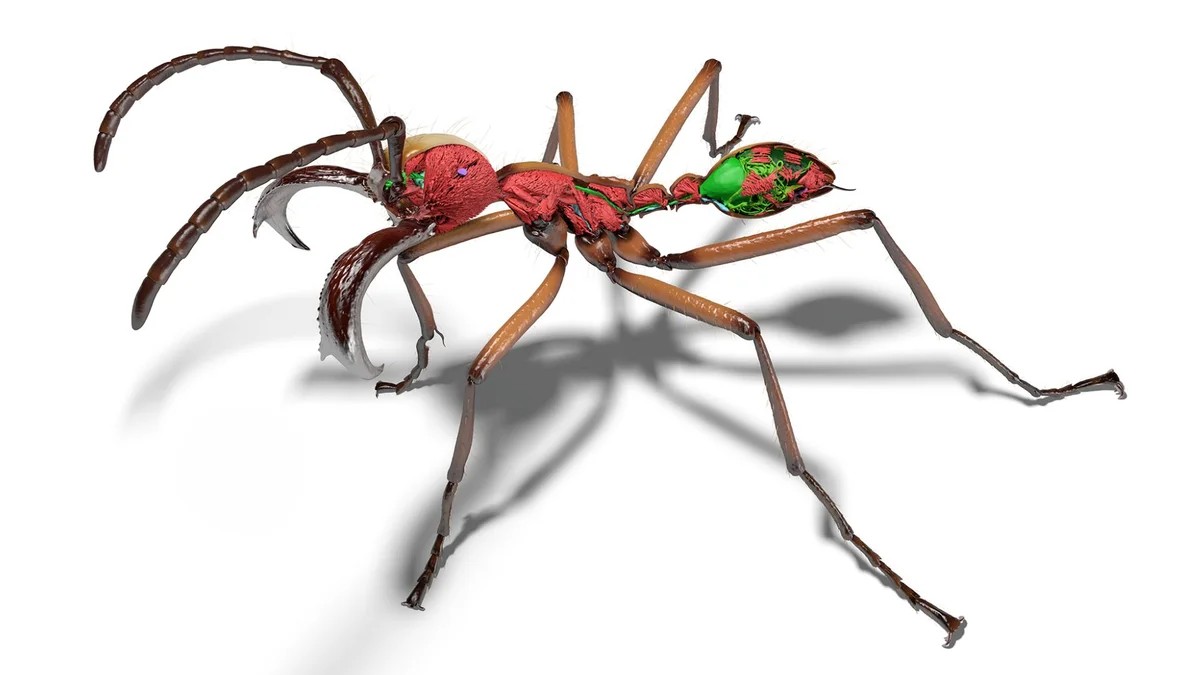
Researchers have unveiled Antscan, a comprehensive digital library containing high-resolution 3D scans of over 2,100 individual ants from 212 different genera. This project, published in Nature Methods, marks a significant leap in biodiversity research by utilizing advanced imaging technology to catalog the anatomy of these ubiquitous insects.
The Scale of the Project
Ants are one of the most abundant and diverse animal groups on Earth, estimated to number over 20 quadrillion individuals. Their widespread presence and complex behaviors make them crucial for understanding ecological systems. However, cataloging their diversity has been historically challenging due to sheer numbers and the difficulty of detailed anatomical study.
The team addressed this by gathering preserved ant specimens from museums and collections worldwide. Instead of traditional CT scans, they used a synchrotron – a type of particle accelerator – to generate exceptionally detailed x-ray images. This method allowed for rapid scanning, capturing around 3,000 images per ant in just seconds.
How Synchrotron Technology Works
Synchrotrons accelerate charged particles to near-light speed around a circular track. As these particles accelerate, they emit intense x-ray beams capable of penetrating even the smallest specimens with great precision. This approach drastically reduced scanning time while simultaneously increasing image quality. The resulting scans reveal intricate details of the ants’ exoskeletons, muscles, nervous systems, and digestive tracts – including previously unknown anatomical features and parasites.
Significance for Biodiversity Research
Antscan isn’t just a collection of scans; it represents a scalable framework for digitizing entire species groups. The publicly accessible data will allow researchers to analyze ant anatomy in unprecedented detail, uncover evolutionary relationships, and identify unique traits across different genera.
“This project shows a pathway toward scaling this up to, eventually, all species,” says Evan Economo, a senior author of the study.
This digitization strategy could be applied to other insect groups, providing a more complete picture of insect evolution. The library will serve as a permanent record for studying ant morphology and behavior, accelerating future biodiversity research efforts.
The creation of Antscan demonstrates how cutting-edge technology can unlock insights into the natural world, providing a powerful tool for understanding and preserving biodiversity in an era of rapid environmental change.