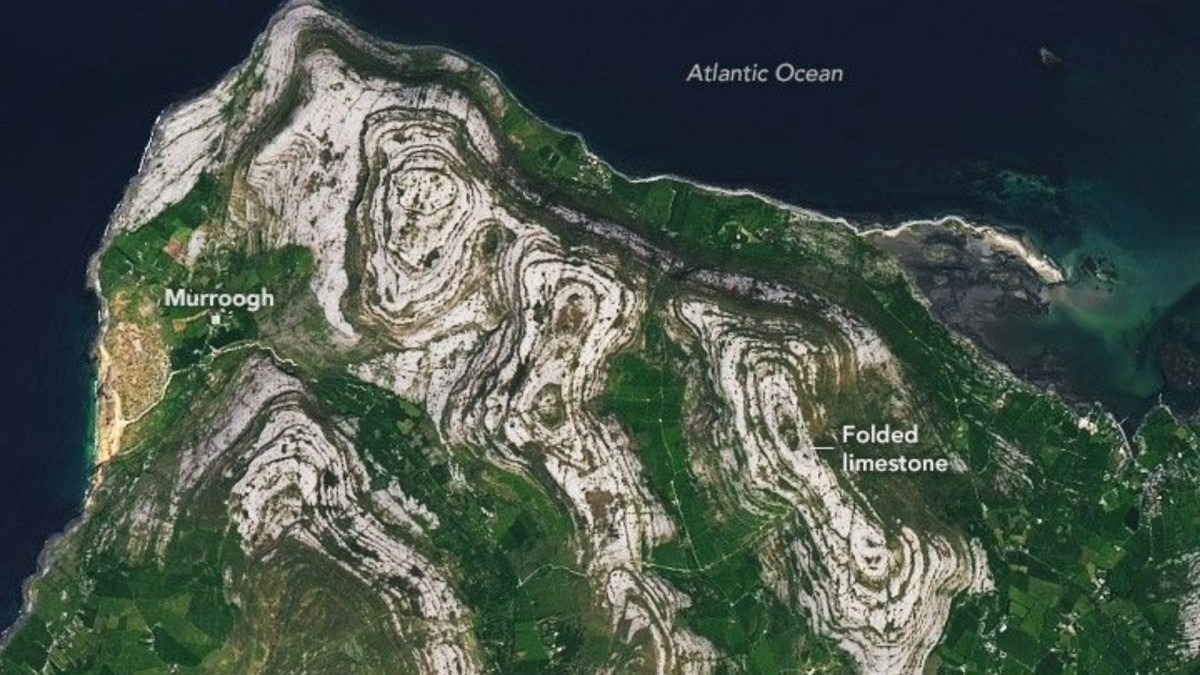
Ireland is famous for its vibrant green countryside, but one area stands out with an entirely different color palette: the Burren region. Located along the western coast, this unique landscape is dominated by gray limestone pavement stretching across rocky, treeless terrain. A recent image captured by NASA’s Landsat 8 satellite reveals the stark beauty of the Burren, including the imposing 860-foot Moneen Mountain, a peak composed entirely of this ancient rock.
A 325-Million-Year History
The limestone that forms the Burren isn’t a recent geological feature; it began as sediment deposited roughly 325 million years ago during the Carboniferous Period. At that time, Ireland sat closer to the equator, submerged under warm, shallow seas. Over millions of years, these horizontal layers of limestone buckled and folded during the Variscan Orogeny, a period of intense mountain-building activity.
Around 250 million years ago, the continents of Euramerica and Gondwana collided to form the supercontinent Pangaea. This collision further warped the rock layers, creating the stepped appearance seen today in the Burren. More erosion-resistant layers remained as ledges, while softer rock eroded away, resulting in the distinctive landscape. Glacial activity also played a role, scraping away soil and sediment to expose the underlying limestone.
Karst Topography and Hidden Life
Limestone is particularly susceptible to chemical weathering, a process that creates karst topography. This results in a landscape riddled with sinkholes, caves, and narrow fissures known as grikes. Many of these grikes collect soil, providing small pockets where vegetation can take root. Though individual grikes are too small to see in satellite images, groupings of them create the concentric patterns visible in NASA’s view of the Burren.
These grikes support a surprising variety of plant life, including clovers, ferns, and other hardy species. The area is even known for its occasional four-leaf clovers, growing amidst the gray rocks as a rare but charming sight.
The Burren is a remarkable example of how geological forces over millions of years can shape a landscape, creating both visual beauty and unique ecological niches. It stands as a testament to Ireland’s deep and dynamic geological history.