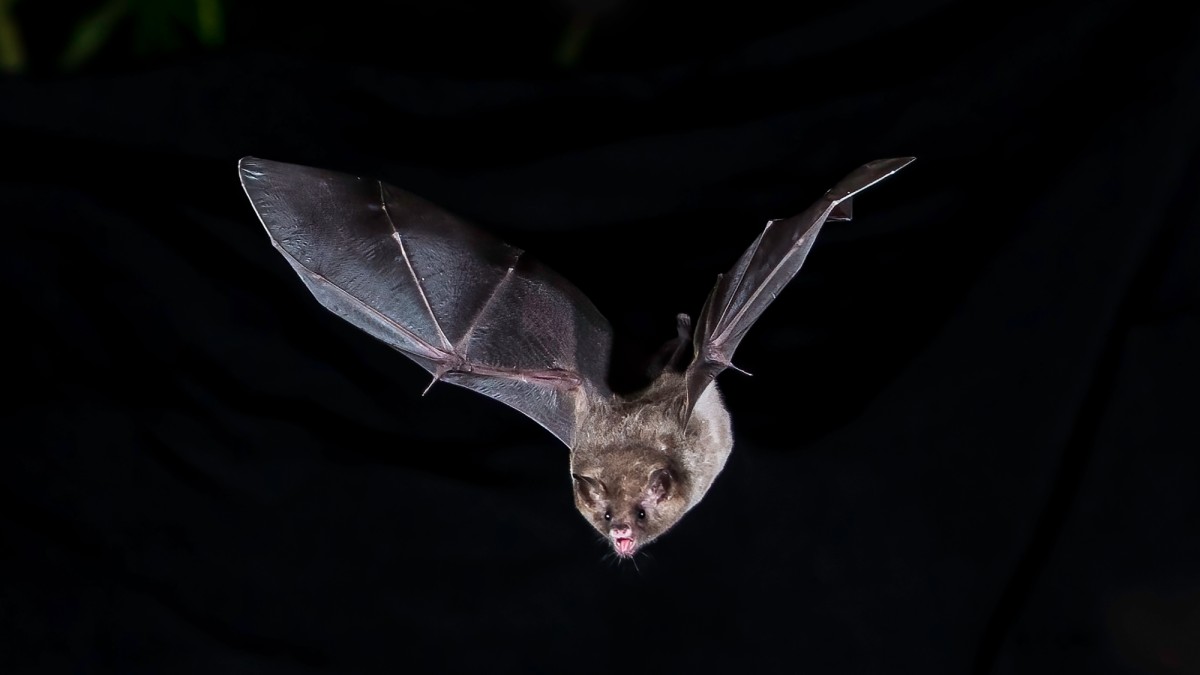
Researchers have built a robotic bat to unlock the secrets of how real bats hunt in complete darkness using echolocation. The study, recently published in the Journal of Experimental Biology, confirms long-held hypotheses about how bats efficiently identify prey hidden on leaves, even in dense jungle environments. This breakthrough provides valuable insight into a sensory system radically different from human vision.
Mimicking Nature’s Precision
Bats use echolocation by emitting high-frequency clicks and interpreting the returning echoes to build a sound-based “image” of their surroundings. This is similar to how autonomous vehicles use LiDAR, but bats achieve this with astonishing simplicity: just two ears and a mouth. Scientists have long known this, but the precise mechanics remained unclear, particularly how bats avoid being overwhelmed by echoes in cluttered habitats.
To understand this, a team led by bat scientist Inga Geipel created a robotic bat. The robot mimics the flight path of real bats, emitting sonar pulses to test how they determine if prey is present on leaves. The experiment revealed that bats don’t need to calculate the exact angle of every leaf; they simply filter for strong, consistent echoes. If a leaf holds prey, the returning signal is stronger, signaling a potential meal.
The Robot’s Design and Results
The robotic bat consists of a sonar emitter and binaural microphones mounted on a linear track, simulating flight. The robot tested 3D-printed leaves with and without artificial prey (dragonflies). The results were striking: the robot detected prey 98% of the time, while falsely identifying prey on empty leaves only 18% of the time. This confirms that bats rely on echo strength rather than precise angle calculations.
“Behavioral experiments had already suggested how these bats might solve the problem of finding prey-occupied leaves, but we wanted to know whether that explanation was actually sufficient to make the behavior work,” explained Dieter Vanderelst, co-author of the study.
Beyond This Study: Expanding Bat-Inspired Tech
This research builds on previous attempts to replicate bat behavior in robotics. In 2017, engineers created Robat, a wheeled robot that navigated solely using echolocation, and in 2015, scientists developed Bat Bot with flapping, shape-changing wings. However, Geipel’s team focused on functionality over aesthetics, prioritizing data accuracy.
Looking ahead, the researchers plan to apply this method to other bat species and explore how they differentiate between prey types. The study highlights that while we have only scratched the surface of understanding bats, the insights gained from robotic models are proving invaluable.
This study demonstrates that even in complex environments, simple yet effective biological strategies can thrive. The robot bat not only confirms scientific hypotheses but also opens new avenues for biomimicry in robotics and sensory technology.