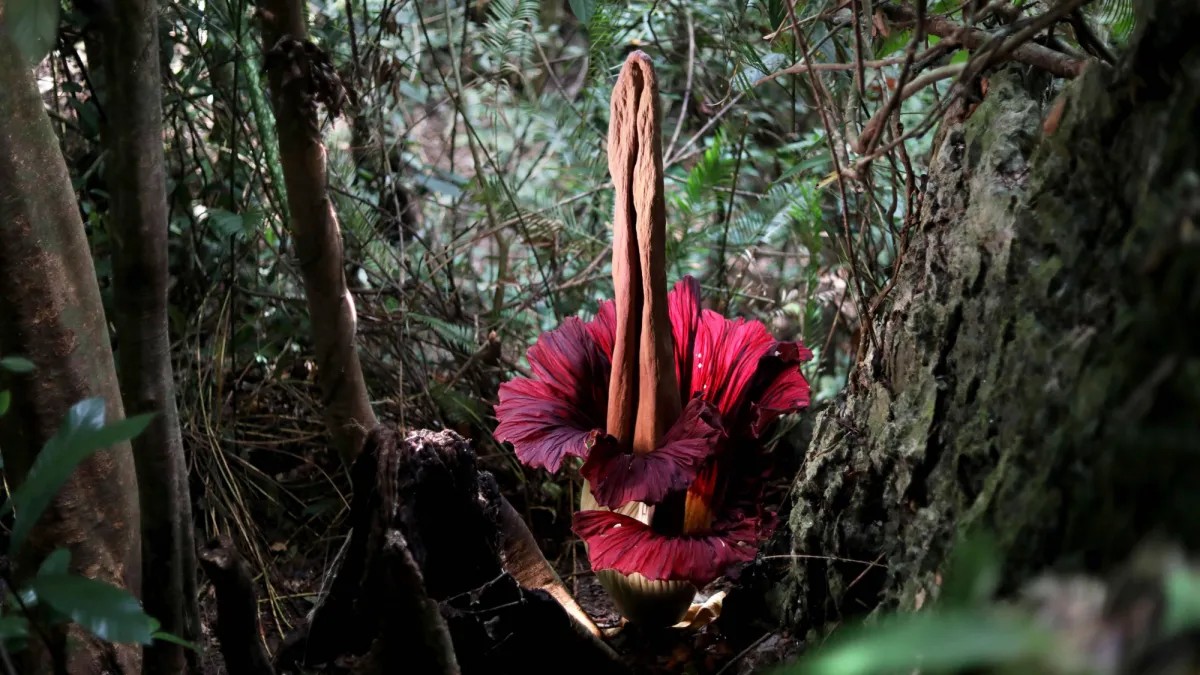
A rare botanical phenomenon has arrived at Mount Holyoke College in Massachusetts. A Titan Arum (Amorphophallus titanum ), commonly known as the “corpse flower,” has begun its bloom, bringing with it a scent that many visitors have described as “unbearable,” “putrid,” and “rotten.”
While the odor may be overwhelming to human senses, it is a highly specialized biological strategy. The stench is designed to mimic decaying organic matter, specifically to attract pollinators like carrion flies that thrive on rotting flesh.
A Masterpiece of Biological Engineering
The Titan Arum is not just a sensory assault; it is a record-breaker in the plant kingdom. To understand why this bloom is such a significant event, one must look at its unique physical characteristics:
- Massive Scale: The plant produces the largest unbranched inflorescence (flower cluster) on Earth. A single bloom can reach heights of 8 to 12 feet.
- Anatomy of a Bloom: What appears to be a single giant flower is actually a complex structure consisting of a spadix (the tall central pole) and a spathe (the large, leaf-like structure surrounding it). The actual flowers are tiny and located at the base of the spadix.
- Energy Storage: The plant relies on a massive, swollen underground base called a corm, which can weigh up to 100 pounds. This corm acts as a battery, storing the immense energy required to fuel such a massive and brief flowering event.
The Chemistry of Decay
The “death” scent is a complex cocktail of chemical compounds. Researchers have identified several key elements that contribute to the flower’s signature odor:
- Sulfides: Compounds like dimethyl trisulfide provide a sulfurous, rotting animal smell.
- Garlic and Cheese Notes: Dimethyl disulfide and methyl thiolacetate add pungent, savory undertones.
- Sweat and Fish: The presence of isovaleric acid (reminiscent of sweaty feet) and trimethylamine (smelling of dead fish) completes the olfactory profile.
Why These Blooms Are So Rare
For most people, witnessing a Titan Arum is a once-in-a-lifetime opportunity. The plant does not follow an annual cycle; instead, it may take five to nine years —or even decades—to accumulate enough energy to bloom. Even when the energy is sufficient, the bloom itself is fleeting, lasting only 24 to 36 hours before the structure collapses.
Conservation Concerns: A Species Under Threat
Beyond its biological curiosity, the Titan Arum is a symbol of a larger environmental crisis. The species is currently listed as Endangered by the International Union for Conservation of Nature (IUCN).
In the wild—primarily on the Indonesian island of Sumatra—the population is estimated to be fewer than 1,000 individual plants. This decline is largely driven by:
* Deforestation: Extensive logging.
* Habitat Loss: The conversion of tropical forests into palm oil plantations.
While the plant can produce hundreds of crimson fruits that are eaten by birds like the rhinoceros hornbill to aid seed dispersal, the survival of the species in its natural habitat remains precarious.
The blooming of a corpse flower is a fleeting triumph of nature, but it serves as a stark reminder of the fragility of specialized species facing rapid habitat loss.